
 Wildlife
of USA
Red Knot
Shorebirds & Sandpipers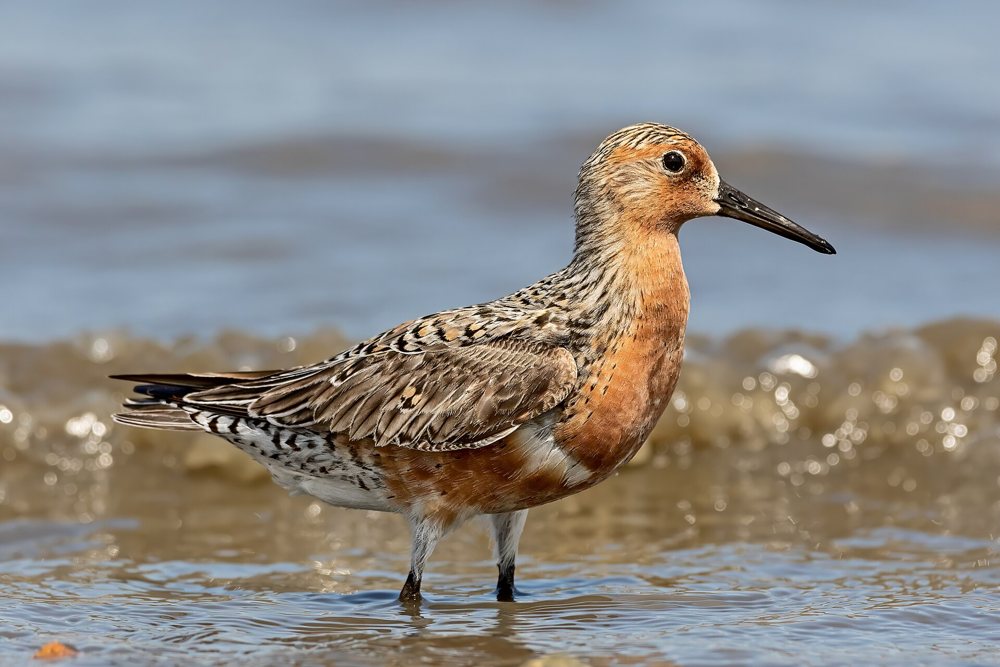
Photo: Chuck Homler d/b/a Focus On Wildlife · CC BY-SA 4.0 (May be cropped or resized)
Calidris canutus
U.S. national list: unknown
Basic stats
Diet
Mostly invertebrates, with some fish and seeds
Habitat
Arctic tundra when breeding; chiefly coastal mudflats and shores otherwise
Range
Breeds in Arctic North America and Eurasia; winters on coasts of Europe, Africa, the Americas and Australasia
Clutch size
4 eggs
Incubation period
About 22 days
Size
23–26cm
Wingspan
47–53cm
Weight
Averages about 142g
The Red Knot is a sturdy Calidris sandpiper whose body reaches 23–26 cm and whose spread wings measure 47–53 cm. It has short dark legs and a medium-length bill. Breeding birds develop cinnamon-red underparts and patterned grey upperparts; non-breeding plumage is largely pale grey. A white wing bar and grey rump are visible in flight. Before long migrations, individuals can accumulate enough reserves to approach twice their earlier mass (Wikipedia, general species account).
The species nests on moist Arctic tundra across northern North America and Eurasia, while different populations spend the rest of the year on coasts from Europe and Africa to South America and Australasia. Arthropods and larvae are important on breeding grounds, whereas hard-shelled molluscs dominate at many staging and winter sites. Outside nesting areas, Red Knots often assemble in very large flocks (Wikipedia, general species account; EltonTraits, Wilman et al. 2014).
Where to see Red Knot in the USA
GBIF records grouped by protected area. They show where the species has been reported, not that it is there now, and they are not population counts.
Recorded in 616 protected areas (1887–2026). The 8 with the most records:
- Cape May National Wildlife Refuge: 4,746 records (1922–2026)
- Monomoy National Wildlife Refuge: 4,172 records (1890–2024)
- Bolsa Chica Ecological Reserve: 4,125 records (1977–2026)
- Pinelands National Reserve: 4,013 records (1887–2026)
- Bolivar Flats Shorebird Sanctuary: 3,900 records (1972–2026)
- Jones Beach State Park: 2,826 records (1926–2024)
- Gateway National Recreation Area: 2,629 records (1959–2026)
- Jamaica Bay Unit: 2,627 records (1959–2026)
Quick answers
- What does the Red Knot eat?
- Mostly invertebrates, with some fish and seeds
- What habitat does the Red Knot live in?
- Arctic tundra when breeding; chiefly coastal mudflats and shores otherwise
- Where is the Red Knot found?
- Breeds in Arctic North America and Eurasia; winters on coasts of Europe, Africa, the Americas and Australasia
- How many eggs does the Red Knot lay?
- 4 eggs
- How long are the eggs of the Red Knot incubated?
- About 22 days
- How big is the Red Knot?
- 23–26cm
- What is the wingspan of the Red Knot?
- 47–53cm
- How much does the Red Knot weigh?
- Averages about 142g