
 Wildlife
of USA
Red Phalarope
Shorebirds & Sandpipers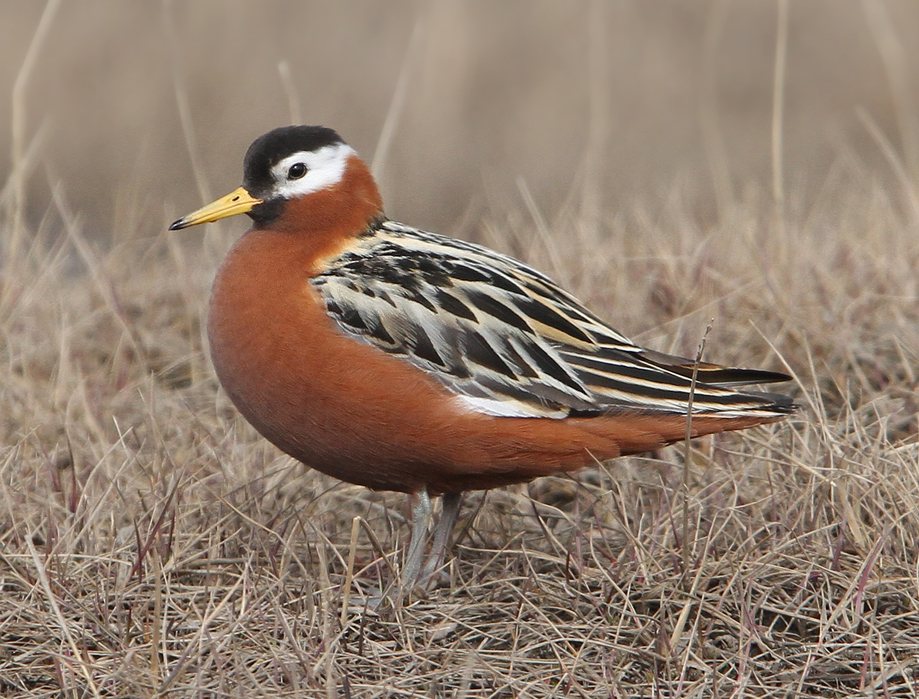
Photo: Christoph Moning · CC BY 4.0 (May be cropped or resized)
Phalaropus fulicarius
U.S. national list: unknown
Basic stats
Diet
Mainly insects and crustaceans
Habitat
Arctic wetlands when breeding; tropical open ocean outside breeding
Range
Breeds around Arctic North America and Eurasia; winters at sea on tropical oceans
Clutch size
3–6 eggs
Incubation period
18–19 days
Size
About 21cm
Weight
Averages about 56g
The Red Phalarope is a small wader with lobed toes and reversed sex roles. Breeding females are brighter and larger than males, with reddish underparts, dark upperparts and white cheek patches; males show a duller version. Winter birds are grey above and white below but retain a dark eye patch. The straight bill changes from yellow and black in breeding plumage to black in winter. Adults are about 21 cm long and average about 56 g (Wikipedia, general species account; AVONET, Tobias et al. 2022).
Across Arctic North America and Eurasia, the species nests near water before migrating mainly over oceans to tropical seas. Females compete for mates and depart after laying, leaving males to incubate three to six eggs for 18–19 days and tend the young. Feeding birds often spin on the water, drawing small prey upward in a vortex. Insects and crustaceans dominate the diet, and oceanic flocks gather where currents concentrate food (Wikipedia, general species account; EltonTraits, Wilman et al. 2014).
Where to see Red Phalarope in the USA
GBIF records grouped by protected area. They show where the species has been reported, not that it is there now, and they are not population counts.
Recorded in 420 protected areas (1879–2026). The 8 with the most records:
- Monterey Bay National Marine Sanctuary: 18,778 records (1903–2026)
- National Petroleum Reserve–Alaska: 12,644 records (1897–2025)
- Greater Farallones National Marine Sanctuary: 4,538 records (1914–2024)
- Pacific Grove Marine Gardens State Marine Conservation Area: 4,019 records (1910–2024)
- Asilomar State Marine Reserve: 3,985 records (1978–2024)
- Southeast Farallon Island State Marine Reserve: 2,618 records (1951–2024)
- Cordell Bank National Marine Sanctuary: 2,270 records (1966–2024)
- Arctic National Wildlife Refuge: 1,286 records (1983–2024)
Quick answers
- What does the Red Phalarope eat?
- Mainly insects and crustaceans
- What habitat does the Red Phalarope live in?
- Arctic wetlands when breeding; tropical open ocean outside breeding
- Where is the Red Phalarope found?
- Breeds around Arctic North America and Eurasia; winters at sea on tropical oceans
- How many eggs does the Red Phalarope lay?
- 3–6 eggs
- How long are the eggs of the Red Phalarope incubated?
- 18–19 days
- How big is the Red Phalarope?
- About 21cm
- How much does the Red Phalarope weigh?
- Averages about 56g