
 Wildlife
of USA
American Golden-Plover
Shorebirds & Sandpipers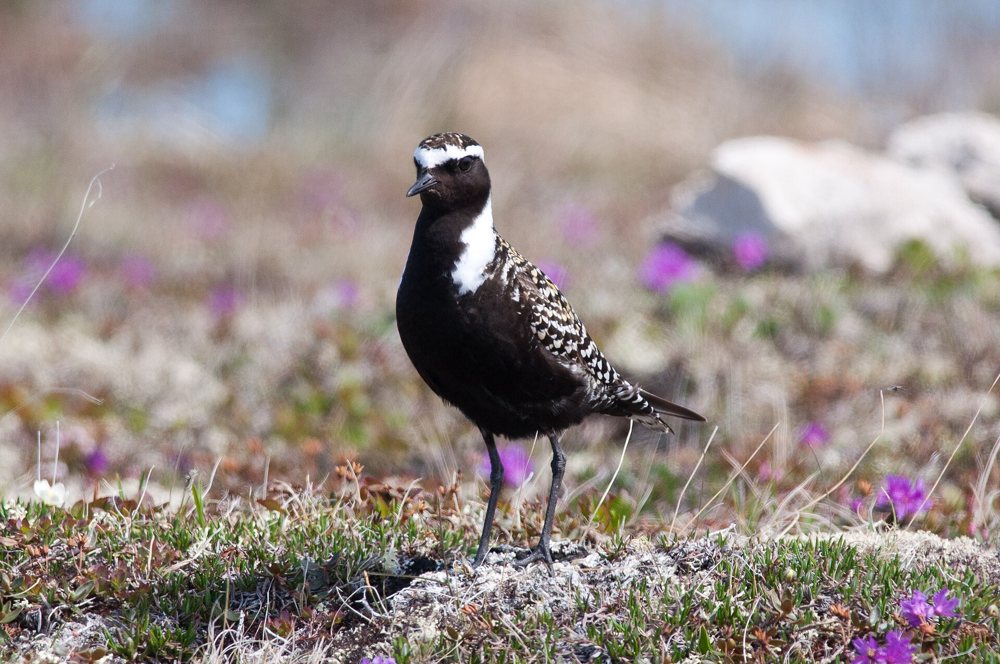
Photo: Peter Wilton · CC BY 2.0 (May be cropped or resized)
Pluvialis dominica
U.S. national list: unknown
Basic stats
Diet
Mostly insects and other invertebrates
Habitat
Arctic tundra when breeding; fields, grassland, beaches and tidal flats during migration and winter
Range
Breeds in Alaska and northern Canada; winters in southern South America
Clutch size
4 eggs
Incubation period
26–27 days
Weight
Averages about 152g
The American Golden-Plover is a slim, medium-sized plover. Breeding adults have gold-spangled dark upperparts, a black face and underparts, and a bold white stripe from the forehead down the side of the breast; females usually show less black. Outside breeding plumage, both sexes become grey-brown above and paler below with a whitish eyebrow. Its long primary projection helps identify it. The species averages about 152 g (Wikipedia, general species account; AVONET, Tobias et al. 2022).
Across its range, the species breeds on dry Arctic tundra in Alaska and northern Canada and winters in southern South America. Its elliptical migration runs north through Central America and south largely over the western Atlantic and Caribbean. Birds forage by sight on tundra, fields, beaches and tidal flats, taking chiefly insects and other invertebrates. A lined ground scrape holds four eggs. Both parents share the 26–27-day incubation, and newly hatched chicks soon leave the nest and feed themselves (Wikipedia, general species account; EltonTraits, Wilman et al. 2014; AnAge).
Where to see American Golden-Plover in the USA
GBIF records grouped by protected area. They show where the species has been reported, not that it is there now, and they are not population counts.
Recorded in 1,082 protected areas (1863–2026). The 8 with the most records:
- National Petroleum Reserve–Alaska: 7,308 records (1881–2024)
- Parker River National Wildlife Refuge: 2,090 records (1955–2025)
- Hagerman National Wildlife Refuge: 1,894 records (1969–2024)
- Montezuma National Wildlife Refuge: 1,646 records (1914–2025)
- Lake Superior State Forest - Newberry Unit: 1,534 records (1933–2024)
- Seney National Wildlife Refuge: 1,526 records (1983–2024)
- Whitefish Point Underwater Preserve: 1,522 records (1983–2024)
- Hornsby Bend Ecological Research Area: 1,429 records (1967–2024)
Quick answers
- What does the American Golden-Plover eat?
- Mostly insects and other invertebrates
- What habitat does the American Golden-Plover live in?
- Arctic tundra when breeding; fields, grassland, beaches and tidal flats during migration and winter
- Where is the American Golden-Plover found?
- Breeds in Alaska and northern Canada; winters in southern South America
- How many eggs does the American Golden-Plover lay?
- 4 eggs
- How long are the eggs of the American Golden-Plover incubated?
- 26–27 days
- How much does the American Golden-Plover weigh?
- Averages about 152g