
 Wildlife
of USA
Wandering Tattler
Shorebirds & Sandpipers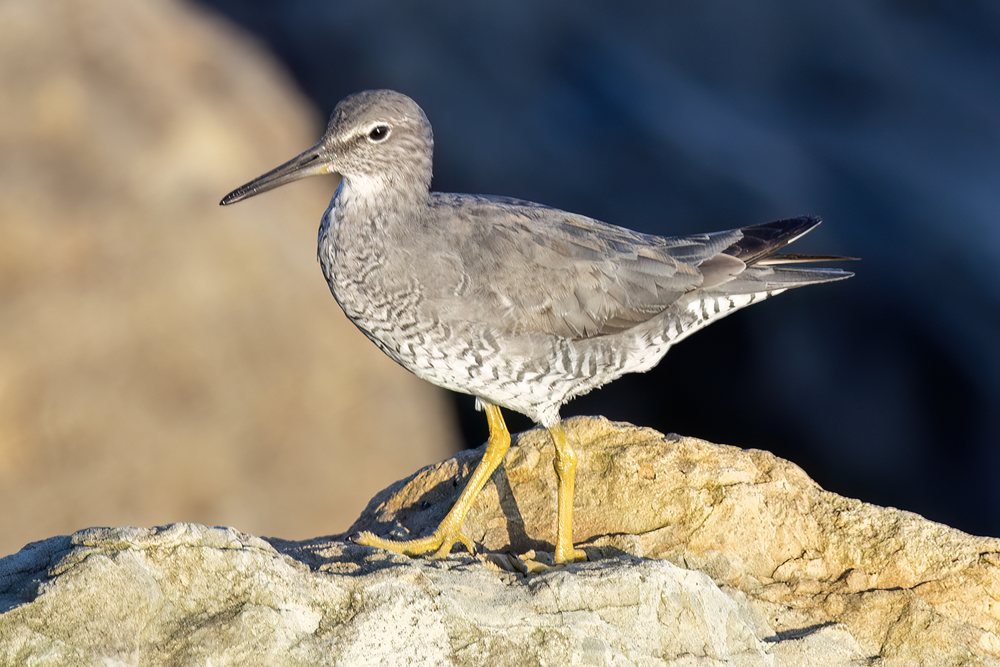
Photo: Polinova · CC BY-SA 4.0 (May be cropped or resized)
Tringa incana
U.S. national list: unknown
Basic stats
Diet
Mostly invertebrates, with fish
Habitat
Mountain streams for breeding; rocky Pacific coasts and islands outside breeding
Range
Breeds in northeastern Russia, Alaska and northwestern Canada; winters widely around the Pacific
Clutch size
4 eggs
Size
26–30cm
Wingspan
50–55cm
Weight
Averages about 108g
The Wandering Tattler is a stocky 26–30 cm shorebird with a wingspan of 50–55 cm. Grey covers the upperparts, face, neck and underwings, contrasting with a white belly; breeding birds develop dense barring below. Short dark-yellow legs and a dark bill complete the appearance. AVONET records an average mass of about 108 g (Wikipedia, general species account; AVONET, Tobias et al. 2022).
It breeds beside rocky mountain streams in northeastern Russia, Alaska and northwestern Canada, then spreads along rocky Pacific coasts and islands as far as South America and Australia. Invertebrates contribute 80% and fish 20% to the EltonTraits diet profile. Birds actively pick crustaceans, worms and insects while repeatedly bobbing. A shallow ground depression holds four eggs, and both parents incubate and tend the mobile young (Wikipedia, general species account; EltonTraits, Wilman et al. 2014).
Where to see Wandering Tattler in the USA
GBIF records grouped by protected area. They show where the species has been reported, not that it is there now, and they are not population counts.
Recorded in 322 protected areas (1887–2026). The 8 with the most records:
- Greater Farallones National Marine Sanctuary: 11,555 records (1887–2025)
- Southeast Farallon Island State Marine Reserve: 10,422 records (1887–2024)
- Hawaiian Islands Humpback Whale National Marine Sanctuary: 8,475 records (1976–2026)
- Monterey Bay National Marine Sanctuary: 6,779 records (1891–2026)
- Keālia Pond National Wildlife Refuge: 3,135 records (1979–2026)
- U.S. Naval Base, Pearl Harbor: 2,419 records (1979–2026)
- Golden Gate National Recreation Area: 2,240 records (1929–2026)
- James Campbell National Wildlife Refuge: 2,166 records (1976–2025)
Quick answers
- What does the Wandering Tattler eat?
- Mostly invertebrates, with fish
- What habitat does the Wandering Tattler live in?
- Mountain streams for breeding; rocky Pacific coasts and islands outside breeding
- Where is the Wandering Tattler found?
- Breeds in northeastern Russia, Alaska and northwestern Canada; winters widely around the Pacific
- How many eggs does the Wandering Tattler lay?
- 4 eggs
- How big is the Wandering Tattler?
- 26–30cm
- What is the wingspan of the Wandering Tattler?
- 50–55cm
- How much does the Wandering Tattler weigh?
- Averages about 108g