
 Wildlife
of USA
Hudsonian Godwit
Shorebirds & Sandpipers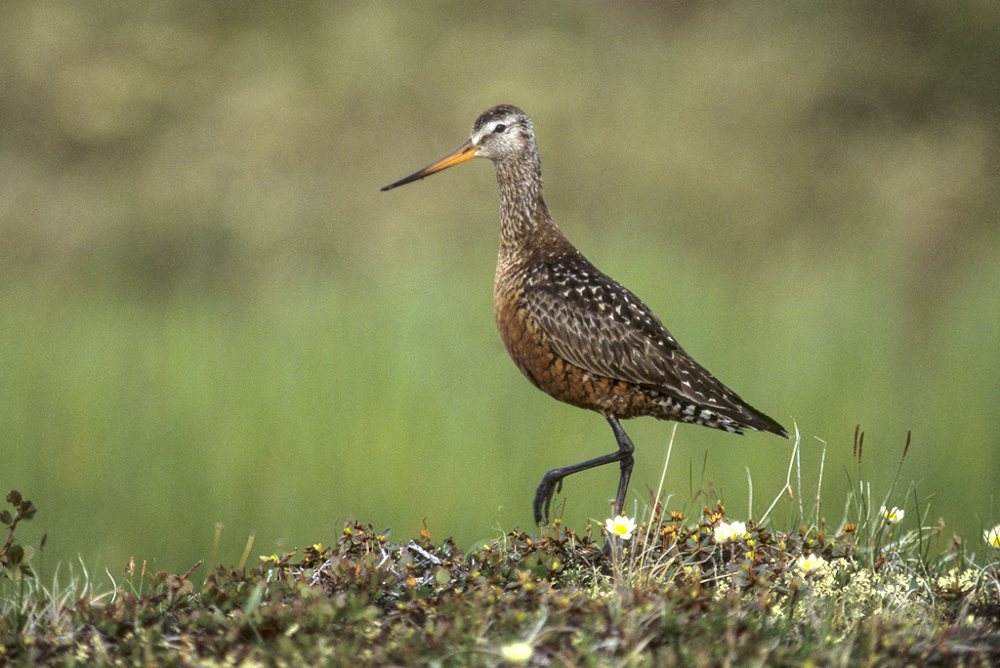
Photo: Francesco Veronesi from Italy · CC BY-SA 2.0 (May be cropped or resized)
Limosa haemastica
U.S. national list: unknown
Basic stats
Diet
Invertebrates
Habitat
Subarctic wetlands, coastal mudflats and estuaries
Range
Breeds in subarctic North America; winters in southern South America
Weight
Averages about 253g
The Hudsonian Godwit is a large shorebird with long bluish-gray legs and a long, slightly upcurved pink bill tipped dark. Breeding adults show chestnut underparts, mottled brown upperparts, black wing linings, a black tail and white rump. AVONET records an average mass of about 253 g and classifies it as a strongly migratory terrestrial wetland predator (Wikipedia, general species account; AVONET, Tobias et al. 2022).
It breeds at scattered subarctic sites in Alaska and Canada and undertakes exceptionally long direct flights to wintering areas in southern South America. Staging birds gather at major wetlands, while coastal mudflats and estuaries provide feeding habitat outside the breeding season. Invertebrates make up 90% of the EltonTraits diet profile, and birds probe or pick prey from wet sediment and shallow water (Wikipedia, general species account; EltonTraits, Wilman et al. 2014).
Where to see Hudsonian Godwit in the USA
GBIF records grouped by protected area. They show where the species has been reported, not that it is there now, and they are not population counts.
Recorded in 615 protected areas (1891–2026). The 8 with the most records:
- Monomoy National Wildlife Refuge: 2,271 records (1892–2024)
- Parker River National Wildlife Refuge: 2,126 records (1964–2025)
- Gateway National Recreation Area: 1,761 records (1958–2025)
- Jamaica Bay Unit: 1,750 records (1958–2025)
- Jamaica Bay Wildlife Refuge: 1,721 records (1958–2025)
- Bombay Hook National Wildlife Refuge: 1,591 records (1951–2024)
- Pinelands National Reserve: 1,218 records (1927–2026)
- Jacques Cousteau National Estuarine Research Reserve: 1,176 records (1933–2026)
Quick answers
- What does the Hudsonian Godwit eat?
- Invertebrates
- What habitat does the Hudsonian Godwit live in?
- Subarctic wetlands, coastal mudflats and estuaries
- Where is the Hudsonian Godwit found?
- Breeds in subarctic North America; winters in southern South America
- How much does the Hudsonian Godwit weigh?
- Averages about 253g