
 Wildlife
of USA
Pectoral Sandpiper
Shorebirds & Sandpipers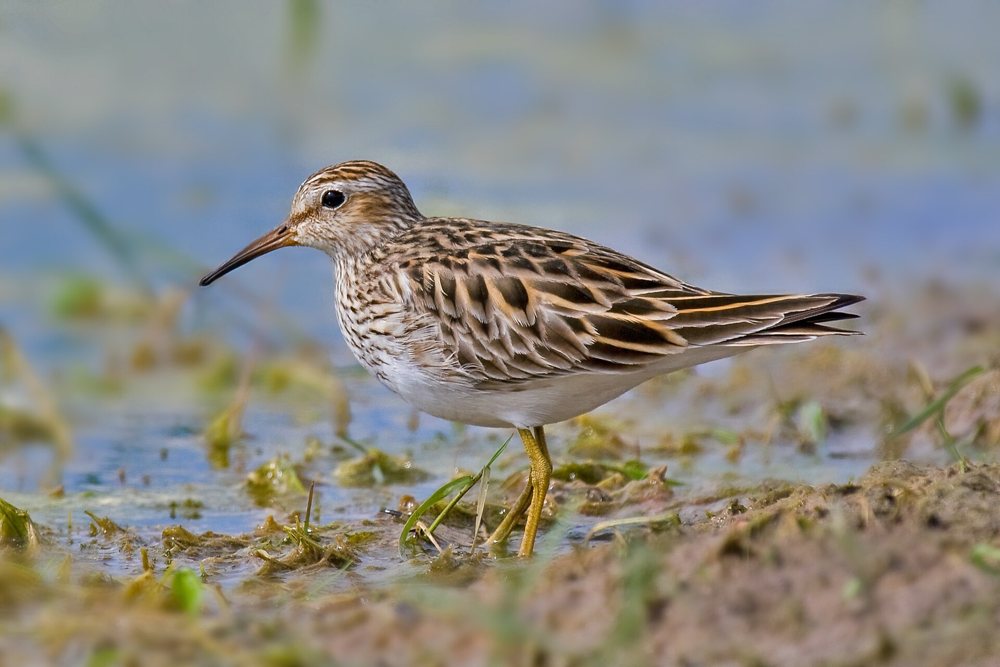
Photo: Andreas Trepte · CC BY-SA 2.5 (May be cropped or resized)
Calidris melanotos
U.S. national list: unknown
Basic stats
Diet
Mostly arthropods and other small invertebrates, with some seeds
Habitat
Boggy Arctic tundra when breeding; freshwater wetlands, grasslands and mudflats at other seasons
Range
Breeds across Arctic Asia and North America; winters mainly in South America and Oceania
Clutch size
Usually 4 eggs
Incubation period
About 22 days
Size
19–23cm
Wingspan
38–46cm
Weight
Averages about 80g
The Pectoral Sandpiper is a medium-sized calidrid with yellowish legs and an olive bill tipped dark. Its grey-brown breast ends abruptly against a white belly, creating the sharp division behind its English name. Breeding males become browner above and darker across the breast, while juveniles show bright rufous tones and pale mantle stripes. It measures 19–23 cm, spans 38–46 cm and averages about 80 g (Wikipedia, general species account; AVONET, Tobias et al. 2022).
The species breeds on boggy Arctic tundra across northern Asia, Alaska and Canada, then migrates mainly to South America, Australia and New Zealand. On passage and in winter it often uses freshwater wetlands, grasslands and mudflats. Birds pick prey from the surface and also probe, eating chiefly arthropods and other small invertebrates, with seeds included. The female constructs a deep, thickly lined ground scrape and lays four eggs; incubation averages about 22 days (Wikipedia, general species account; EltonTraits, Wilman et al. 2014; AnAge).
Where to see Pectoral Sandpiper in the USA
GBIF records grouped by protected area. They show where the species has been reported, not that it is there now, and they are not population counts.
Recorded in 2,421 protected areas (1876–2026). The 8 with the most records:
- National Petroleum Reserve–Alaska: 11,583 records (1898–2025)
- Hornsby Bend Ecological Research Area: 7,326 records (1960–2026)
- Montezuma National Wildlife Refuge: 7,115 records (1951–2025)
- Pinelands National Reserve: 6,682 records (1928–2026)
- Jacques Cousteau National Estuarine Research Reserve: 4,927 records (1928–2026)
- Brigantine National Wildlife Refuge: 4,910 records (1940–2026)
- Edwin B. Forsythe National Wildlife Refuge: 4,894 records (1948–2026)
- Hagerman National Wildlife Refuge: 4,755 records (1948–2024)
Quick answers
- What does the Pectoral Sandpiper eat?
- Mostly arthropods and other small invertebrates, with some seeds
- What habitat does the Pectoral Sandpiper live in?
- Boggy Arctic tundra when breeding; freshwater wetlands, grasslands and mudflats at other seasons
- Where is the Pectoral Sandpiper found?
- Breeds across Arctic Asia and North America; winters mainly in South America and Oceania
- How many eggs does the Pectoral Sandpiper lay?
- Usually 4 eggs
- How long are the eggs of the Pectoral Sandpiper incubated?
- About 22 days
- How big is the Pectoral Sandpiper?
- 19–23cm
- What is the wingspan of the Pectoral Sandpiper?
- 38–46cm
- How much does the Pectoral Sandpiper weigh?
- Averages about 80g