
 Wildlife
of USA
Kentish Plover
Shorebirds & Sandpipers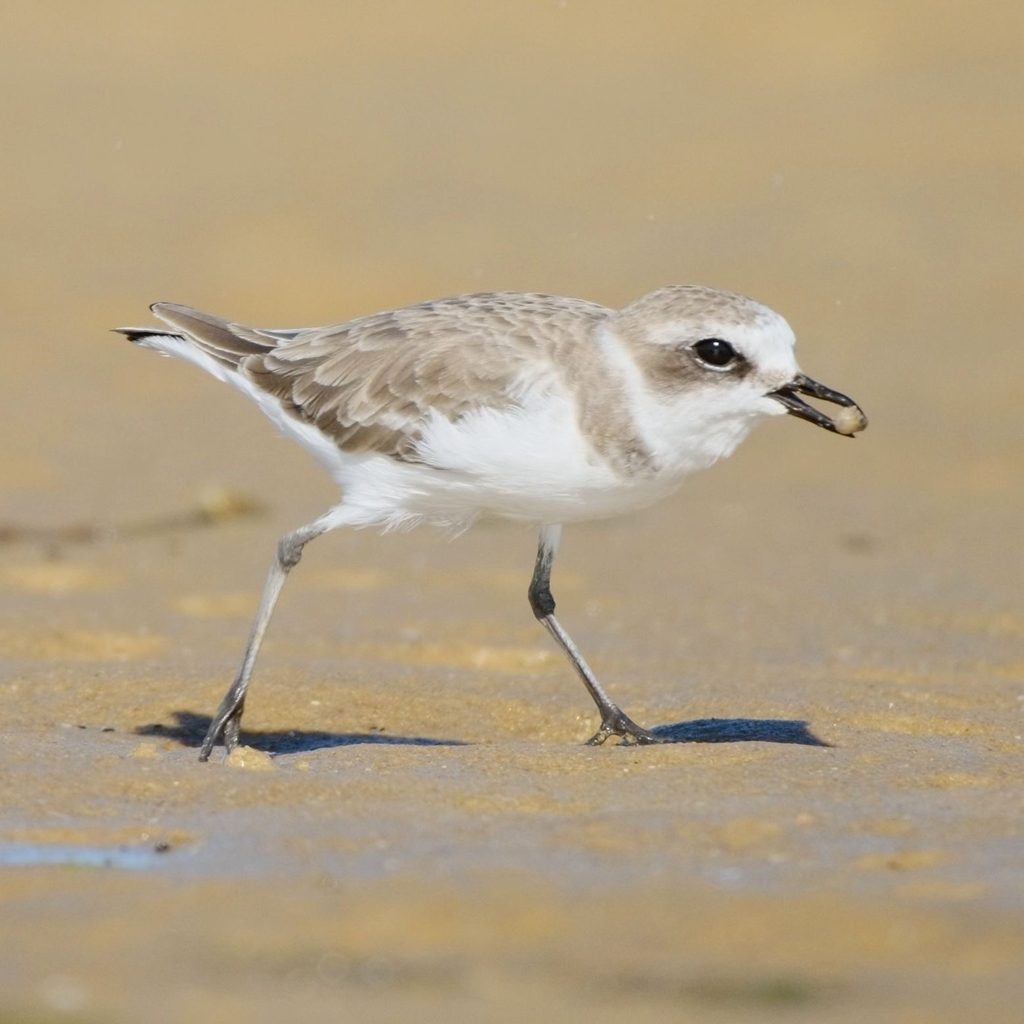
Photo: Jennifer Frey · CC BY 4.0 (May be cropped or resized)
Anarhynchus alexandrinus
U.S. national list: unknown
Basic stats
Diet
Invertebrates
Habitat
Sandy coasts, salt marshes, lagoons, saline lake shores and sparsely vegetated dry wetlands
Range
Europe, Africa and Asia, with resident and migratory populations
Clutch size
Usually 3 eggs
Incubation period
About 24 days
Weight
Averages about 42g
The Kentish Plover is a small, pale shorebird with dark legs and a short dark bill. Both sexes are sandy grey-brown above and white below, but breeding males show a darker forehead bar, ear patch and incomplete breast-side patches, together with warmer colour on the crown and nape. Females are less strongly marked, and the difference fades as the season advances. Adults average about 42 g (Wikipedia, general species account; AVONET, Tobias et al. 2022).
Across Europe, Africa and Asia, the species occupies sandy coasts, lagoons, salt marshes, saline lake margins and other open ground with sparse vegetation. Some populations migrate, whereas others remain resident. It feeds on invertebrates picked from the surface or soft substrate, often running between short pauses. The ground nest is placed in an open scrape where vegetation is low. A usual clutch consists of three eggs, and incubation averages about 24 days (Wikipedia, general species account; EltonTraits, Wilman et al. 2014; AnAge).
Records of Kentish Plover in the USA
This bird's natural range lies outside the USA (AviList v2026), so these are records of wandering, escaped or introduced birds, not places to expect it.
GBIF records grouped by protected area. They show where the species has been reported, not that it is there now, and they are not population counts.
Recorded in 7 protected areas (1878–2010).
- Bear River Migratory Bird Refuge: 14 records (1967–1999)
- Eden Landing Ecological Reserve: 6 records (2006–2010)
- Monterey Bay National Marine Sanctuary: 6 records (1878–2007)
- Summer Lake Wildlife Area: 5 records (1947–1948)
- Chumash Heritage National Marine Sanctuary: 4 records (2009)
- Montaña de Oro State Park: 3 records (2008)
- Santa Monica Mountains National Recreation Area: 3 records (2008–2009)
Quick answers
- What does the Kentish Plover eat?
- Invertebrates
- What habitat does the Kentish Plover live in?
- Sandy coasts, salt marshes, lagoons, saline lake shores and sparsely vegetated dry wetlands
- Where is the Kentish Plover found?
- Europe, Africa and Asia, with resident and migratory populations
- How many eggs does the Kentish Plover lay?
- Usually 3 eggs
- How long are the eggs of the Kentish Plover incubated?
- About 24 days
- How much does the Kentish Plover weigh?
- Averages about 42g