
 Wildlife
of USA
Curlew Sandpiper
Shorebirds & Sandpipers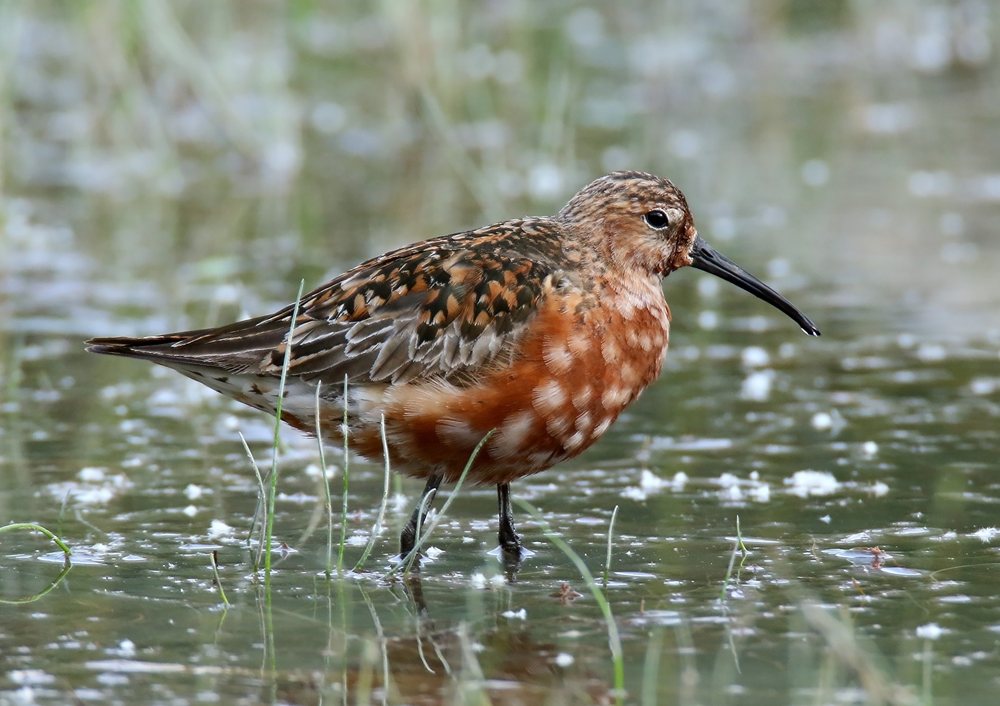
Photo: Imran Shah from Islamabad, Pakistan · CC BY-SA 2.0 (May be cropped or resized)
Calidris ferruginea
U.S. national list: unknown
Basic stats
Diet
Mostly invertebrates, with some seeds
Habitat
Arctic bogs and coastal lowlands when breeding; tidal mudflats, saltpans and wetlands at other seasons
Range
Breeds in Arctic Siberia; winters in Africa, southern Eurasia and Oceania
Size
18–23cm
Wingspan
38–46cm
Weight
Averages about 58g
The Curlew Sandpiper is a small wader with a relatively long, gently downcurved bill. Breeding adults develop rich rusty underparts, while non-breeding birds are grey above and white below; juveniles have neatly fringed upperparts and a scaly appearance. A broad white rump and a pale wing stripe are apparent in flight. The species measures 18–23 cm, spans 38–46 cm and averages about 58 g (Wikipedia, general species account; AVONET, Tobias et al. 2022).
The species breeds in bogs and coastal lowlands of Arctic Siberia before travelling to wintering grounds in Africa, southern Eurasia and Oceania. Outside the breeding season it frequents tidal mudflats, saltpans and other shallow wetlands, often feeding in sizeable flocks. Its diet is dominated by invertebrates, including insects and small crustaceans, with seeds also taken. Courtship includes aerial pursuit, ground display and presentation of a false nest scrape; chicks leave the nest mobile soon after hatching (Wikipedia, general species account; EltonTraits, Wilman et al. 2014).
Records of Curlew Sandpiper in the USA
This bird's natural range lies outside the USA (AviList v2026), so these are records of wandering, escaped or introduced birds, not places to expect it.
GBIF records grouped by protected area. They show where the species has been reported, not that it is there now, and they are not population counts.
Recorded in 74 protected areas (1951–2026). The 8 with the most records:
- Pinelands National Reserve: 945 records (1969–2024)
- Heislerville Fish and Wildlife Management Area: 501 records (1977–2024)
- Jacques Cousteau National Estuarine Research Reserve: 441 records (1951–2023)
- Brigantine National Wildlife Refuge: 440 records (1951–2023)
- Edwin B. Forsythe National Wildlife Refuge: 438 records (1969–2023)
- Bombay Hook National Wildlife Refuge: 366 records (1975–2024)
- National Petroleum Reserve–Alaska: 179 records (1972–2024)
- Montezuma National Wildlife Refuge: 170 records (1998–2022)
Quick answers
- What does the Curlew Sandpiper eat?
- Mostly invertebrates, with some seeds
- What habitat does the Curlew Sandpiper live in?
- Arctic bogs and coastal lowlands when breeding; tidal mudflats, saltpans and wetlands at other seasons
- Where is the Curlew Sandpiper found?
- Breeds in Arctic Siberia; winters in Africa, southern Eurasia and Oceania
- How big is the Curlew Sandpiper?
- 18–23cm
- What is the wingspan of the Curlew Sandpiper?
- 38–46cm
- How much does the Curlew Sandpiper weigh?
- Averages about 58g