
 Wildlife
of USA
Little Stint
Shorebirds & Sandpipers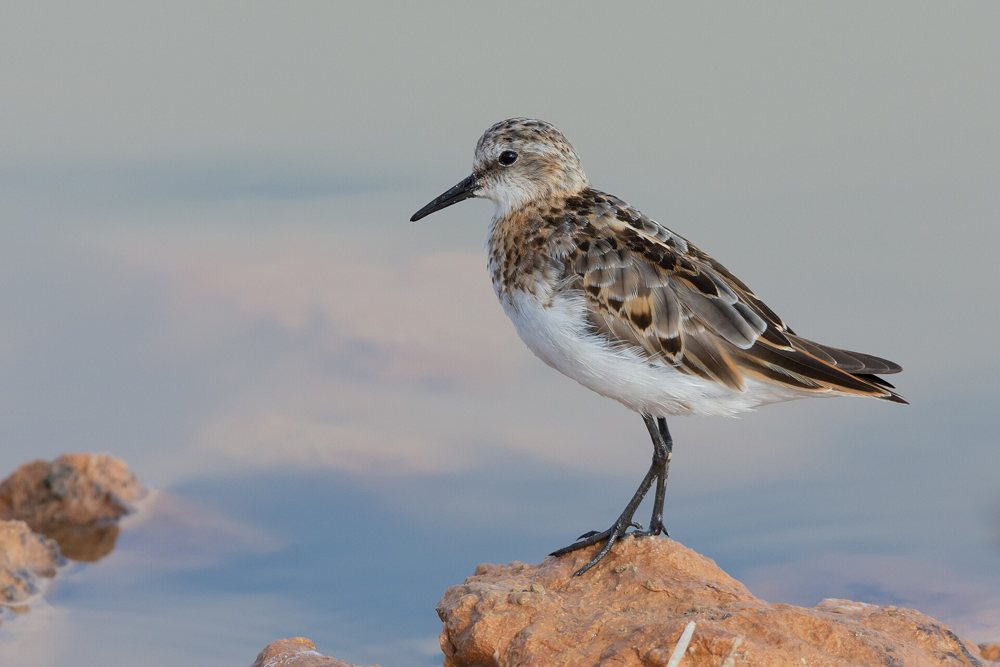
Photo: El Golli Mohamed · CC BY-SA 4.0 (May be cropped or resized)
Calidris minuta
U.S. national list: unknown
Basic stats
Diet
Mostly invertebrates, with some plant material
Habitat
Grassy Arctic tundra near wetlands when breeding; mudflats, pool margins and shallow wetlands at other seasons
Range
Breeds in Arctic Europe and Asia; winters mainly in Africa and southern Asia
Weight
Averages about 21g
The Little Stint is a minute sandpiper with dark legs and a short, fine-tipped bill. Breeding birds have warm orange tones on the head and breast and a prominent pale V on the back, whereas winter birds are much greyer. Juveniles show pale crown stripes and neatly patterned upperparts. Its tiny size, rapid movements and relatively long primary projection help distinguish it from other small waders. Adults average about 21 g (Wikipedia, general species account; AVONET, Tobias et al. 2022).
The species breeds on low grassy tundra near Arctic wetlands in Europe and Asia, then migrates long distances to Africa and southern Asia. Outside the nesting season it gathers on coastal mudflats, inland pool margins and other shallow wetlands, often among other small sandpipers. It picks and probes for invertebrates and also consumes some plant material. Both sexes may incubate separate clutches in a flexible mating system; nests are bare-ground scrapes holding three to five eggs (Wikipedia, general species account; EltonTraits, Wilman et al. 2014).
Records of Little Stint in the USA
This bird's natural range lies outside the USA (AviList v2026), so these are records of wandering, escaped or introduced birds, not places to expect it.
GBIF records grouped by protected area. They show where the species has been reported, not that it is there now, and they are not population counts.
Recorded in 29 protected areas (1976–2024). The 8 with the most records:
- San Diego National Wildlife Refuge: 781 records (2010–2024)
- Monomoy National Wildlife Refuge: 212 records (1980–2018)
- Pinelands National Reserve: 192 records (2020–2022)
- San Jacinto / Lake Perris Core Reserve: 180 records (2016–2023)
- Brigantine National Wildlife Refuge: 156 records (2020)
- National Petroleum Reserve–Alaska: 154 records (1976–2024)
- Don Edwards San Francisco Bay National Wildlife Refuge: 148 records (2006–2017)
- Emiquon National Wildlife Refuge: 89 records (2019)
Quick answers
- What does the Little Stint eat?
- Mostly invertebrates, with some plant material
- What habitat does the Little Stint live in?
- Grassy Arctic tundra near wetlands when breeding; mudflats, pool margins and shallow wetlands at other seasons
- Where is the Little Stint found?
- Breeds in Arctic Europe and Asia; winters mainly in Africa and southern Asia
- How much does the Little Stint weigh?
- Averages about 21g