
 Wildlife
of USA
Common Ringed Plover
Shorebirds & Sandpipers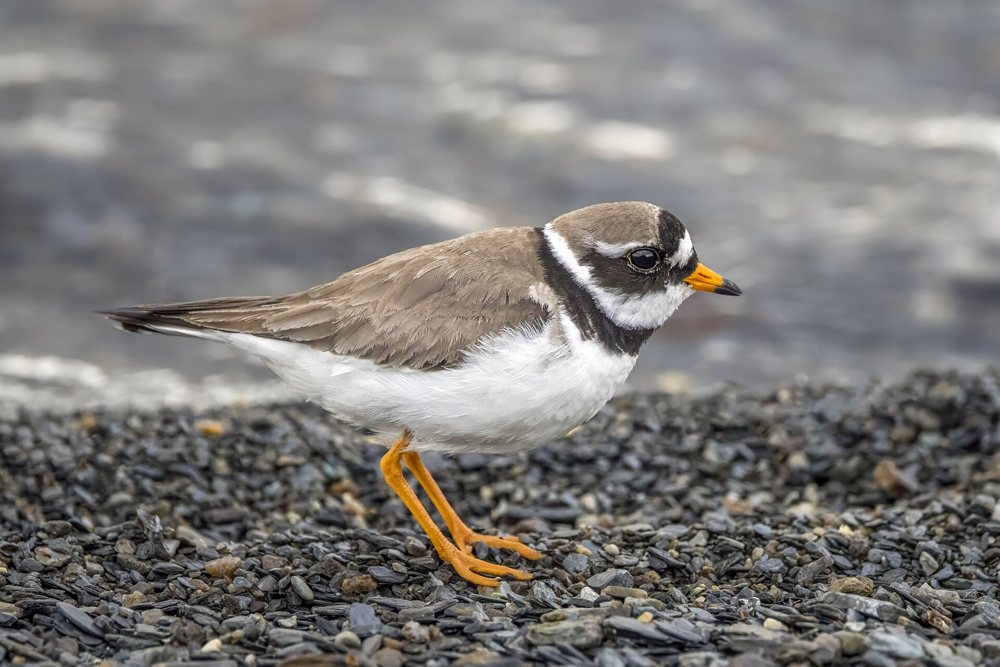
Photo: Charles J. Sharp · CC BY-SA 4.0 (May be cropped or resized)
Charadrius hiaticula
U.S. national list: unknown
Basic stats
Diet
Insects, crustaceans and worms
Habitat
Open beaches, flats and sparsely vegetated uplands when breeding; coastal shores and fields at other seasons
Range
Breeds across northern Eurasia and Greenland; many populations winter along coasts south to Africa
Clutch size
Usually 3–4 eggs
Incubation period
21–27 days
Size
17–19.5cm
Wingspan
35–41cm
Weight
Averages about 64g
The Common Ringed Plover is a compact shorebird with orange legs, a short orange-and-black bill and a single dark breast band. Adults have a grey-brown back, white underparts, a brown crown and a strongly patterned black-and-white face. Juveniles are duller, often with an incomplete brownish breast band. Unlike the similar Little Ringed Plover, it lacks a conspicuous yellow eye-ring. It measures 17–19.5 cm, spans 35–41 cm and averages about 64 g (Wikipedia, general species account; AVONET, Tobias et al. 2022).
Across northern Eurasia and Greenland, the species nests on bare or sparsely vegetated ground along beaches, flats and cold uplands. Many birds migrate to coastal wintering areas as far south as Africa, although some western populations remain year-round. It finds insects, crustaceans and worms visually on beaches, tidal flats and fields, sometimes vibrating a foot to expose prey. Three or four eggs are laid in a shallow scrape and incubated by both parents for 21–27 days (Wikipedia, general species account; EltonTraits, Wilman et al. 2014).
Where to see Common Ringed Plover in the USA
GBIF records grouped by protected area. They show where the species has been reported, not that it is there now, and they are not population counts.
Recorded in 16 protected areas (1973–2024). The 8 with the most records:
- Rachel Carson National Wildlife Refuge: 156 records (2023)
- Phillip Burton Wilderness: 110 records (2018–2024)
- Otis Pike Fire Island High Dune Wilderness: 104 records (2023)
- National Petroleum Reserve–Alaska: 79 records (2015–2024)
- Parker River National Wildlife Refuge: 52 records (2013–2019)
- Pea Island National Wildlife Refuge: 29 records (2018)
- Montaña de Oro State Park: 28 records (2020)
- Maine Coastal Islands National Wildlife Refuge: 18 records (2020)
Quick answers
- What does the Common Ringed Plover eat?
- Insects, crustaceans and worms
- What habitat does the Common Ringed Plover live in?
- Open beaches, flats and sparsely vegetated uplands when breeding; coastal shores and fields at other seasons
- Where is the Common Ringed Plover found?
- Breeds across northern Eurasia and Greenland; many populations winter along coasts south to Africa
- How many eggs does the Common Ringed Plover lay?
- Usually 3–4 eggs
- How long are the eggs of the Common Ringed Plover incubated?
- 21–27 days
- How big is the Common Ringed Plover?
- 17–19.5cm
- What is the wingspan of the Common Ringed Plover?
- 35–41cm
- How much does the Common Ringed Plover weigh?
- Averages about 64g