
 Wildlife
of USA
Gray-tailed Tattler
Shorebirds & Sandpipers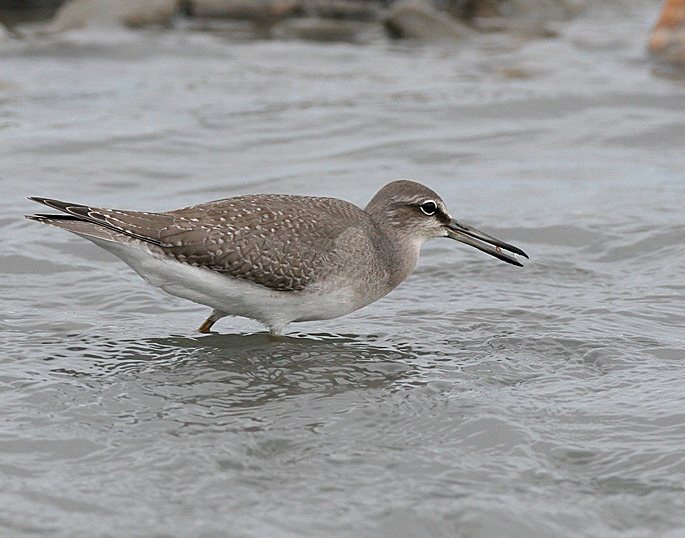
Photo: honan4108 on Flickr · CC BY 2.0 (May be cropped or resized)
Tringa brevipes
U.S. national list: unknown
Basic stats
Diet
Insects, crustaceans and other invertebrates
Habitat
Stony riverbeds when breeding; muddy and sandy coasts at other seasons
Range
Breeds in northeastern Siberia; winters from Southeast Asia to Australia
Weight
Averages about 127g
The Gray-tailed Tattler is a medium-sized shorebird with plain grey upperparts and wings, white underparts, short yellowish legs and a straight bill with a pale base. Breeding birds develop a scaly pattern across the breast and belly, together with a stronger pale supercilium. It closely resembles the Wandering Tattler, and voice is often the clearest separator. The species averages about 127 g (Wikipedia, general species account; AVONET, Tobias et al. 2022).
Across its range, the species nests along stony riverbeds in northeastern Siberia, sometimes using an old nest made by another bird. After breeding it travels south to coastal feeding grounds extending between Southeast Asia and Australia, and is generally seen singly or in small numbers except at communal roosts. Birds forage on mud, sand or in shallow water, locating prey by sight and picking up insects, crustaceans and other invertebrates (Wikipedia, general species account; EltonTraits, Wilman et al. 2014).
Records of Gray-tailed Tattler in the USA
This bird's natural range lies outside the USA (AviList v2026), so these are records of wandering, escaped or introduced birds, not places to expect it.
GBIF records grouped by protected area. They show where the species has been reported, not that it is there now, and they are not population counts.
Recorded in 11 protected areas (1974–2024). The 8 with the most records:
- Alaska Maritime National Wildlife Refuge: 242 records (1974–2024)
- Florida Keys National Marine Sanctuary: 204 records (2021)
- National Petroleum Reserve–Alaska: 82 records (1977–2024)
- San Diego National Wildlife Refuge: 44 records (2022)
- Marine Corps Base Hawaii Kaneohe: 28 records (2024)
- Hawaiian Islands National Wildlife Refuge: 26 records (2011–2012)
- James Campbell National Wildlife Refuge: 26 records (1988–2018)
- Hawaiian Islands Humpback Whale National Marine Sanctuary: 15 records (1988–2024)
Quick answers
- What does the Gray-tailed Tattler eat?
- Insects, crustaceans and other invertebrates
- What habitat does the Gray-tailed Tattler live in?
- Stony riverbeds when breeding; muddy and sandy coasts at other seasons
- Where is the Gray-tailed Tattler found?
- Breeds in northeastern Siberia; winters from Southeast Asia to Australia
- How much does the Gray-tailed Tattler weigh?
- Averages about 127g