
 Wildlife
of USA
Yellow-throated Vireo
Other Songbirds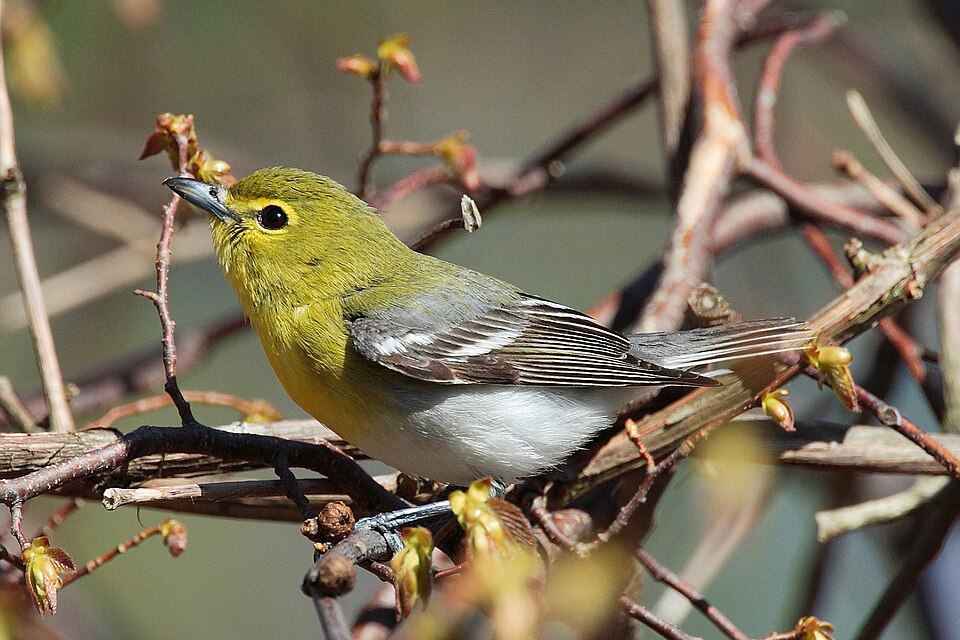
Photo: Mdf · CC BY-SA 3.0 (May be cropped or resized)
Vireo flavifrons
U.S. national list: unknown
Yellow-throated Vireo breeds in open deciduous woods across southern Canada and the eastern United States, then moves south for winter into Mexico, Central America, the Caribbean and the deep South. It is about 13 cm long and often forages alone high in the canopy. The species also uses woodland, coastal scrub and other forest types. Its seasonal movements connect temperate breeding grounds with warmer wintering areas, where it can be found in a range of wooded habitats. (Wikipedia, general species account; Collins Birds of the World; AVONET, Tobias et al. 2022; EltonTraits, Wilman et al. 2014)
Olive colors the head and upperparts, while the throat is yellow and the belly white. Yellow spectacles surround the dark eye, and the dark wings and tail show pale bars. The bill is stout and the legs bluish gray. It searches high branches for insects and may take berries, particularly before migration and during winter. The nest is a thick cup attached to a fork in a tree branch. Its song is slow and slurred, with repeated phrases. (Wikipedia, general species account; Collins Birds of the World; AVONET, Tobias et al. 2022; EltonTraits, Wilman et al. 2014)
Where to see Yellow-throated Vireo in the USA
GBIF records grouped by protected area. They show where the species has been reported, not that it is there now, and they are not population counts.
Recorded in 5,587 protected areas (1885–2026). The 8 with the most records:
- Montgomery County Agricultural Reserve: 5,009 records (1971–2026)
- Jefferson National Forest: 4,636 records (1966–2026)
- Delaware Water Gap National Recreation Area: 4,278 records (1980–2024)
- Texas Point National Wildlife Refuge: 4,207 records (1989–2024)
- Cuyahoga Valley National Park: 4,157 records (1956–2026)
- Oak Openings Preserve Metropark: 3,867 records (1981–2024)
- Smith Oaks Bird Sanctuary: 3,831 records (1964–2026)
- Basha Kill Wildlife Management Area: 3,757 records (1966–2024)