
 Wildlife
of USA
Least Flycatcher
Other Songbirds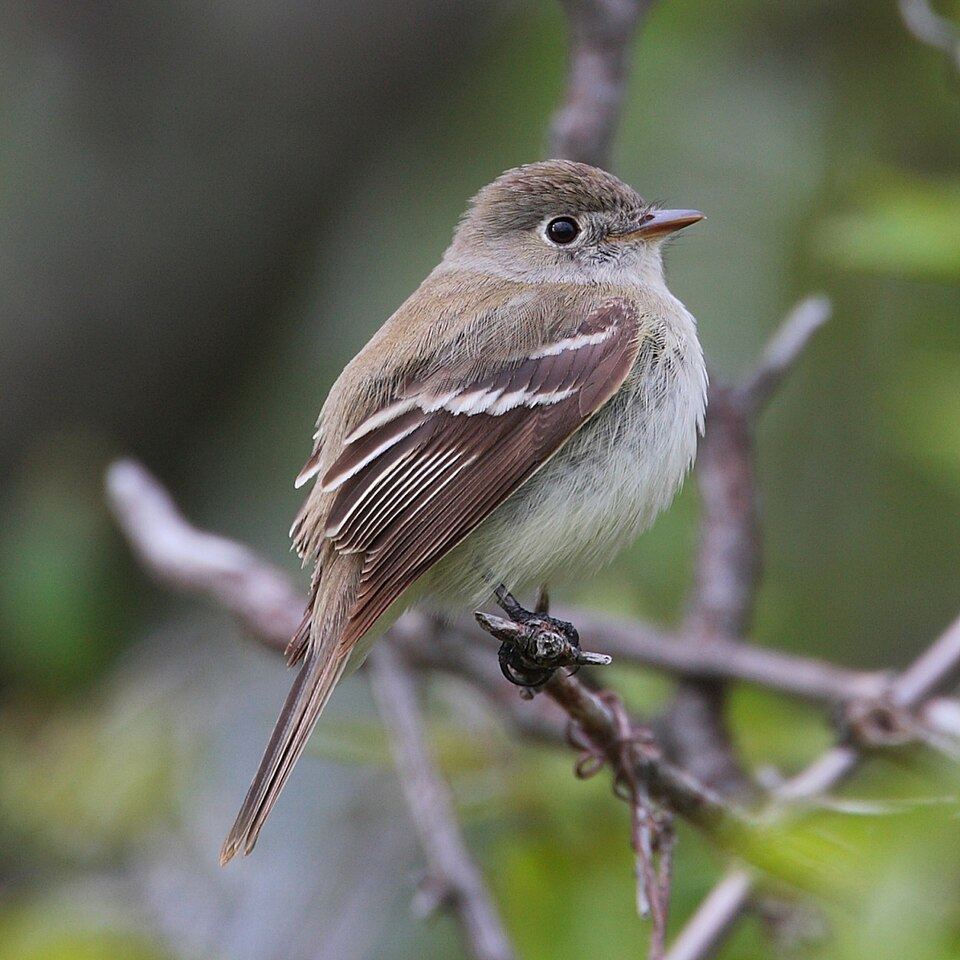
Photo: User:Mdf · CC BY-SA 3.0 (May be cropped or resized)
Empidonax minimus
U.S. national list: unknown
Basic stats
Diet
Insects, other invertebrates, and occasional berries (Wikipedia, general species account; EltonTraits, Wilman et al. 2014)
Habitat
Deciduous or mixed forest, aspen clusters, orchards, open woods, and forest edges (Wikipedia, general species account)
Range
Canada and the northeastern and central-northern United States; winters from Mexico to Panama (Wikipedia, general species account)
Clutch size
4
Incubation period
14
Weight
10
Least Flycatchers breed in eastern Canada and the central-northern and northeastern United States, then migrate to Central America from Mexico to Panama. Breeding settings include deciduous or mixed forest, aspen clusters, orchards, shade trees, open woods, and edges; winter habitat includes forest edges and second growth. The average AVONET mass is 10 g, matching the AnAge adult-weight value (Wikipedia, general species account; AVONET, Tobias et al. 2022; AnAge).
The diet is mainly insects and other small invertebrates, with berries taken occasionally. Birds watch from a perch and catch prey in the air, also taking some items from vegetation. Females build cup nests in small-tree forks or on branches. Clutches usually center on four eggs; incubation lasts about 13–16 days, while AnAge gives four and 14 days (Wikipedia, general species account; EltonTraits, Wilman et al. 2014; AnAge).
Where to see Least Flycatcher in the USA
GBIF records grouped by protected area. They show where the species has been reported, not that it is there now, and they are not population counts.
Recorded in 5,153 protected areas (1885–2026). The 8 with the most records:
- Adirondack Park: 7,916 records (1903–2025)
- Chequamegon–Nicolet National Forest: 5,134 records (1966–2024)
- Tawas Point State Park: 5,093 records (1981–2025)
- Horicon National Wildlife Refuge: 3,851 records (1965–2025)
- Minnesota Valley National Wildlife Refuge: 3,578 records (1982–2026)
- Braddock Bay Wildlife Management Area: 3,038 records (1964–2024)
- Ottawa National Wildlife Refuge: 2,823 records (1975–2026)
- Basha Kill Wildlife Management Area: 2,778 records (1966–2025)
Quick answers
- What does the Least Flycatcher eat?
- Insects, other invertebrates, and occasional berries (Wikipedia, general species account; EltonTraits, Wilman et al. 2014)
- What habitat does the Least Flycatcher live in?
- Deciduous or mixed forest, aspen clusters, orchards, open woods, and forest edges (Wikipedia, general species account)
- Where is the Least Flycatcher found?
- Canada and the northeastern and central-northern United States; winters from Mexico to Panama (Wikipedia, general species account)
- How many eggs does the Least Flycatcher lay?
- 4
- How long are the eggs of the Least Flycatcher incubated?
- 14
- How much does the Least Flycatcher weigh?
- 10