
 Wildlife
of USA
Philadelphia Vireo
Other Songbirds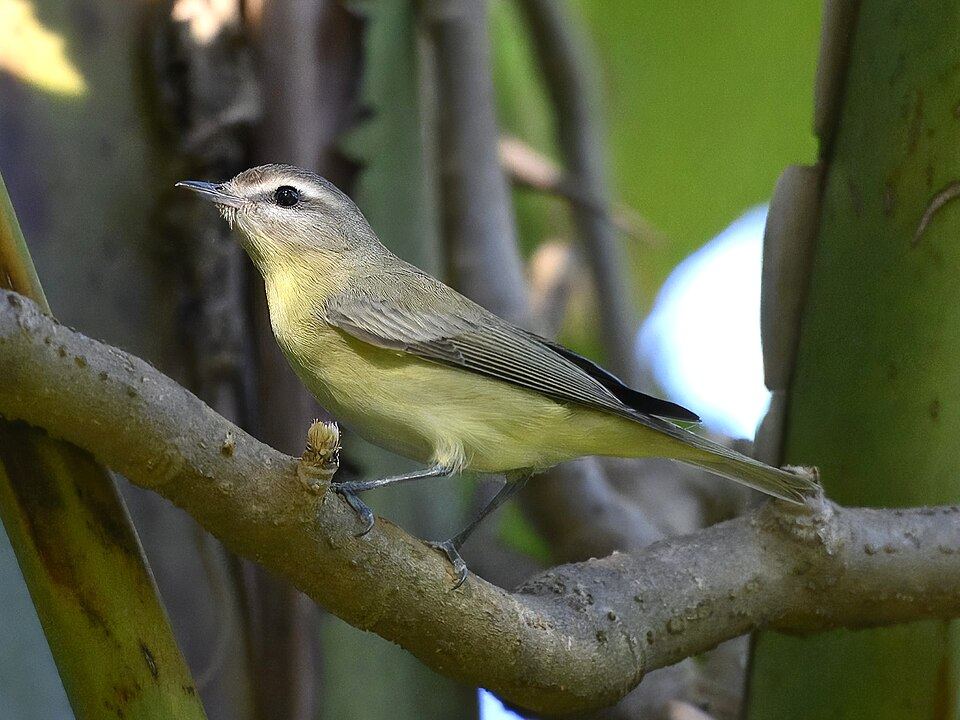
Photo: lwolfartist · CC BY 2.0 (May be cropped or resized)
Vireo philadelphicus
U.S. national list: unknown
Basic stats
Diet
Insects and berries
Habitat
Deciduous and mixed woodland edges
Range
Canada in summer, Mexico and Central America in winter
Clutch size
3–5
Incubation period
Up to 14 days
Size
13cm
Weight
12
Olive-brown back and yellow underparts define Philadelphia Vireo's coloring, with gray crown and dark eyes. A dark line passes through the eyes beneath a pale brow stripe. The wings have no bars, and the bird lacks an eye-ring; its bill is stout and its legs blue-gray. Dark lores and brighter yellow undersides distinguish it from the similar Warbling Vireo. It breeds along woodland margins across Canada, placing a basket-shaped cup high in a branch fork. (Wikipedia, general species account; Collins Birds of the World)
For winter, this vireo travels to Mexico and Central America and only rarely wanders to western Europe. It takes insects from trees, at times hovering or darting out after prey, and eats berries before migration. Its vocal phrases use three to five weeezh notes; compared with the Red-eyed Vireo, they pause longer and sound higher. The female lays three to five lightly spotted white eggs, which both parents incubate for up to 14 days. Average mass is about 12 g. (Wikipedia, general species account; AVONET, Tobias et al. 2022; AnAge)
Where to see Philadelphia Vireo in the USA
GBIF records grouped by protected area. They show where the species has been reported, not that it is there now, and they are not population counts.
Recorded in 2,513 protected areas (1888–2026). The 8 with the most records:
- Texas Point National Wildlife Refuge: 2,312 records (1989–2024)
- Smith Oaks Bird Sanctuary: 2,121 records (1973–2026)
- Tawas Point State Park: 2,103 records (1984–2024)
- Radnor Lake State Natural Area: 1,453 records (1948–2024)
- Monhegan Lobster Conservation Area: 1,270 records (1980–2024)
- Ottawa National Wildlife Refuge: 1,254 records (1975–2026)
- Monhegan Wildlands: 1,223 records (1980–2024)
- Higbee Beach Wildlife Management Area: 1,099 records (1971–2024)
Quick answers
- What does the Philadelphia Vireo eat?
- Insects and berries
- What habitat does the Philadelphia Vireo live in?
- Deciduous and mixed woodland edges
- Where is the Philadelphia Vireo found?
- Canada in summer, Mexico and Central America in winter
- How many eggs does the Philadelphia Vireo lay?
- 3–5
- How long are the eggs of the Philadelphia Vireo incubated?
- Up to 14 days
- How big is the Philadelphia Vireo?
- 13cm
- How much does the Philadelphia Vireo weigh?
- 12