
 Wildlife
of USA
Acadian Flycatcher
Other Songbirds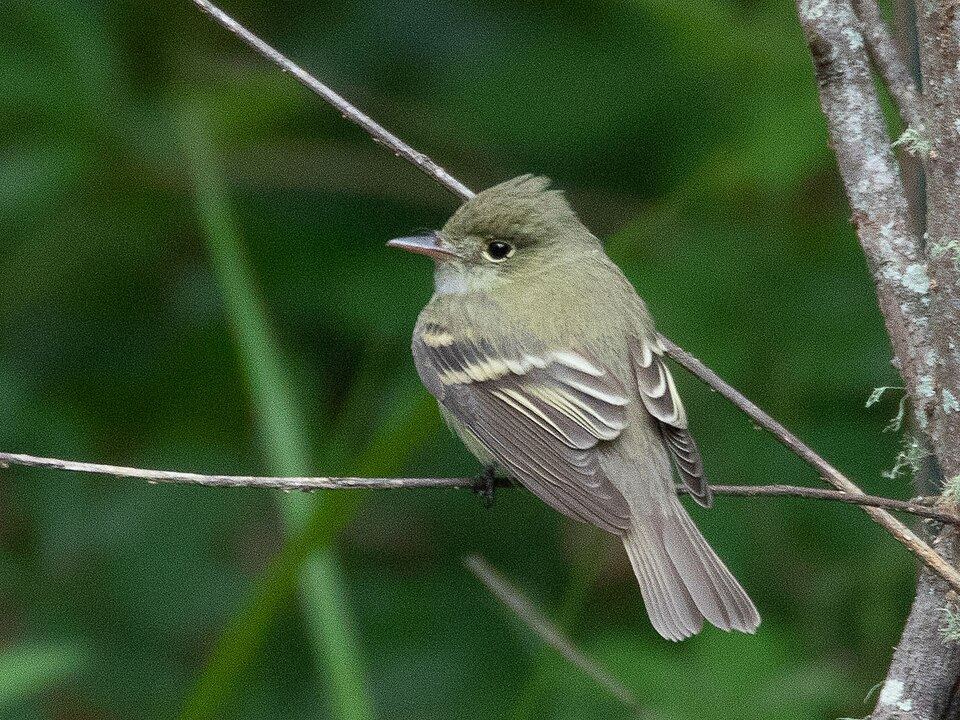
Photo: Bettina Arrigoni · CC BY 2.0 (May be cropped or resized)
Empidonax virescens
U.S. national list: unknown
Basic stats
Diet
Insects, berries, and seeds (Wikipedia, general species account; EltonTraits, Wilman et al. 2014)
Habitat
Deciduous forest, lowland forest, and marshy areas near water (Wikipedia, general species account)
Range
Eastern United States and southwestern Ontario, migrating through Mexico and the Caribbean to Central America and northern South America (Wikipedia, general species account)
Clutch size
3
Incubation period
13
Weight
13
Acadian Flycatchers breed in deciduous forest, in eastern North America, especially in woodland near water. During migration they pass through Mexico and the Caribbean toward Central and northwestern South America, including Colombia, Venezuela, and Ecuador. AVONET gives an average mass of 13 g after rounding, and AnAge lists 12.6 g (Wikipedia, general species account; AVONET, Tobias et al. 2022; AnAge).
Birds wait on middle-tree perches and fly out to catch insects, sometimes hovering to glean foliage; berries and seeds may also be eaten. Loose, shallow nests are built in horizontal forks of trees or shrubs, especially in lowland forest and marshy areas. AnAge supplies a clutch value of three and incubation of 13 days (Wikipedia, general species account; EltonTraits, Wilman et al. 2014; AnAge).
Where to see Acadian Flycatcher in the USA
GBIF records grouped by protected area. They show where the species has been reported, not that it is there now, and they are not population counts.
Recorded in 3,794 protected areas (1885–2026). The 8 with the most records:
- Montgomery County Agricultural Reserve: 8,265 records (1972–2025)
- Pinelands National Reserve: 6,984 records (1936–2026)
- Huntley Meadows Park: 5,571 records (1980–2026)
- Belleplain State Forest: 4,455 records (1951–2026)
- Cuyahoga Valley National Park: 4,009 records (1956–2026)
- National Capital Parks-East: 3,727 records (1885–2026)
- Jefferson National Forest: 3,672 records (1900–2024)
- George Washington National Forest: 3,647 records (1977–2024)
Quick answers
- What does the Acadian Flycatcher eat?
- Insects, berries, and seeds (Wikipedia, general species account; EltonTraits, Wilman et al. 2014)
- What habitat does the Acadian Flycatcher live in?
- Deciduous forest, lowland forest, and marshy areas near water (Wikipedia, general species account)
- Where is the Acadian Flycatcher found?
- Eastern United States and southwestern Ontario, migrating through Mexico and the Caribbean to Central America and northern South America (Wikipedia, general species account)
- How many eggs does the Acadian Flycatcher lay?
- 3
- How long are the eggs of the Acadian Flycatcher incubated?
- 13
- How much does the Acadian Flycatcher weigh?
- 13