
 Wildlife
of USA
Scissor-tailed Flycatcher
Other Songbirds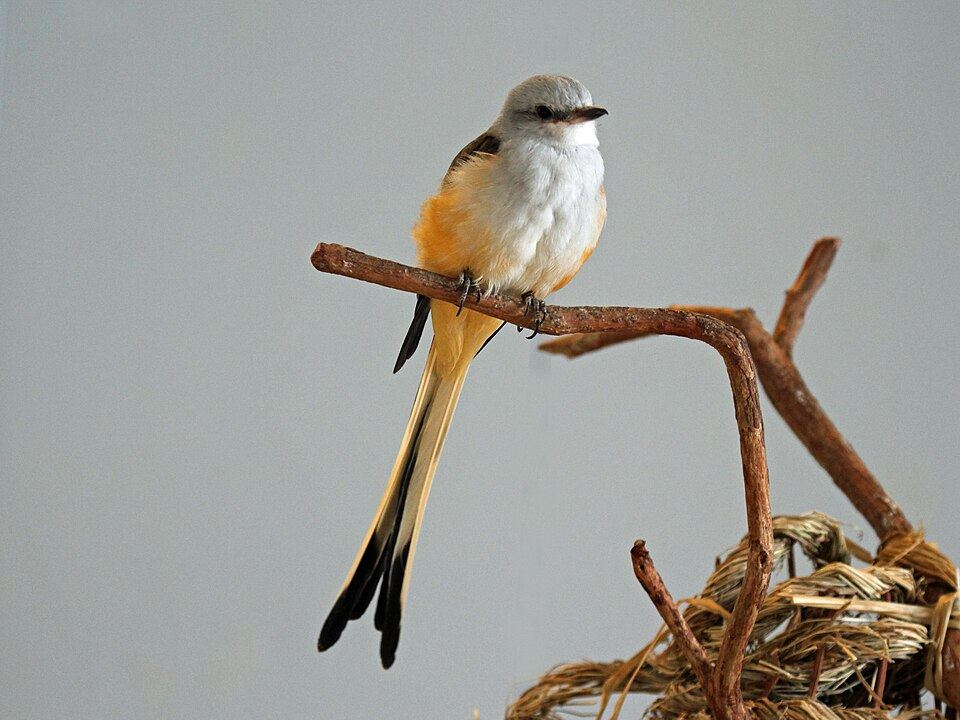
Photo: DickDaniels (http://theworldbirds.org/) · CC BY-SA 4.0 (May be cropped or resized)
Tyrannus forficatus
U.S. national list: unknown
Basic stats
Habitat
Open shrubby country with scattered trees
Range
Central United States to northeastern Mexico, wintering south to Panama
Clutch size
3–6 eggs
Weight
Up to 43g
Scissor-tailed Flycatcher breeds in open, brushy country with scattered trees, mainly across the south-central United States and into northeastern Mexico. Its nesting range includes Texas, Oklahoma, Kansas, parts of Louisiana, Arkansas and Missouri, reaching eastern New Mexico. Out-of-range sightings extend north to southern Canada and New York, east to Florida and Georgia, and into the West Indies. For winter, it moves through Texas and eastern Mexico toward southern Mexico and Panama. (Wikipedia, general species account)
Males can reach 15 inches, while a female tail is as much as 30 percent shorter; the long, deeply forked tail is black above and white below. Adults combine pale grey upperparts with light undersides, salmon-pink flanks and dark wings. They hawk insects such as grasshoppers and dragonflies from a perch, adding berries during winter. A cup nest sits in an isolated tree or shrub, sometimes on a telephone pole; both parents feed the young, and a clutch contains three to six eggs. (Wikipedia, general species account)
Where to see Scissor-tailed Flycatcher in the USA
GBIF records grouped by protected area. They show where the species has been reported, not that it is there now, and they are not population counts.
Recorded in 852 protected areas (1930–2026). The 8 with the most records:
- Hornsby Bend Ecological Research Area: 10,934 records (1960–2026)
- Mitchell Lake Audubon Center: 6,841 records (1980–2026)
- Jocelyn Nungaray National Wildlife Refuge: 6,694 records (1967–2026)
- Hagerman National Wildlife Refuge: 4,610 records (1969–2026)
- Estero Llano Grande State Park: 4,516 records (2000–2024)
- Laguna Atascosa National Wildlife Refuge: 4,354 records (1962–2025)
- Santa Ana National Wildlife Refuge: 3,797 records (1965–2024)
- Everglades & Dry Tortugas: 3,751 records (1972–2026)
Quick answers
- What habitat does the Scissor-tailed Flycatcher live in?
- Open shrubby country with scattered trees
- Where is the Scissor-tailed Flycatcher found?
- Central United States to northeastern Mexico, wintering south to Panama
- How many eggs does the Scissor-tailed Flycatcher lay?
- 3–6 eggs
- How much does the Scissor-tailed Flycatcher weigh?
- Up to 43g