
 Wildlife
of USA
Royal Tern
Gulls, Terns & Jaegers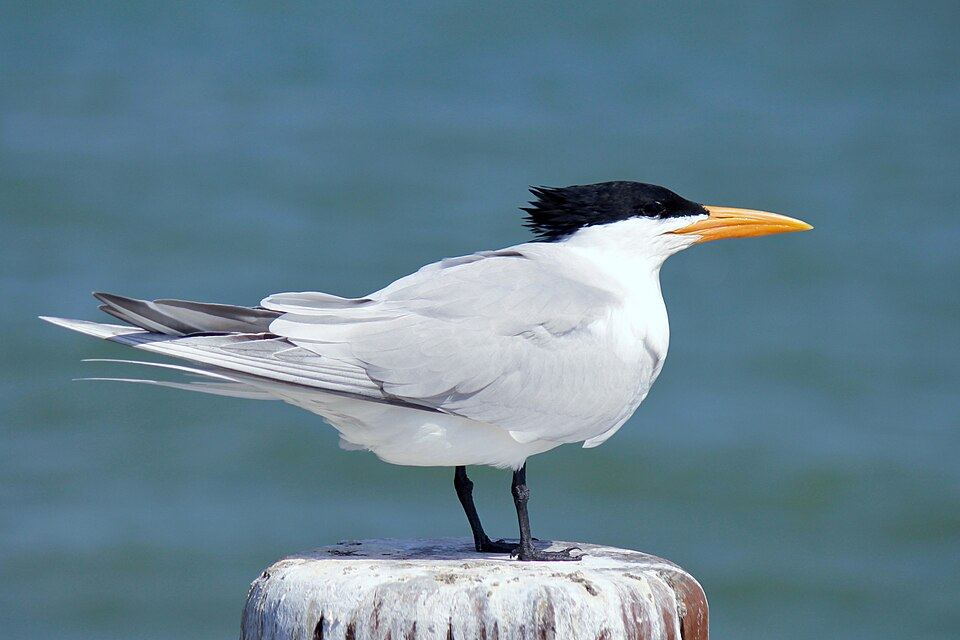
Photo: EyeLoveBirds from Vancouver, Canada · CC BY-SA 2.0 (May be cropped or resized)
Thalasseus maximus
U.S. national list: unknown
Basic stats
Diet
Mostly fish, with aquatic invertebrates
Habitat
Warm coasts, estuaries, beaches and offshore islands
Range
Atlantic and Pacific coasts of the Americas and the Atlantic coast of Africa
Clutch size
About 2 eggs
Incubation period
About 28 days
Weight
Averages about 415g
The Royal Tern is a large, pale tern with long pointed wings, a deeply forked tail and a heavy orange bill. Breeding adults have a glossy black cap that recedes to a shaggy rear crest outside breeding. AVONET records an average mass of about 415 g, above the AnAge adult value, and identifies strong migration (Wikipedia, general species account; AVONET, Tobias et al. 2022; AnAge).
It occurs along warm Atlantic and Pacific coasts of the Americas and on the Atlantic coast of Africa. Beaches, estuaries and offshore islands provide feeding and colonial nesting habitat. Fish contribute 80% and aquatic invertebrates 20% to the EltonTraits diet profile. Birds plunge from the air into the sea. AnAge reports about two eggs and incubation near 28 days (Wikipedia, general species account; EltonTraits, Wilman et al. 2014; AnAge).
Where to see Royal Tern in the USA
GBIF records grouped by protected area. They show where the species has been reported, not that it is there now, and they are not population counts.
Recorded in 726 protected areas (1837–2026). The 8 with the most records:
- Florida Keys National Marine Sanctuary: 17,376 records (1914–2026)
- Merritt Island National Wildlife Refuge: 15,981 records (1928–2026)
- Bolivar Flats Shorebird Sanctuary: 11,911 records (1973–2026)
- Timucuan Ecological and Historic Preserve: 11,626 records (1966–2026)
- Pea Island National Wildlife Refuge: 11,504 records (1964–2026)
- Chincoteague National Wildlife Refuge: 10,213 records (1950–2026)
- Cape May Point State Park: 9,530 records (1966–2026)
- Saint Marks National Wildlife Refuge (Panacea Unit): 8,488 records (1922–2026)
Quick answers
- What does the Royal Tern eat?
- Mostly fish, with aquatic invertebrates
- What habitat does the Royal Tern live in?
- Warm coasts, estuaries, beaches and offshore islands
- Where is the Royal Tern found?
- Atlantic and Pacific coasts of the Americas and the Atlantic coast of Africa
- How many eggs does the Royal Tern lay?
- About 2 eggs
- How long are the eggs of the Royal Tern incubated?
- About 28 days
- How much does the Royal Tern weigh?
- Averages about 415g