
 Wildlife
of USA
Iceland Gull
Gulls, Terns & Jaegers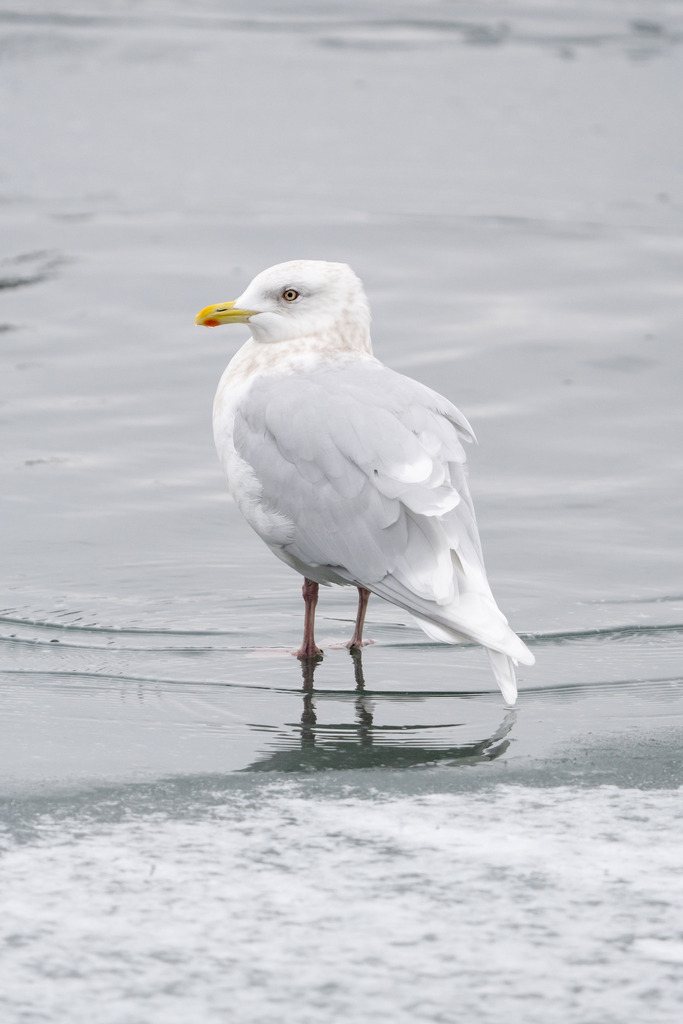
Photo: (c) Andrew Lai, some rights reserved (CC BY) · CC BY 4.0 (May be cropped or resized)
Larus glaucoides
U.S. national list: unknown
Basic stats
Diet
Mostly fish, with invertebrates and other animal prey
Habitat
Arctic coasts and cliffs; winter harbours, inland lakes and refuse sites
Range
Breeds in Arctic Canada and Greenland; winters around the North Atlantic and northern North America
Clutch size
Usually 2–3 eggs
Incubation period
About 25 days
Size
50–64cm
Wingspan
115–150cm
Weight
Averages about 693g
The Iceland Gull is a slender, medium-sized gull measuring 50–64 cm with a 115–150 cm wingspan. Adults have a very pale grey back and wings with white outer primaries, while young birds are softly mottled and lack strongly contrasting black wingtips. It is smaller and finer-billed than the Glaucous Gull. AVONET records an average mass of about 693 g (Wikipedia, general species account; AVONET, Tobias et al. 2022).
Despite its name, it breeds in Arctic Canada and Greenland rather than Iceland, wintering around the North Atlantic and northern North America. Coastal cliffs and ground sites hold breeding colonies; winter birds use harbours, inland lakes, refuse sites and fish-cleaning areas. Fish supply 50% of the EltonTraits profile, with invertebrates and other animal prey each at 20%. Two or three eggs are laid in a grass-, moss- or seaweed-lined nest and incubated for about 25 days (Wikipedia, general species account; EltonTraits, Wilman et al. 2014; AnAge).
Where to see Iceland Gull in the USA
GBIF records grouped by protected area. They show where the species has been reported, not that it is there now, and they are not population counts.
Recorded in 872 protected areas (1882–2026). The 8 with the most records:
- Monterey Bay National Marine Sanctuary: 8,541 records (1910–2026)
- Greater Farallones National Marine Sanctuary: 5,247 records (1971–2024)
- Southeast Farallon Island State Marine Reserve: 3,879 records (1971–2024)
- Golden Gate National Recreation Area: 2,886 records (1979–2024)
- Asilomar State Marine Reserve: 2,528 records (1975–2024)
- Pacific Grove Marine Gardens State Marine Conservation Area: 2,475 records (1978–2024)
- Marin Headlands State Park: 1,543 records (1990–2024)
- American River Parkway: 1,422 records (1984–2025)
Quick answers
- What does the Iceland Gull eat?
- Mostly fish, with invertebrates and other animal prey
- What habitat does the Iceland Gull live in?
- Arctic coasts and cliffs; winter harbours, inland lakes and refuse sites
- Where is the Iceland Gull found?
- Breeds in Arctic Canada and Greenland; winters around the North Atlantic and northern North America
- How many eggs does the Iceland Gull lay?
- Usually 2–3 eggs
- How long are the eggs of the Iceland Gull incubated?
- About 25 days
- How big is the Iceland Gull?
- 50–64cm
- What is the wingspan of the Iceland Gull?
- 115–150cm
- How much does the Iceland Gull weigh?
- Averages about 693g