
 Wildlife
of USA
Franklin's Gull
Gulls, Terns & Jaegers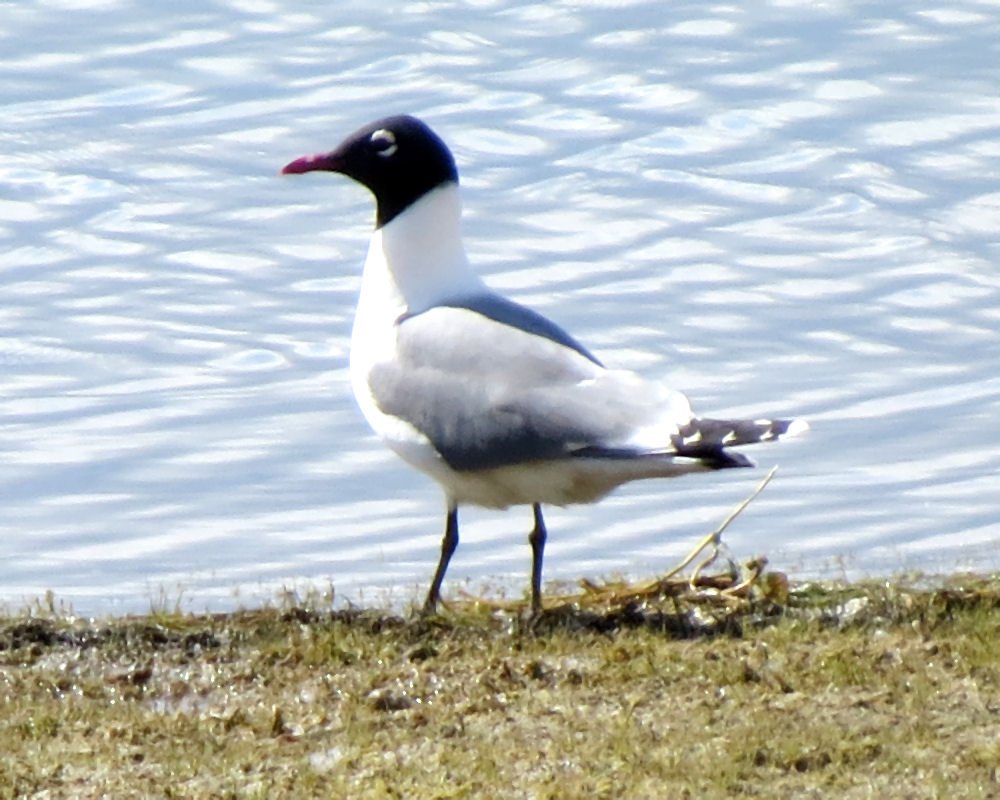
Photo: D. Gordon E. Robertson · CC BY-SA 4.0 (May be cropped or resized)
Leucophaeus pipixcan
U.S. national list: unknown
Basic stats
Diet
Invertebrates, seeds and other plant material
Habitat
Prairie lakes and marshes when breeding; coasts and fields at other seasons
Range
Breeds in central North America; winters mainly along western South America
Clutch size
Usually 2–3 eggs
Incubation period
About 24 days
Size
32–36cm
Weight
Averages about 280g
Franklin's Gull is a 32–36 cm gull with a dark gray back, white body and black breeding hood. Adults have red legs and bill, black wingtips beside a white band, and lose most of the hood in winter. AVONET records an average mass of about 280 g and classifies it as a strongly migratory coastal omnivore (Wikipedia, general species account; AVONET, Tobias et al. 2022).
Colonies form beside prairie lakes and marshes in central Canada and the northern United States; wintering birds range through the Caribbean and along western South America. They catch swarming insects in flight, glean terrestrial and aquatic invertebrates, and also take seeds and other plant matter. Ground or floating nests usually hold two or three eggs, with incubation averaging about 24 days (Wikipedia, general species account; EltonTraits, Wilman et al. 2014; AnAge).
Where to see Franklin's Gull in the USA
GBIF records grouped by protected area. They show where the species has been reported, not that it is there now, and they are not population counts.
Recorded in 1,624 protected areas (1915–2026). The 8 with the most records:
- Great Salt Lake State Park: 10,864 records (1965–2026)
- Malheur National Wildlife Refuge: 5,319 records (1969–2026)
- Bear River National Migratory Bird Refuge (historical): 4,458 records (1955–2026)
- Cheyenne Bottoms Wildlife Area: 4,273 records (1967–2026)
- Quivira National Wildlife Refuge: 3,808 records (1925–2024)
- Utah Lake State Park: 3,650 records (1977–2026)
- Farmington Bay Waterfowl Management Area: 3,614 records (1973–2026)
- Tuttle Creek Recreation Area: 2,996 records (1968–2026)
Quick answers
- What does the Franklin's Gull eat?
- Invertebrates, seeds and other plant material
- What habitat does the Franklin's Gull live in?
- Prairie lakes and marshes when breeding; coasts and fields at other seasons
- Where is the Franklin's Gull found?
- Breeds in central North America; winters mainly along western South America
- How many eggs does the Franklin's Gull lay?
- Usually 2–3 eggs
- How long are the eggs of the Franklin's Gull incubated?
- About 24 days
- How big is the Franklin's Gull?
- 32–36cm
- How much does the Franklin's Gull weigh?
- Averages about 280g