
 Wildlife
of USA
Lesser Black-backed Gull
Gulls, Terns & Jaegers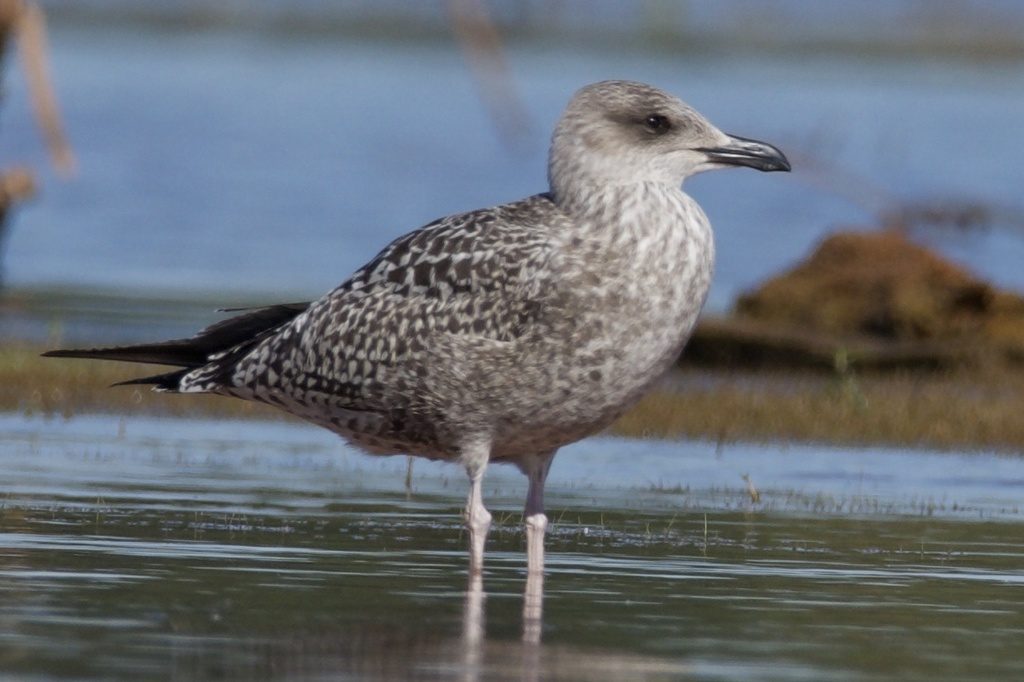
Photo: Cody Delano · CC BY 4.0 (May be cropped or resized)
Larus fuscus
U.S. national list: unknown
Basic stats
Diet
Invertebrates, fish and small vertebrates
Habitat
Coasts, estuaries, wetlands, farmland and towns
Range
Breeds mainly in northern and western Europe; winters from western Europe to West Africa, with regular occurrence in North America
Size
51–64cm
Wingspan
124–150cm
Weight
Averages about 762g
The Lesser Black-backed Gull is a large gull with a dark slate-grey back and wings, white head and underparts, yellow legs and a yellow bill marked red near the tip. Adults measure about 51–64 cm, with wings spanning roughly 124–150 cm. Immature plumages are mottled brown and develop gradually over several years. It is smaller and more lightly built than the Great Black-backed Gull (Wikipedia, general species account).
The species breeds mainly around northern and western European coasts and commonly migrates south toward western Europe and West Africa; it is also now regular in North America. It uses shores, estuaries, farmland, reservoirs and towns. The diet is broad, with invertebrates, fish and small vertebrates each contributing important shares in EltonTraits; scavenged material is excluded from the summary because it falls below the threshold (EltonTraits, Wilman et al. 2014). AVONET mean mass rounds to 762 g (AVONET, Tobias et al. 2022).
Where to see Lesser Black-backed Gull in the USA
GBIF records grouped by protected area. They show where the species has been reported, not that it is there now, and they are not population counts.
Recorded in 976 protected areas (1934–2026). The 8 with the most records:
- Back Bay National Wildlife Refuge: 4,698 records (1989–2026)
- Cape Henlopen State Park: 4,617 records (1981–2025)
- Cape May Point State Park: 4,318 records (1981–2024)
- Spruce Run Recreation Area: 4,292 records (1981–2024)
- Chincoteague National Wildlife Refuge: 3,865 records (1975–2024)
- Pea Island National Wildlife Refuge: 3,819 records (1980–2026)
- Nockamixon State Park: 3,182 records (1986–2026)
- Pinelands National Reserve: 3,130 records (1983–2026)
Quick answers
- What does the Lesser Black-backed Gull eat?
- Invertebrates, fish and small vertebrates
- What habitat does the Lesser Black-backed Gull live in?
- Coasts, estuaries, wetlands, farmland and towns
- Where is the Lesser Black-backed Gull found?
- Breeds mainly in northern and western Europe; winters from western Europe to West Africa, with regular occurrence in North America
- How big is the Lesser Black-backed Gull?
- 51–64cm
- What is the wingspan of the Lesser Black-backed Gull?
- 124–150cm
- How much does the Lesser Black-backed Gull weigh?
- Averages about 762g