
 Wildlife
of USA
Common Tern
Gulls, Terns & Jaegers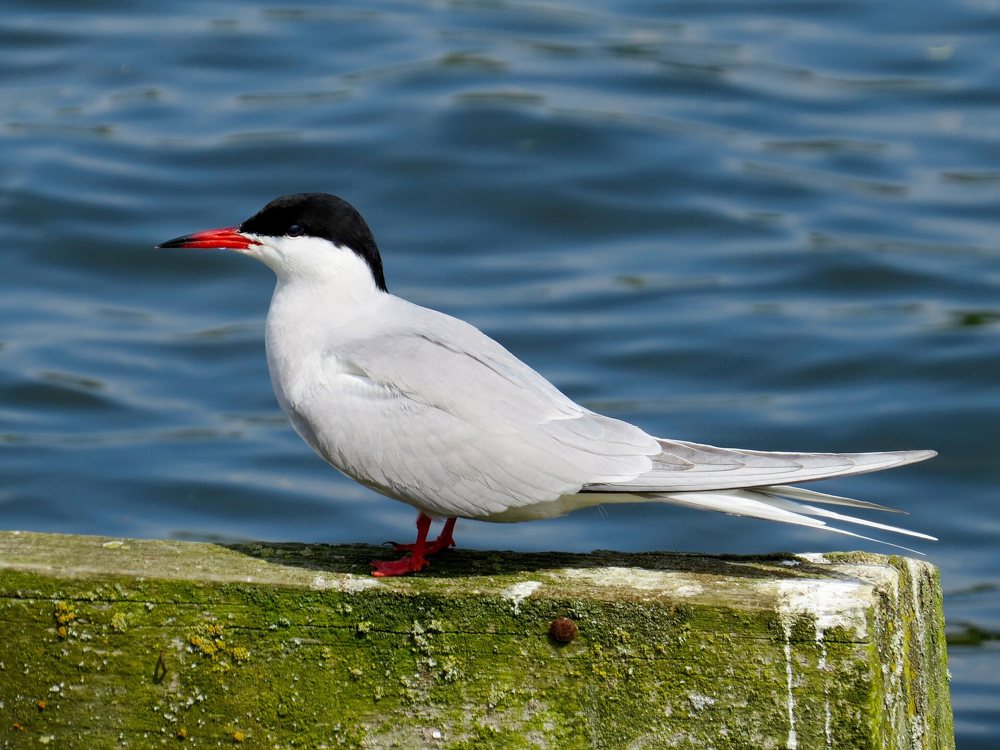
Photo: MPF · CC BY-SA 4.0 (May be cropped or resized)
Sterna hirundo
U.S. national list: unknown
Basic stats
Diet
Mostly fish, with molluscs, crustaceans and other invertebrates
Habitat
Coasts and inland waters, nesting on open, sparsely vegetated ground near water
Range
Breeds across the temperate and subarctic northern hemisphere; winters on tropical and subtropical coasts
Clutch size
Usually 2–3 eggs
Incubation period
About 21–24 days
Size
31–35cm
Wingspan
77–98cm
Weight
Averages about 129g
The Common Tern breeds around the temperate and subarctic Northern Hemisphere and migrates to tropical and subtropical coasts for the non-breeding season. Breeding adults have pale grey upperparts, very pale underparts, a black cap, reddish legs and a narrow pointed bill whose pattern varies among subspecies. Measuring about 31–35 cm with a 77–98 cm wingspan, it is an agile flier capable of hovering, abrupt turns and vertical take-off. (Wikipedia, general species account)
The species uses both marine and fresh water, usually plunge-diving for fish but also taking molluscs, crustaceans and other invertebrates. Colonies form on flat, open surfaces close to water, including beaches, islands and artificial rafts. The shallow scrape may be bare or edged with nearby material, and its mottled eggs blend into the substrate. Both adults incubate; accounts give up to three eggs and hatching after roughly 21–22 days, while AnAge records an average incubation of 24 days. (Wikipedia, general species account; AnAge)
Where to see Common Tern in the USA
GBIF records grouped by protected area. They show where the species has been reported, not that it is there now, and they are not population counts.
Recorded in 1,543 protected areas (1878–2026). The 8 with the most records:
- Pinelands National Reserve: 15,308 records (1921–2026)
- Parker River National Wildlife Refuge: 12,844 records (1961–2026)
- Gateway National Recreation Area: 12,469 records (1956–2026)
- Jamaica Bay Unit: 12,149 records (1956–2026)
- Jacques Cousteau National Estuarine Research Reserve: 11,701 records (1921–2026)
- Brigantine National Wildlife Refuge: 10,717 records (1938–2026)
- Edwin B. Forsythe National Wildlife Refuge: 10,327 records (1954–2026)
- Maine Coastal Islands National Wildlife Refuge: 9,560 records (1881–2026)
Quick answers
- What does the Common Tern eat?
- Mostly fish, with molluscs, crustaceans and other invertebrates
- What habitat does the Common Tern live in?
- Coasts and inland waters, nesting on open, sparsely vegetated ground near water
- Where is the Common Tern found?
- Breeds across the temperate and subarctic northern hemisphere; winters on tropical and subtropical coasts
- How many eggs does the Common Tern lay?
- Usually 2–3 eggs
- How long are the eggs of the Common Tern incubated?
- About 21–24 days
- How big is the Common Tern?
- 31–35cm
- What is the wingspan of the Common Tern?
- 77–98cm
- How much does the Common Tern weigh?
- Averages about 129g