
 Wildlife
of USA
Caspian Tern
Gulls, Terns & Jaegers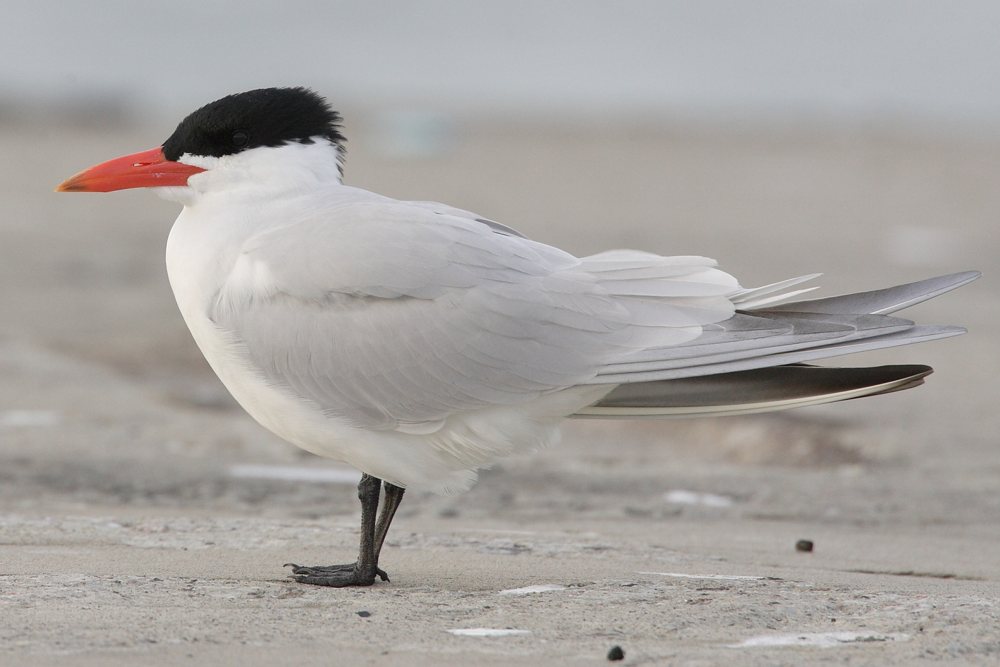
Photo: Mdf · CC BY-SA 3.0 (May be cropped or resized)
Hydroprogne caspia
U.S. national list: unknown
Basic stats
Diet
Mostly fish, with occasional small vertebrates and carrion
Habitat
Large lakes, rivers, lagoons, estuaries and sheltered coasts
Range
Scattered breeding distribution across North America, Europe, Africa, Asia and Australasia
Clutch size
Usually 2 eggs
Incubation period
About 21 days
Weight
Averages about 655g
The Caspian Tern is the world's largest tern, powerfully built with broad wings, a shallowly forked tail and a heavy red bill tipped dark. Adults are pale grey above and white below, with a black cap that becomes streaked outside the breeding season. Its deep, harsh call and deliberate wingbeats reinforce its robust appearance. The species averages about 655 g and has a mean wing length of roughly 410.7 mm (Wikipedia, general species account; AVONET, Tobias et al. 2022).
Across a scattered worldwide range, the species frequents large lakes, rivers, lagoons, estuaries and sheltered coasts. It searches from the air and plunge-dives for fish, which dominate its diet, though small vertebrates and carrion are sometimes taken. Nesting pairs use open ground on islands, beaches and sparsely vegetated shores, either alone or in colonies. A usual clutch contains two eggs and incubation averages about 21 days (Wikipedia, general species account; EltonTraits, Wilman et al. 2014; AnAge).
Where to see Caspian Tern in the USA
GBIF records grouped by protected area. They show where the species has been reported, not that it is there now, and they are not population counts.
Recorded in 2,904 protected areas (1876–2026). The 8 with the most records:
- Monterey Bay National Marine Sanctuary: 26,444 records (1954–2026)
- Pinelands National Reserve: 19,495 records (1925–2026)
- Jacques Cousteau National Estuarine Research Reserve: 17,884 records (1931–2026)
- Brigantine National Wildlife Refuge: 17,547 records (1951–2026)
- Edwin B. Forsythe National Wildlife Refuge: 17,391 records (1957–2026)
- Montezuma National Wildlife Refuge: 15,642 records (1950–2025)
- Merritt Island National Wildlife Refuge: 13,498 records (1967–2026)
- Bolsa Chica Ecological Reserve: 13,193 records (1949–2026)
Quick answers
- What does the Caspian Tern eat?
- Mostly fish, with occasional small vertebrates and carrion
- What habitat does the Caspian Tern live in?
- Large lakes, rivers, lagoons, estuaries and sheltered coasts
- Where is the Caspian Tern found?
- Scattered breeding distribution across North America, Europe, Africa, Asia and Australasia
- How many eggs does the Caspian Tern lay?
- Usually 2 eggs
- How long are the eggs of the Caspian Tern incubated?
- About 21 days
- How much does the Caspian Tern weigh?
- Averages about 655g