
 Wildlife
of USA
Ring-necked Pheasant
Pheasants, Partridges & Quails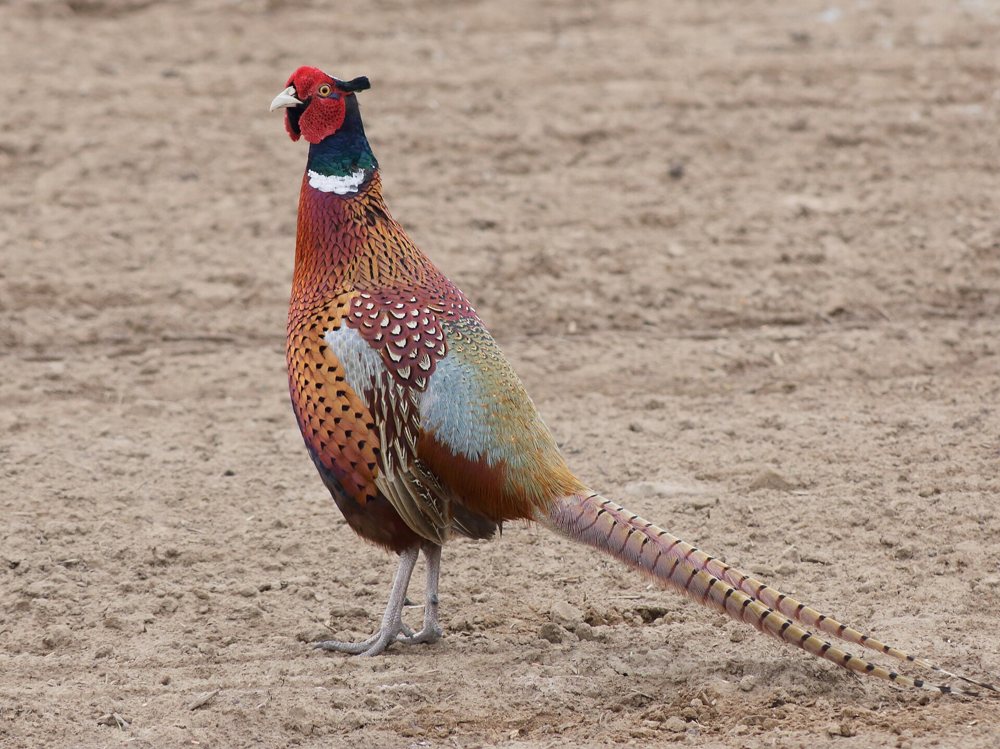
Photo: Estormiz · CC0
Phasianus colchicus
U.S. national list: unknown
Basic stats
Diet
Fruit, seeds and other plant material, with some invertebrates
Habitat
Farmland, grassland, scrub and woodland edge
Range
Native from southeastern Europe across temperate Asia; introduced widely elsewhere
Clutch size
About 11 eggs
Incubation period
About 24 days
Weight
Averages about 1120g
The Ring-necked Pheasant belongs to a highly variable species whose males are large, long-tailed and vividly coloured, while females are smaller and mottled brown. Many males in the ring-necked group carry a white collar separating the glossy dark head from the coppery body, though plumage differs among subspecies and introduced mixtures. The species is strongly terrestrial and averages about 1,120 g (Wikipedia, general species account; AVONET, Tobias et al. 2022).
Native populations extend from southeastern Europe across temperate Asia, while releases for hunting have established the species widely elsewhere. It uses farmland, grassland, scrub and woodland margins, feeding on the ground. Fruit, seeds and other plant material dominate the diet; invertebrates are also eaten and independently supported by the species account despite their smaller EltonTraits share. Dataset means indicate about eleven eggs and an incubation period near 24 days (Wikipedia, general species account; EltonTraits, Wilman et al. 2014; AnAge).
Where to see Ring-necked Pheasant in the USA
GBIF records grouped by protected area. They show where the species has been reported, not that it is there now, and they are not population counts.
Recorded in 3,392 protected areas (1901–2026). The 8 with the most records:
- Malheur National Wildlife Refuge: 8,648 records (1958–2026)
- Great Salt Lake State Park: 7,524 records (1975–2026)
- Utah Lake State Park: 6,966 records (1973–2026)
- Bear River National Migratory Bird Refuge (historical): 6,279 records (1958–2026)
- Monhegan Lobster Conservation Area: 5,708 records (1978–2026)
- Yolo Bypass Wildlife Area: 5,535 records (1960–2026)
- Monhegan Wildlands: 5,477 records (1978–2024)
- Farmington Bay Waterfowl Management Area: 4,804 records (1973–2026)
Quick answers
- What does the Ring-necked Pheasant eat?
- Fruit, seeds and other plant material, with some invertebrates
- What habitat does the Ring-necked Pheasant live in?
- Farmland, grassland, scrub and woodland edge
- Where is the Ring-necked Pheasant found?
- Native from southeastern Europe across temperate Asia; introduced widely elsewhere
- How many eggs does the Ring-necked Pheasant lay?
- About 11 eggs
- How long are the eggs of the Ring-necked Pheasant incubated?
- About 24 days
- How much does the Ring-necked Pheasant weigh?
- Averages about 1120g