
 Wildlife
of USA
Plain Chachalaca
Pheasants, Partridges & Quails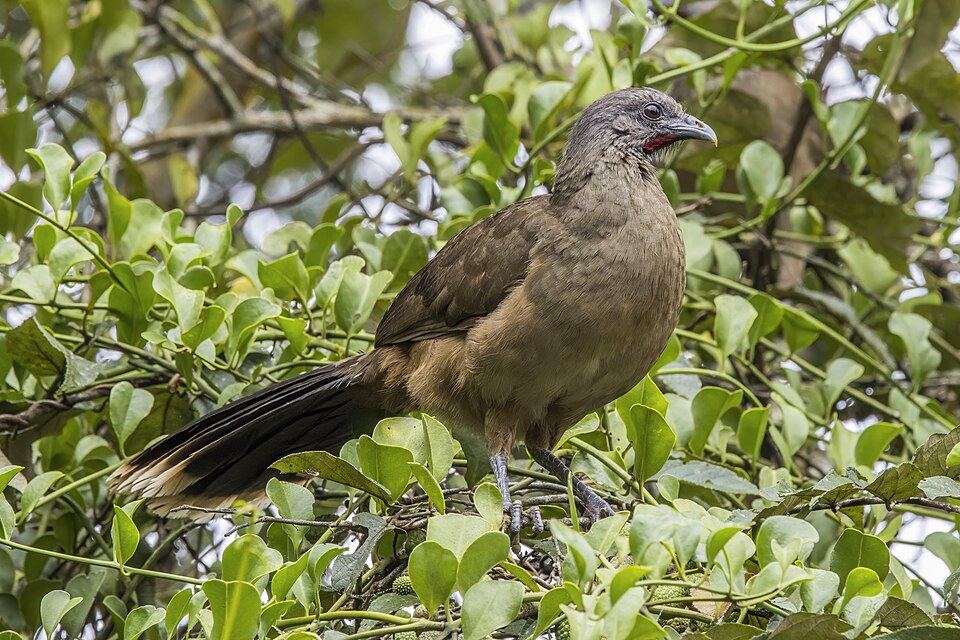
Photo: Charles J. Sharp · CC BY-SA 4.0 (May be cropped or resized)
Ortalis vetula
U.S. national list: unknown
The plain chachalaca (Ortalis vetula) is a large Cracidae bird, in the family of chachalacas, guans and curassows. It breeds from mezquital scrub in the southernmost Texas Rio Grande Valley to northern Costa Rica, across tropical and subtropical settings. In Central America, one range runs through Pacific lowlands from Chiapas, Mexico, to northern Nicaragua; another, separated by a short gap, occurs in Costa Rica. It uses dry or moist forest, especially where scrub and savanna are interspersed. (Wikipedia, general species account)
Often in groups of up to 15, the plain chachalaca is wary and secretive. To evade danger, it runs quickly along the ground or leaps and glides through tangled brush. It eats fruit—including figs, palm fruits and Sapotaceae—as well as seeds, leaves and flowers, feeding in trees or on the ground. It sometimes damages tomato and cucumber crops. Its loud, raucous RAW-pa-haw or cha-cha-LAW-ka call often becomes a rhythmic chorus from several birds, especially morning and evening, usually high in trees. (Wikipedia, general species account)
Where to see Plain Chachalaca in the USA
GBIF records grouped by protected area. They show where the species has been reported, not that it is there now, and they are not population counts.
Recorded in 11 protected areas (1923–2026). The 8 with the most records:
- Estero Llano Grande State Park: 24,334 records (2000–2026)
- Santa Ana National Wildlife Refuge: 13,356 records (1962–2026)
- Bentsen-Rio Grande Valley State Park: 8,169 records (1966–2026)
- Laguna Atascosa National Wildlife Refuge: 6,604 records (1962–2026)
- Resaca de la Palma State Park: 5,441 records (1923–2025)
- Las Palomas Wildlife Management Area - Anacua Unit: 447 records (1989–2024)
- Palo Alto Battlefield National Historical Park: 405 records (2011–2024)
- Falcon State Park: 198 records (1974–2024)