
 Wildlife
of USA
Chukar
Pheasants, Partridges & Quails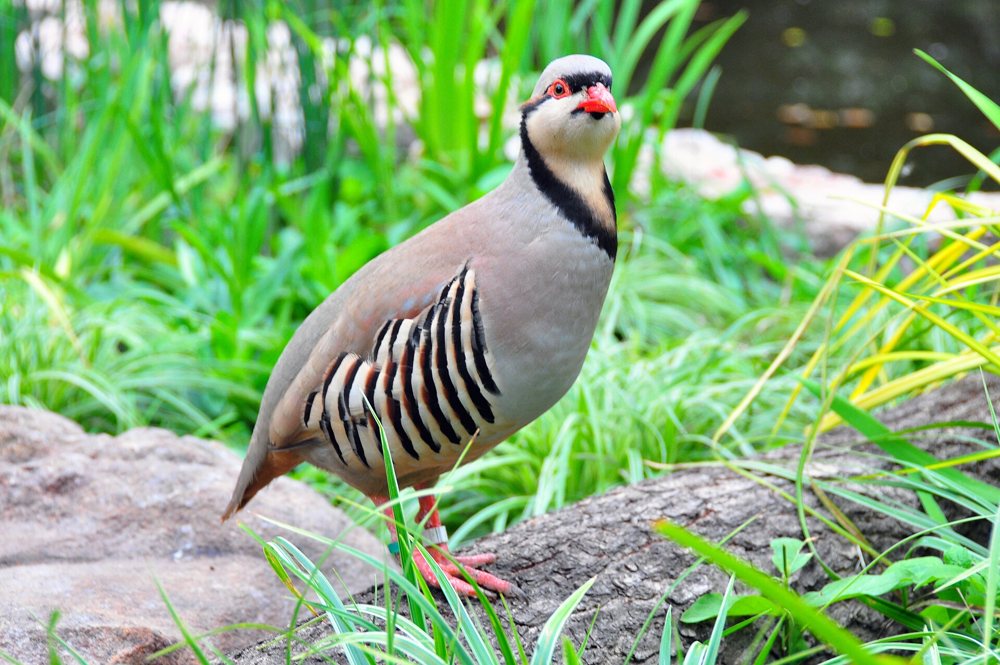
Photo: Olaf Oliviero Riemer · CC BY-SA 3.0 (May be cropped or resized)
Alectoris chukar
U.S. national list: unknown
Basic stats
Diet
Mostly plant material, with invertebrates
Habitat
Rocky slopes, semi-arid hills, grass and sparse scrub
Range
Native from southeastern Europe and the Middle East across temperate Asia; introduced elsewhere
Size
32–35cm
Weight
Averages about 502g
The Chukar is a rotund partridge, 32–35 cm long, with a light brown back, grey breast, buff belly and boldly barred flanks. A black band passes through the eye and encircles the white throat; the bill and legs are red. Females are slightly smaller and lack the male's spur. AVONET records an average mass of about 502 g (Wikipedia, general species account; AVONET, Tobias et al. 2022).
Its native range extends from southeastern Europe and the Middle East across temperate Asia, while introduced populations occur elsewhere. Chukars inhabit dry rocky slopes, semi-arid hills, grass, sparse scrub, cultivation and desert plains, generally avoiding humid country. They feed on the ground, chiefly on plant material but also on invertebrates. Outside breeding they gather in coveys and usually run uphill before resorting to short downhill flight (Wikipedia, general species account; EltonTraits, Wilman et al. 2014; Collins Birds of the World).
Where to see Chukar in the USA
GBIF records grouped by protected area. They show where the species has been reported, not that it is there now, and they are not population counts.
Recorded in 553 protected areas (1945–2026). The 8 with the most records:
- Great Salt Lake State Park: 4,393 records (1977–2026)
- Antelope Island State Park: 4,286 records (1977–2026)
- Haleakalā National Park: 2,181 records (1964–2026)
- Haleakalā Wilderness: 1,253 records (1964–2026)
- Wasatch–Cache National Forest: 1,006 records (1965–2024)
- Inyo National Forest: 984 records (1954–2026)
- Owens Peak Wilderness: 769 records (1977–2024)
- Boise River Wildlife Management Area: 657 records (1996–2026)
Quick answers
- What does the Chukar eat?
- Mostly plant material, with invertebrates
- What habitat does the Chukar live in?
- Rocky slopes, semi-arid hills, grass and sparse scrub
- Where is the Chukar found?
- Native from southeastern Europe and the Middle East across temperate Asia; introduced elsewhere
- How big is the Chukar?
- 32–35cm
- How much does the Chukar weigh?
- Averages about 502g