
 Wildlife
of USA
Indian Peafowl
Pheasants, Partridges & Quails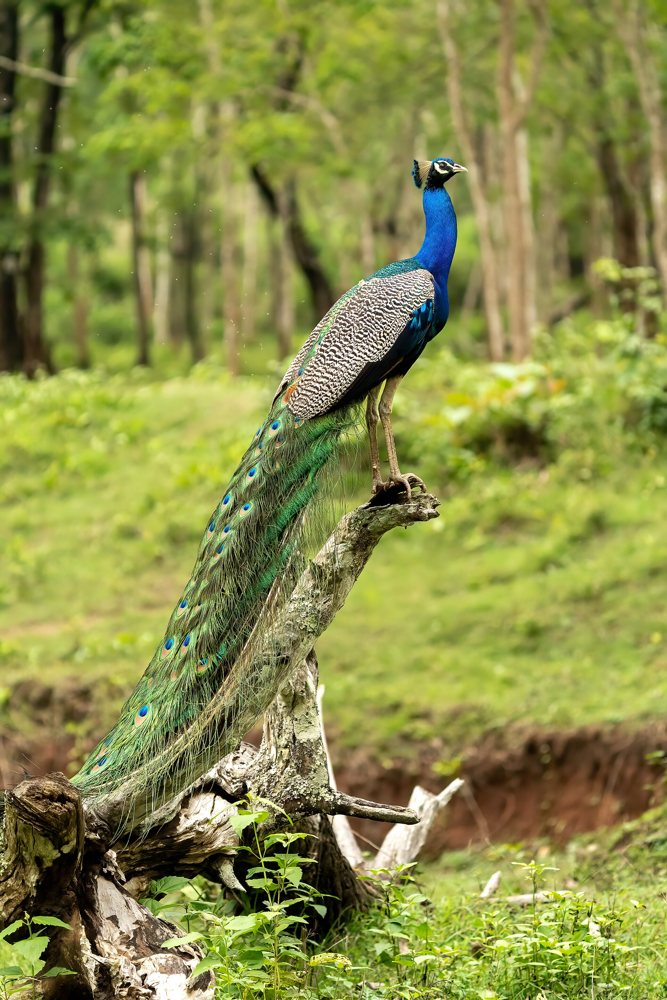
Photo: Kandukuru Nagarjun from Bangalore, India · CC BY 2.0 (May be cropped or resized)
Pavo cristatus
U.S. national list: unknown
Basic stats
Diet
Seeds, other plant material and invertebrates
Habitat
Open forest, scrub, forest edge and cultivated land
Range
Native to the Indian subcontinent and introduced in many other regions
Clutch size
Averages about 5 eggs
Incubation period
About 29 days
Weight
Averages about 4155g
The Indian Peafowl shows extreme differences between the sexes. The male has a metallic blue head and neck, fan-shaped crest and an elongated train of upper-tail coverts bearing colourful eyespots, which he raises and vibrates during display. The smaller female is mainly brown, has pale facial markings and green gloss on the lower neck, and carries no train. Despite the male's ornamentation, both sexes can fly. The species averages about 4,155 g in AVONET (Wikipedia, general species account; AVONET, Tobias et al. 2022).
Native to the Indian subcontinent and introduced widely elsewhere, the species lives mainly on the ground in open forest, scrub, forest edge and cultivated country. It forages for seeds and other plant material as well as invertebrates; the general account also records berries and small vertebrate prey. Birds usually flee through cover on foot but fly into tall trees to roost. AnAge reports an average clutch of about five eggs and an incubation period near 29 days (Wikipedia, general species account; EltonTraits, Wilman et al. 2014; AnAge).
Where to see Indian Peafowl in the USA
GBIF records grouped by protected area. They show where the species has been reported, not that it is there now, and they are not population counts.
Recorded in 264 protected areas (1969–2026). The 8 with the most records:
- Irvine Park: 5,275 records (1990–2026)
- Floyd Lamb Park at Tule Springs: 1,083 records (1996–2025)
- Timucuan Ecological and Historic Preserve: 598 records (1995–2024)
- Fort George Island Cultural State Park: 545 records (1995–2024)
- National Key Deer Refuge: 515 records (2006–2024)
- American River Parkway: 446 records (2007–2026)
- Angeles National Forest: 441 records (2008–2024)
- Florida Keys National Marine Sanctuary: 429 records (1978–2026)
Quick answers
- What does the Indian Peafowl eat?
- Seeds, other plant material and invertebrates
- What habitat does the Indian Peafowl live in?
- Open forest, scrub, forest edge and cultivated land
- Where is the Indian Peafowl found?
- Native to the Indian subcontinent and introduced in many other regions
- How many eggs does the Indian Peafowl lay?
- Averages about 5 eggs
- How long are the eggs of the Indian Peafowl incubated?
- About 29 days
- How much does the Indian Peafowl weigh?
- Averages about 4155g