
 Wildlife
of USA
Ring-billed Gull
Gulls, Terns & Jaegers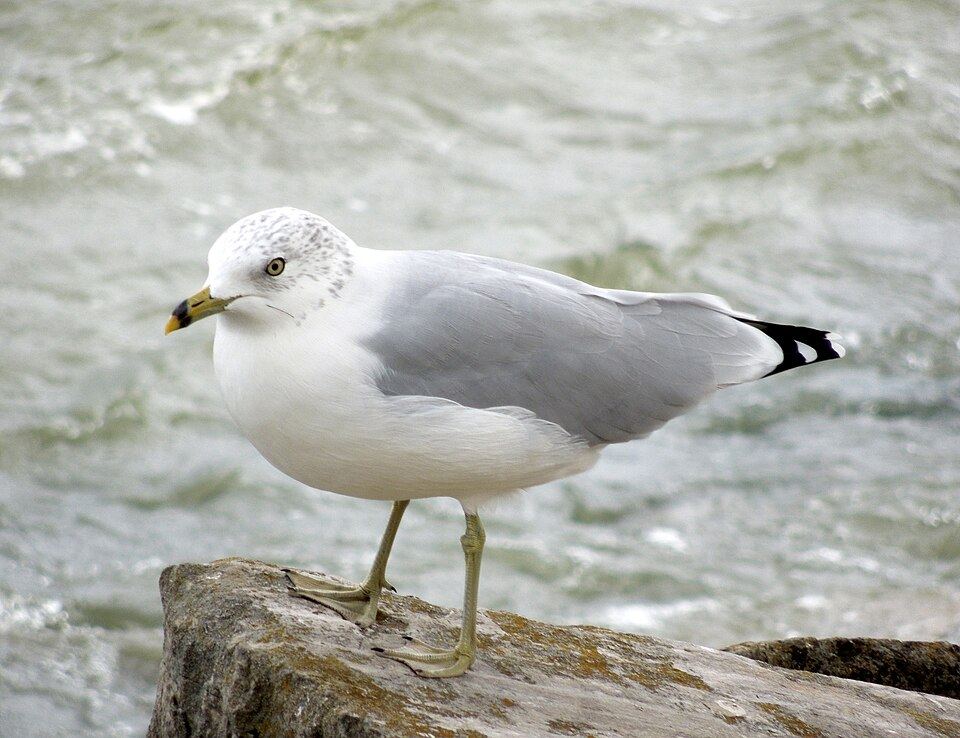
Photo: Robert & Pam from McClure · CC BY-SA 2.0 (May be cropped or resized)
Larus delawarensis
U.S. national list: unknown
Basic stats
Diet
Fish, invertebrates and carrion
Habitat
Coasts, lakes, rivers and urban open spaces
Range
Breeds across Canada and the northern United States; winters mainly in the United States and northern Mexico
Clutch size
3 eggs
Incubation period
About 21 days
Size
43–54cm
Wingspan
105–117cm
Weight
Averages about 516g
Ring-billed Gulls are medium in build, roughly 43–54 cm long with a 105–117 cm wingspan. Adults are white below and pale grey above, with black-tipped wings, yellow legs and a yellow bill crossed by a black ring. Younger birds pass through brown-patterned plumages before attaining adult appearance. AVONET gives an average mass of about 516 g, close to the AnAge value (Wikipedia, general species account; AVONET, Tobias et al. 2022; AnAge).
It breeds near lakes, rivers and coasts across Canada and the northern United States, wintering chiefly farther south in the United States and northern Mexico. Fish and invertebrates each supply 30% and carrion 20% of the EltonTraits diet profile. Colonies nest on islands, shorelines and sometimes flat roofs. AnAge reports three eggs and incubation lasting about 21 days (Wikipedia, general species account; EltonTraits, Wilman et al. 2014; AnAge).
Where to see Ring-billed Gull in the USA
GBIF records grouped by protected area. They show where the species has been reported, not that it is there now, and they are not population counts.
Recorded in 6,469 protected areas (1875–2026). The 8 with the most records:
- Pinelands National Reserve: 47,719 records (1925–2026)
- Gateway National Recreation Area: 40,409 records (1957–2026)
- Jamaica Bay Unit: 37,442 records (1957–2026)
- National Capital Parks-East: 36,399 records (1887–2026)
- Montezuma National Wildlife Refuge: 32,199 records (1942–2026)
- Jacques Cousteau National Estuarine Research Reserve: 29,764 records (1929–2026)
- Brigantine National Wildlife Refuge: 29,609 records (1939–2026)
- Edwin B. Forsythe National Wildlife Refuge: 28,884 records (1954–2026)
Quick answers
- What does the Ring-billed Gull eat?
- Fish, invertebrates and carrion
- What habitat does the Ring-billed Gull live in?
- Coasts, lakes, rivers and urban open spaces
- Where is the Ring-billed Gull found?
- Breeds across Canada and the northern United States; winters mainly in the United States and northern Mexico
- How many eggs does the Ring-billed Gull lay?
- 3 eggs
- How long are the eggs of the Ring-billed Gull incubated?
- About 21 days
- How big is the Ring-billed Gull?
- 43–54cm
- What is the wingspan of the Ring-billed Gull?
- 105–117cm
- How much does the Ring-billed Gull weigh?
- Averages about 516g