
 Wildlife
of USA
Laughing Gull
Gulls, Terns & Jaegers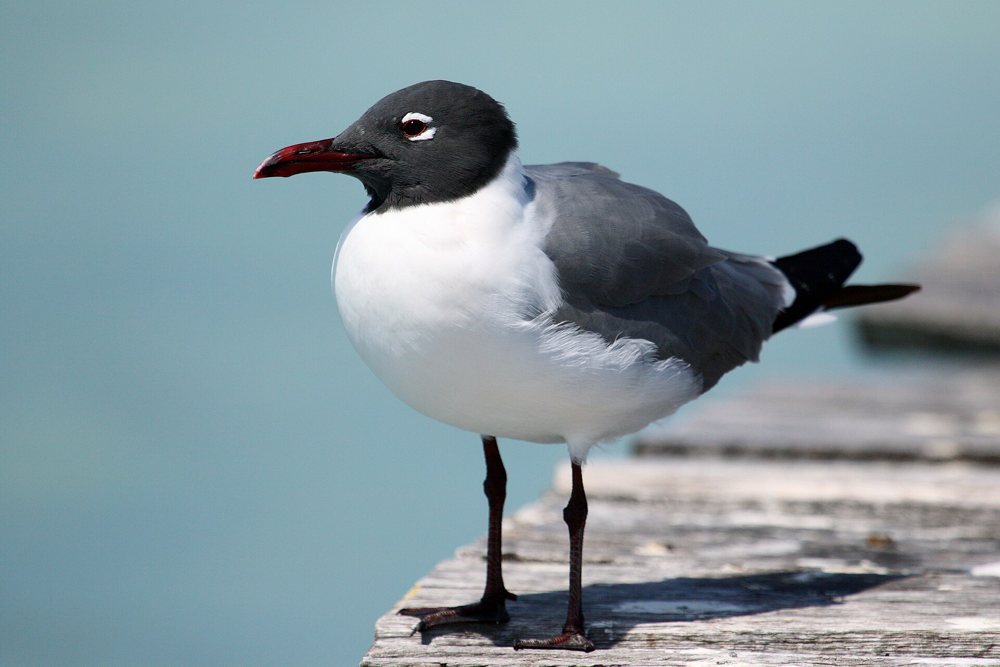
Photo: Cephas · CC BY-SA 4.0 (May be cropped or resized)
Leucophaeus atricilla
U.S. national list: unknown
Basic stats
Diet
Opportunistic omnivore and scavenger
Habitat
Coasts, estuaries and low coastal islands
Range
Atlantic shores from southeastern Canada through the Caribbean to northern South America
Clutch size
Averages about 3 eggs
Incubation period
Averages about 24 days
Size
36–41cm
Wingspan
98–110cm
Weight
Averages about 307g
The Laughing Gull is a medium-sized gull measuring 36–41 cm from bill to tail and 98–110 cm across the wings. Breeding adults have a black hood, white body, dark grey back and wings, black wingtips and a long red bill; the hood is largely lost in winter. Its raucous, laugh-like call gives the species its name. AVONET records an average mass of about 307 g (Wikipedia, general species account; AVONET, Tobias et al. 2022).
The species occurs along Atlantic coasts from southeastern Canada through the Caribbean to northern South America, with northern populations shifting south in winter. It frequents coastal waters, estuaries and low islands and feeds as an opportunistic omnivore and scavenger. Large colonies nest on coastal islands, where both sexes build with vegetation. AnAge gives averages of three eggs and 24 days of incubation (Wikipedia, general species account; AnAge; Collins Birds of the World).
Where to see Laughing Gull in the USA
GBIF records grouped by protected area. They show where the species has been reported, not that it is there now, and they are not population counts.
Recorded in 1,456 protected areas (1884–2026). The 8 with the most records:
- Pinelands National Reserve: 71,872 records (1892–2026)
- Florida Keys National Marine Sanctuary: 40,003 records (1921–2026)
- Jacques Cousteau National Estuarine Research Reserve: 37,485 records (1921–2026)
- Brigantine National Wildlife Refuge: 36,222 records (1921–2026)
- Edwin B. Forsythe National Wildlife Refuge: 36,220 records (1921–2026)
- Gateway National Recreation Area: 32,081 records (1956–2026)
- Jamaica Bay Unit: 30,664 records (1956–2026)
- Cape May Point State Park: 25,294 records (1920–2026)
Quick answers
- What does the Laughing Gull eat?
- Opportunistic omnivore and scavenger
- What habitat does the Laughing Gull live in?
- Coasts, estuaries and low coastal islands
- Where is the Laughing Gull found?
- Atlantic shores from southeastern Canada through the Caribbean to northern South America
- How many eggs does the Laughing Gull lay?
- Averages about 3 eggs
- How long are the eggs of the Laughing Gull incubated?
- Averages about 24 days
- How big is the Laughing Gull?
- 36–41cm
- What is the wingspan of the Laughing Gull?
- 98–110cm
- How much does the Laughing Gull weigh?
- Averages about 307g