
 Wildlife
of USA
Harlequin Duck
Waterfowl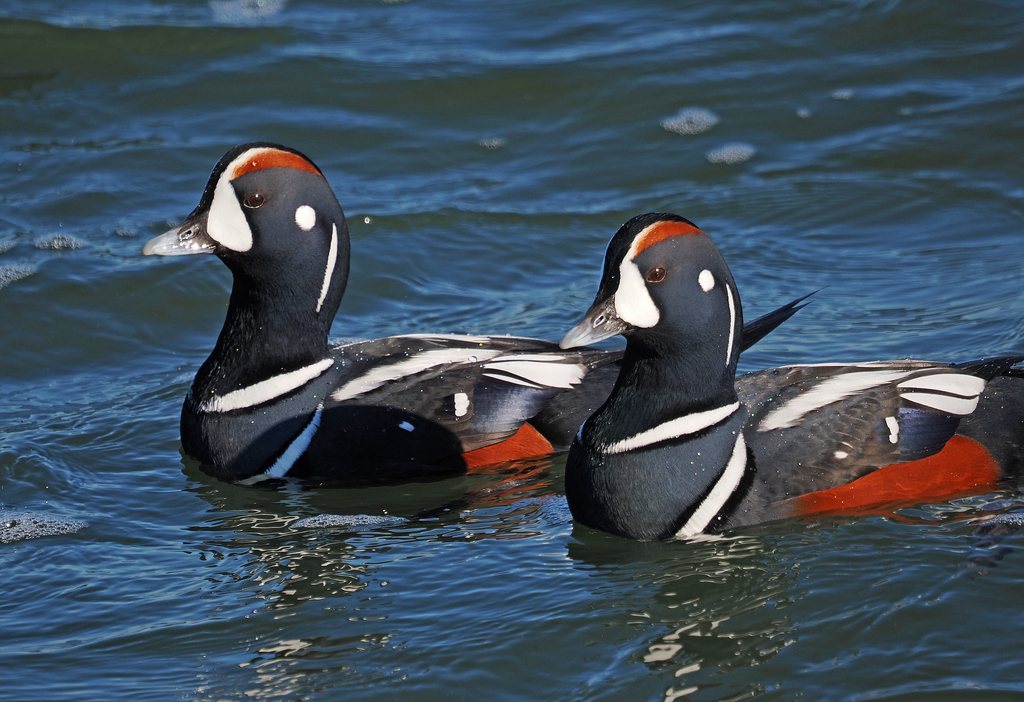
Photo: (c) Judy Gallagher, some rights reserved (CC BY-SA) · CC BY-SA 4.0 (May be cropped or resized)
Histrionicus histrionicus
U.S. national list: unknown
Basic stats
Diet
Molluscs, crustaceans and insects
Habitat
Fast streams and rocky coasts
Range
Northern North America, Greenland, Iceland and eastern Russia
Clutch size
About 6 eggs
Incubation period
About 28 days
Weight
Average 562g
The Harlequin Duck breeds beside cold, fast streams in northern North America, Greenland, Iceland and eastern Russia, and winters mostly along rocky coasts. Breeding males have slate-blue plumage patterned with white, black and chestnut; females are brownish-grey with pale facial patches. The male also has a long, pointed black tail. AVONET gives an average mass of 562 g (Wikipedia, general species account; AVONET, Tobias et al. 2022).
The duck dives or swims underwater to feed, and also dabbles. Its prey includes molluscs, crustaceans and insects. Nests are usually concealed on the ground near a stream. AnAge reports a clutch of about six eggs and an incubation period of about 28 days. Many birds winter near Atlantic and Pacific surf. They breed beside cold, swift water (Wikipedia, general species account; AnAge).
Where to see Harlequin Duck in the USA
GBIF records grouped by protected area. They show where the species has been reported, not that it is there now, and they are not population counts.
Recorded in 550 protected areas (1874–2026). The 8 with the most records:
- Pinelands National Reserve: 7,552 records (1934–2026)
- Halibut Point State Park: 4,778 records (1962–2026)
- Tongass National Forest: 4,328 records (1903–2026)
- Ocean Shore State Recreation Area: 4,284 records (1969–2026)
- Sachuest Point National Wildlife Refuge: 3,513 records (1967–2026)
- Alaska Maritime National Wildlife Refuge: 2,992 records (1911–2024)
- South Beach State Park: 2,984 records (1975–2026)
- Oregon Islands National Wildlife Refuge: 2,940 records (1930–2026)
Quick answers
- What does the Harlequin Duck eat?
- Molluscs, crustaceans and insects
- What habitat does the Harlequin Duck live in?
- Fast streams and rocky coasts
- Where is the Harlequin Duck found?
- Northern North America, Greenland, Iceland and eastern Russia
- How many eggs does the Harlequin Duck lay?
- About 6 eggs
- How long are the eggs of the Harlequin Duck incubated?
- About 28 days
- How much does the Harlequin Duck weigh?
- Average 562g