
 Wildlife
of USA
Eurasian Wigeon
Waterfowl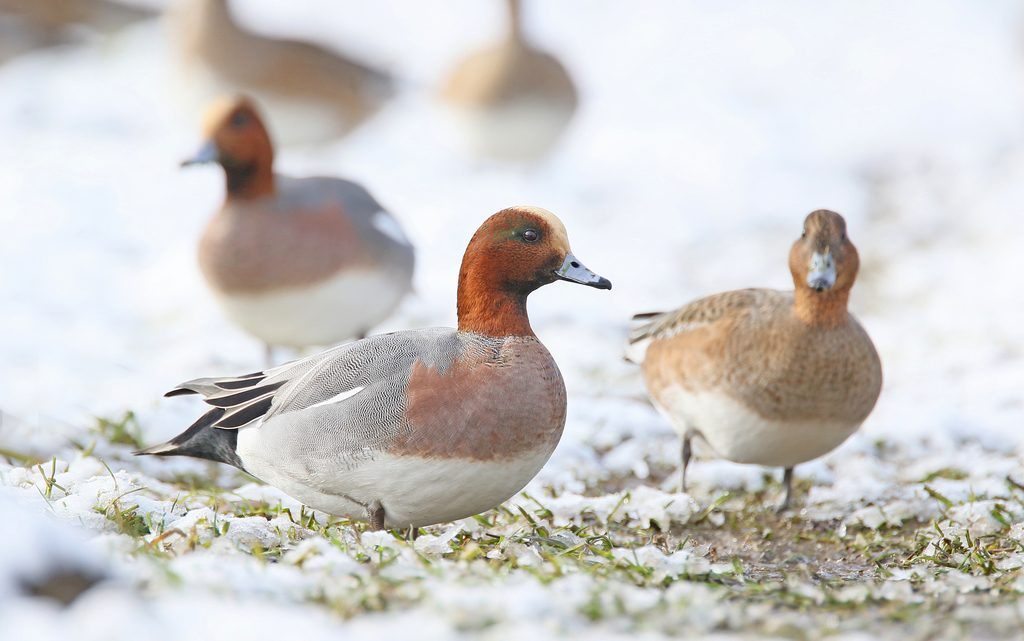
Photo: Christoph Moning · CC BY 4.0 (May be cropped or resized)
Mareca penelope
U.S. national list: unknown
Basic stats
Diet
Aquatic vegetation and seeds
Habitat
Lakes, marshes, flooded grassland, estuaries and sheltered coasts
Range
Breeds across northern Eurasia; winters in western Europe, Africa and southern Asia
Clutch size
Averages about 8 eggs
Incubation period
About 24 days
Weight
Averages about 770g
The Eurasian Wigeon is a compact dabbling duck with a short grey-blue bill. Breeding males have a chestnut head, creamy forehead, grey body and dark rear, while females are variably warm brown or grey-brown. Both sexes show a white belly, and males reveal bold white wing patches in flight. Its whistling call is a familiar feature of winter flocks (Wikipedia, general species account).
Across the Palearctic, the species breeds beside northern wetlands and migrates to milder waters in western Europe, Africa and southern Asia. It feeds heavily on aquatic plants and also takes seeds, grazing on damp grassland as well as dabbling in shallow water (EltonTraits, Wilman et al. 2014). AnAge reports an average clutch of eight eggs and incubation near 24 days. AVONET's mean mass is about 770 g, higher than the adult figure in AnAge (AnAge; AVONET, Tobias et al. 2022).
Where to see Eurasian Wigeon in the USA
GBIF records grouped by protected area. They show where the species has been reported, not that it is there now, and they are not population counts.
Recorded in 720 protected areas (1924–2026). The 8 with the most records:
- Cape May Point State Park: 7,220 records (1982–2024)
- Billy Frank Jr. Nisqually National Wildlife Refuge: 4,797 records (1926–2026)
- Arcata Marsh and Wildlife Sanctuary: 2,201 records (1968–2025)
- Colusa National Wildlife Refuge: 1,994 records (1977–2025)
- Greater Farallones National Marine Sanctuary: 1,791 records (1975–2024)
- Dungeness Wildlife Area: 1,532 records (1989–2024)
- Bolinas Lagoon Preserve: 1,256 records (1975–2024)
- Montezuma National Wildlife Refuge: 1,197 records (1963–2024)
Quick answers
- What does the Eurasian Wigeon eat?
- Aquatic vegetation and seeds
- What habitat does the Eurasian Wigeon live in?
- Lakes, marshes, flooded grassland, estuaries and sheltered coasts
- Where is the Eurasian Wigeon found?
- Breeds across northern Eurasia; winters in western Europe, Africa and southern Asia
- How many eggs does the Eurasian Wigeon lay?
- Averages about 8 eggs
- How long are the eggs of the Eurasian Wigeon incubated?
- About 24 days
- How much does the Eurasian Wigeon weigh?
- Averages about 770g