
 Wildlife
of USA
Great-tailed Grackle
Other Songbirds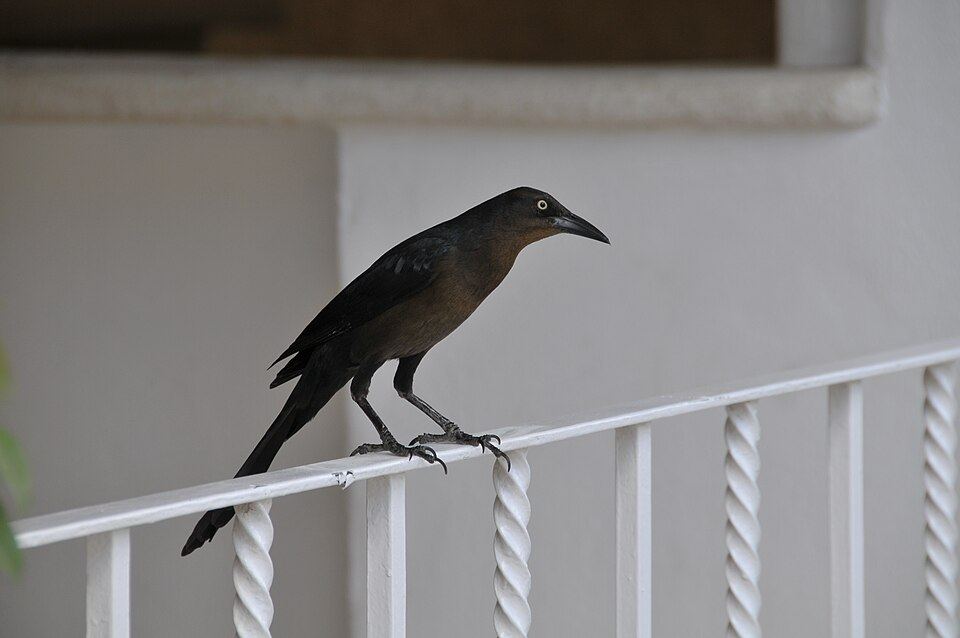
Photo: Chris Murray · CC BY 2.0 (May be cropped or resized)
Quiscalus mexicanus
U.S. national list: unknown
The great-tailed grackle (Quiscalus mexicanus), or Mexican grackle, is a social, medium-sized Icteridae passerine native to North and South America. It is one of ten living grackle species. It is close kin to the extinct slender-billed grackle and the boat-tailed grackle. In the southern and southwestern United States, people sometimes call it a blackbird or, incorrectly, a crow because of its glossy black plumage. Grackles belong to their own genus, separate from other blackbirds such as red-winged and Brewer’s blackbirds, despite sharing a family. Brewer’s blackbird is among the species that looks most similar. (Wikipedia, general species account)
In parts of Mexico, Spanish names for the bird translate as “raven” or “crow,” although it belongs neither to Corvus nor to the crow family Corvidae. It is larger than a starling but smaller than a crow, measuring 38–46 cm. Males weigh 203–265 g and females 115–142 g. Both sexes have long tails, and the wingspan is 48–58 cm. (Wikipedia, general species account)
Where to see Great-tailed Grackle in the USA
GBIF records grouped by protected area. They show where the species has been reported, not that it is there now, and they are not population counts.
Recorded in 1,329 protected areas (1901–2026). The 8 with the most records:
- Estero Llano Grande State Park: 27,755 records (2000–2026)
- Laguna Atascosa National Wildlife Refuge: 17,772 records (1962–2026)
- Patagonia Lake State Park: 17,199 records (1972–2026)
- Port Aransas Nature Preserve: 16,121 records (1978–2026)
- Tonto National Forest: 15,948 records (1973–2026)
- Santa Ana National Wildlife Refuge: 14,868 records (1968–2024)
- Hornsby Bend Ecological Research Area: 14,164 records (1967–2026)
- Santa Cruz River Park: 12,722 records (1938–2026)