
 Wildlife
of USA
White-rumped Shama
Other Songbirds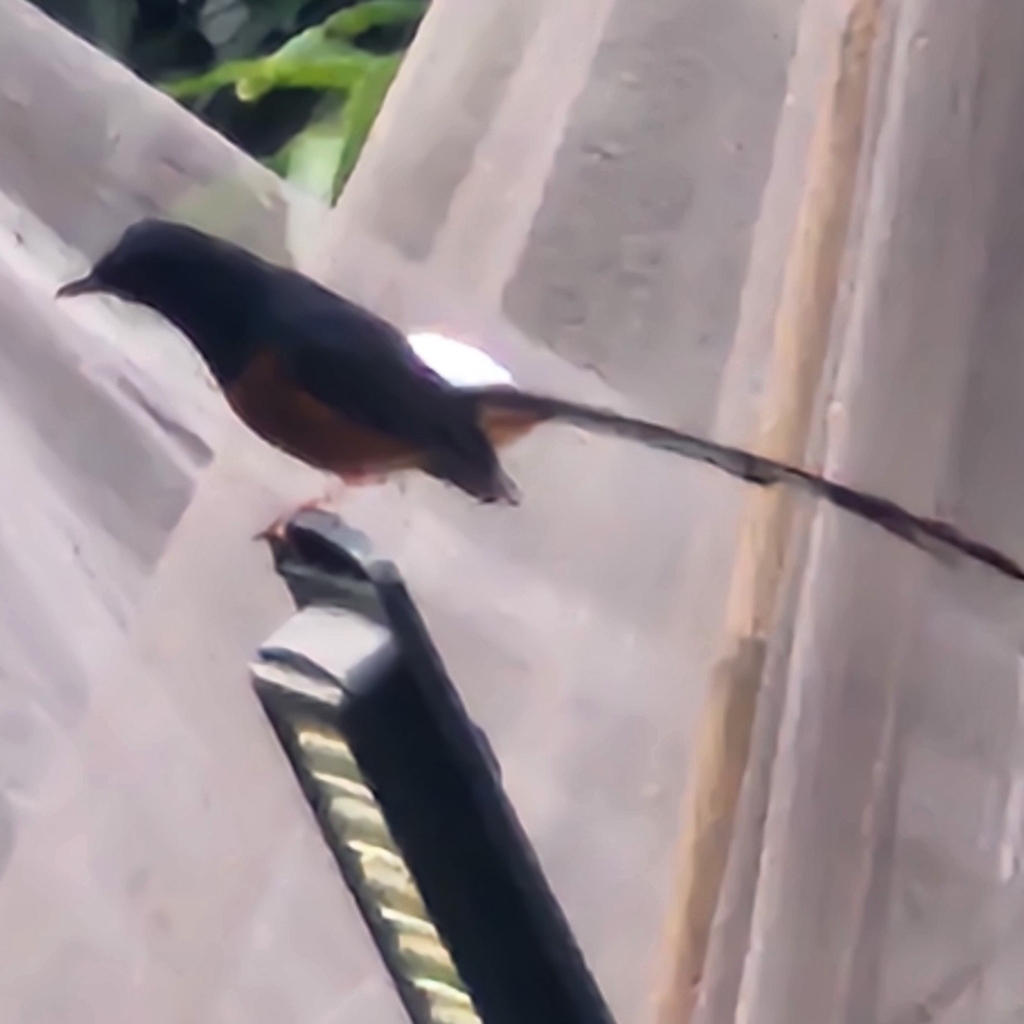
Photo: Lehmann (iNaturalist) · CC BY 4.0 (May be cropped or resized)
Copsychus malabaricus
U.S. national list: unknown
Basic stats
Diet
Invertebrates and fruit
Habitat
Dense undergrowth in scrub, secondary forest and bamboo
Range
Native to the Indian subcontinent and Southeast Asia, with introduced populations elsewhere
Clutch size
4–5 eggs
Incubation period
12–15 days
Size
23–28cm
Weight
Averages about 29g
The White-rumped Shama is a long-tailed forest songbird. A male combines glossy black plumage with chestnut underparts and conspicuous white on the rump and outer tail, whereas females are shorter and grey-brown. Juveniles resemble females but have a mottled breast. Both sexes have a dark bill and pink feet. The species measures 23–28 cm and averages about 29 g, and its rich song contains varied clear phrases (Wikipedia, general species account; AVONET, Tobias et al. 2022).
Native to the Indian subcontinent and Southeast Asia and introduced elsewhere, the species favours dense undergrowth in scrub, secondary forest and bamboo. Invertebrates dominate the diet, while fruit forms a substantial secondary share. The female builds a nest of roots, leaves and stems in a tree hollow while the male guards. She incubates the four or five eggs for 12–15 days, and both parents later provision the young (Wikipedia, general species account; EltonTraits, Wilman et al. 2014; AnAge).
Records of White-rumped Shama in the USA
This bird's natural range lies outside the USA (AviList v2026), so these are records of wandering, escaped or introduced birds, not places to expect it.
GBIF records grouped by protected area. They show where the species has been reported, not that it is there now, and they are not population counts.
Recorded in 50 protected areas (1968–2026). The 8 with the most records:
- Hawaiian Islands Humpback Whale National Marine Sanctuary: 4,312 records (1976–2026)
- Round Top Forest Reserve: 2,672 records (1968–2026)
- U.S. Naval Base, Pearl Harbor: 1,946 records (1979–2025)
- Kīlauea Point National Wildlife Refuge: 1,777 records (1976–2025)
- Koke'e State Park: 1,578 records (1982–2026)
- Pearl Harbor National Wildlife Refuge: 1,576 records (1990–2025)
- Na Pali-Kona: 1,451 records (1981–2024)
- Hanalei National Wildlife Refuge: 1,314 records (1982–2024)
Quick answers
- What does the White-rumped Shama eat?
- Invertebrates and fruit
- What habitat does the White-rumped Shama live in?
- Dense undergrowth in scrub, secondary forest and bamboo
- Where is the White-rumped Shama found?
- Native to the Indian subcontinent and Southeast Asia, with introduced populations elsewhere
- How many eggs does the White-rumped Shama lay?
- 4–5 eggs
- How long are the eggs of the White-rumped Shama incubated?
- 12–15 days
- How big is the White-rumped Shama?
- 23–28cm
- How much does the White-rumped Shama weigh?
- Averages about 29g