
 Wildlife
of USA
Eyebrowed Thrush
Other Songbirds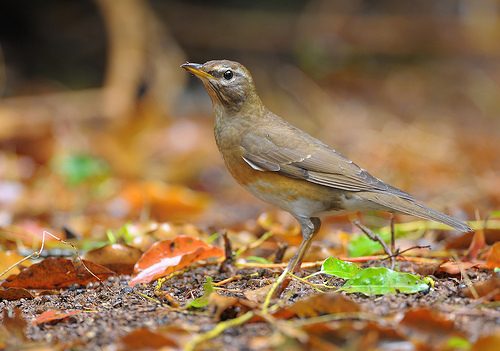
Photo: Robert tdc · CC BY-SA 4.0 (May be cropped or resized)
Turdus obscurus
U.S. national list: unknown
Basic stats
Diet
Fruit and invertebrates
Habitat
Coniferous forest and taiga when breeding; wooded habitats outside the breeding season
Range
Breeds from Siberia and Mongolia to Japan; winters in China and Southeast Asia
Clutch size
4–6 eggs
Weight
Averages about 63g
The Eyebrowed Thrush has a grey head and back, orange breast and flanks, and a clean white belly. Its dark eye-line is bordered by pale stripes above and below, producing the conspicuous facial pattern behind its name. Males and females are broadly alike, while immature birds have browner upperparts. The male's song is a simple sequence of whistles resembling that of the related Mistle Thrush (Wikipedia, general species account).
This strongly migratory thrush breeds in dense conifer forest and taiga from Siberia and Mongolia eastward to Japan, then spends winter farther south in China and Southeast Asia. Fruit provides the larger share of its recorded diet, supplemented by insects and earthworms (EltonTraits, Wilman et al. 2014; Wikipedia, general species account). Migrants and wintering birds often gather in small flocks. A neat tree nest contains 4–6 eggs (Wikipedia, general species account).
Quick answers
- What does the Eyebrowed Thrush eat?
- Fruit and invertebrates
- What habitat does the Eyebrowed Thrush live in?
- Coniferous forest and taiga when breeding; wooded habitats outside the breeding season
- Where is the Eyebrowed Thrush found?
- Breeds from Siberia and Mongolia to Japan; winters in China and Southeast Asia
- How many eggs does the Eyebrowed Thrush lay?
- 4–6 eggs
- How much does the Eyebrowed Thrush weigh?
- Averages about 63g