
 Wildlife
of USA
Spotted Sandpiper
Shorebirds & Sandpipers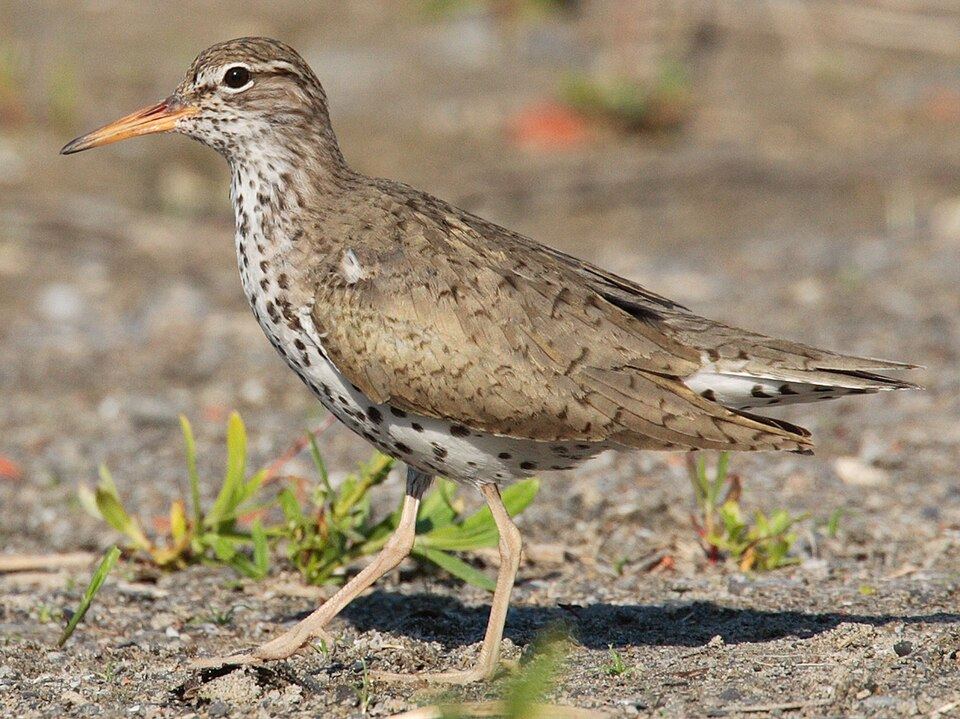
Photo: No machine-readable author provided. Factumquintus assumed (based on copyright claims). · CC BY-SA 3.0 (May be cropped or resized)
Actitis macularius
U.S. national list: unknown
Basic stats
Diet
Invertebrates and fish
Habitat
Freshwater shores, riverbanks and wetland margins
Range
Breeds across most of Canada and the United States; winters south to South America
Clutch size
Usually 4 eggs
Incubation period
About 20 days
Weight
Averages about 40g
The Spotted Sandpiper is a small shorebird with brown upperparts, white underparts and short yellowish legs. Breeding plumage carries bold dark spots below, while non-breeding birds become plain and resemble the Common Sandpiper. Its stiff-winged low flight and constant tail-bobbing walk are characteristic. AVONET gives an average mass of about 40 g (Wikipedia, general species account; AVONET, Tobias et al. 2022).
It breeds beside fresh water across much of Canada and the United States and winters from the southern United States through the Caribbean into South America. Birds forage mainly on the ground along wet margins. Invertebrates form 80% of the EltonTraits diet profile and fish 20%. Females commonly lay four eggs, while AnAge gives an average incubation period of about 20 days (Wikipedia, general species account; EltonTraits, Wilman et al. 2014; AnAge).
Where to see Spotted Sandpiper in the USA
GBIF records grouped by protected area. They show where the species has been reported, not that it is there now, and they are not population counts.
Recorded in 6,820 protected areas (1874–2026). The 8 with the most records:
- Pinelands National Reserve: 14,781 records (1896–2026)
- American River Parkway: 14,195 records (1970–2026)
- Estero Llano Grande State Park: 13,319 records (1991–2024)
- Hornsby Bend Ecological Research Area: 12,930 records (1961–2026)
- Monterey Bay National Marine Sanctuary: 10,829 records (1911–2026)
- Maine Coastal Islands National Wildlife Refuge: 10,314 records (1881–2026)
- Jacques Cousteau National Estuarine Research Reserve: 9,396 records (1928–2026)
- Brigantine National Wildlife Refuge: 9,169 records (1939–2026)
Quick answers
- What does the Spotted Sandpiper eat?
- Invertebrates and fish
- What habitat does the Spotted Sandpiper live in?
- Freshwater shores, riverbanks and wetland margins
- Where is the Spotted Sandpiper found?
- Breeds across most of Canada and the United States; winters south to South America
- How many eggs does the Spotted Sandpiper lay?
- Usually 4 eggs
- How long are the eggs of the Spotted Sandpiper incubated?
- About 20 days
- How much does the Spotted Sandpiper weigh?
- Averages about 40g