
 Wildlife
of USA
Rock Pigeon
Pigeons, Doves & Sandgrouse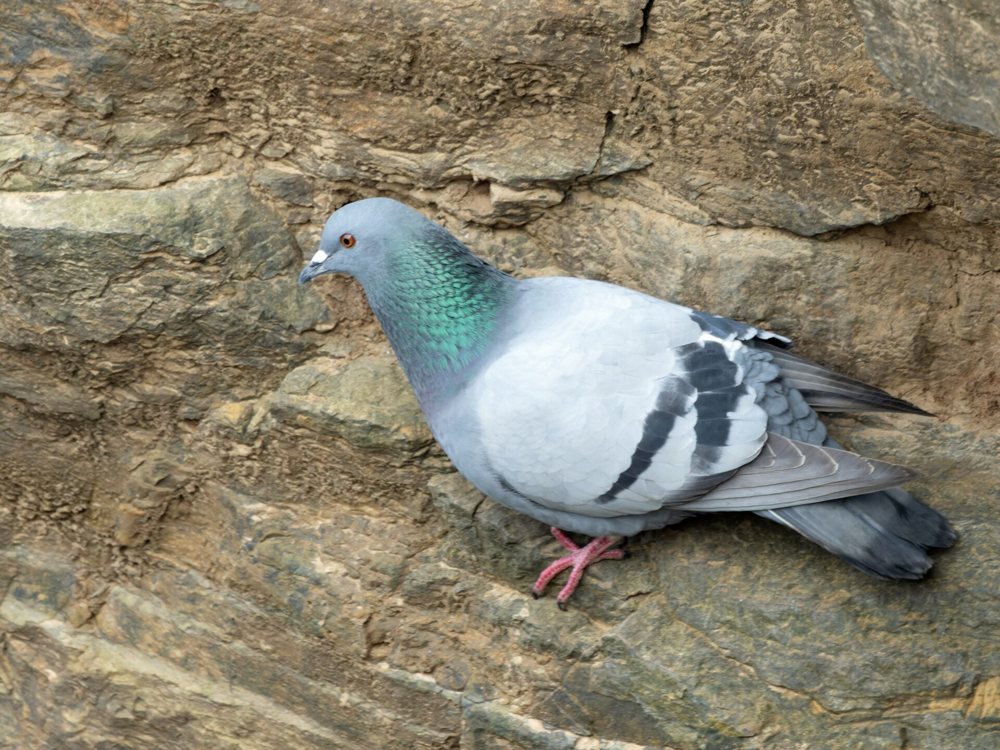
Photo: william_stephens · CC BY 4.0 (May be cropped or resized)
Columba livia
U.S. national list: unknown
Basic stats
Diet
Mostly seeds and other plant material, with some invertebrates
Habitat
Open and semi-open country, cliffs, rock ledges and human-modified settings
Range
Native wild populations from Europe and North Africa into western and southern Asia; domestic and feral descendants occur worldwide
Clutch size
Usually 2 eggs
Incubation period
About 18 days
Size
30–35cm
Wingspan
62–68cm
Weight
Averages about 354g
The Rock Pigeon is the wild ancestor of domestic pigeons and the feral birds now familiar in cities worldwide. Wild-type birds are pale bluish grey, with two dark bars on each wing, a black terminal tail band, an iridescent neck and a contrasting white lower back. They occupy open or semi-open places where they can forage on the ground, using cliffs and rocky ledges for roosting and nesting; buildings provide feral birds with similar structures. (Wikipedia, general species account)
Most of the species’ diet consists of seeds, supplemented by other plant matter and some invertebrates. The birds are mainly terrestrial foragers and are not considered migratory in the trait dataset. Body length is about 30–35 cm, while the spread wings measure 62–68 cm and AVONET reports a mean mass of about 354.2 g. AnAge gives a usual clutch of two and incubation of about 18 days. (EltonTraits, Wilman et al. 2014; AVONET, Tobias et al. 2022; AnAge; Wikipedia, general species account)
Where to see Rock Pigeon in the USA
GBIF records grouped by protected area. They show where the species has been reported, not that it is there now, and they are not population counts.
Recorded in 7,305 protected areas (1878–2026). The 8 with the most records:
- Monterey Bay National Marine Sanctuary: 50,008 records (1970–2026)
- National Capital Parks-East: 30,711 records (1901–2026)
- Gateway National Recreation Area: 24,673 records (1959–2026)
- Jamaica Bay Unit: 22,752 records (1959–2026)
- Golden Gate National Recreation Area: 15,758 records (1971–2026)
- Jones Beach State Park: 14,083 records (1959–2026)
- Bolsa Chica Ecological Reserve: 13,872 records (1969–2026)
- Florida Keys National Marine Sanctuary: 13,177 records (1964–2026)
Quick answers
- What does the Rock Pigeon eat?
- Mostly seeds and other plant material, with some invertebrates
- What habitat does the Rock Pigeon live in?
- Open and semi-open country, cliffs, rock ledges and human-modified settings
- Where is the Rock Pigeon found?
- Native wild populations from Europe and North Africa into western and southern Asia; domestic and feral descendants occur worldwide
- How many eggs does the Rock Pigeon lay?
- Usually 2 eggs
- How long are the eggs of the Rock Pigeon incubated?
- About 18 days
- How big is the Rock Pigeon?
- 30–35cm
- What is the wingspan of the Rock Pigeon?
- 62–68cm
- How much does the Rock Pigeon weigh?
- Averages about 354g