
 Wildlife
of USA
Zebra Dove
Pigeons, Doves & Sandgrouse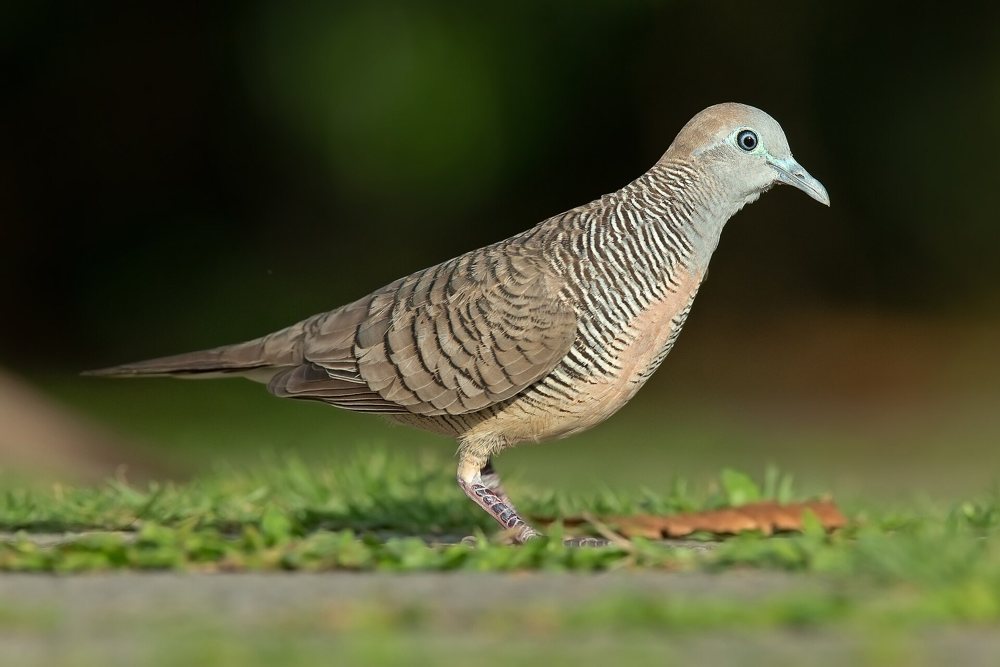
Photo: JJ Harrison ( https://tiny.jjharrison.com.au/t/1MF79Mf2vRuTfWFs ) · CC BY-SA 4.0 (May be cropped or resized)
Geopelia striata
U.S. national list: unknown
Basic stats
Diet
Mostly small seeds, with insects and other invertebrates
Habitat
Scrub, farmland, open lowlands, parks and gardens
Range
Native to Southeast Asia; introduced populations occur on many tropical islands
Clutch size
Usually 1–2 eggs
Incubation period
13–18 days
Size
20–23cm
Wingspan
24–26cm
Weight
Averages about 57g
The Zebra Dove is a small, slender ground dove with a long narrow tail. Brownish-grey upperparts and pinkish underparts are crossed by fine black-and-white bars. Its blue-grey face surrounds the eye with a patch of exposed blue skin. White tips mark the tail, and juveniles are duller and paler. Its gentle series of staccato coos is highly characteristic. Adults measure 20–23 cm, span 24–26 cm and average about 57 g (Wikipedia, general species account; AVONET, Tobias et al. 2022).
Across its native Southeast Asian range, the species inhabits scrub, farmland, parks, gardens and other open lowland settings; escaped and released birds have established populations on many tropical islands. It walks over bare ground, roads and short grass to collect small seeds, also eating insects and other invertebrates. A simple platform of leaves and grass is placed in a bush, tree or occasionally on the ground. One or two eggs are incubated by both parents for 13–18 days (Wikipedia, general species account; EltonTraits, Wilman et al. 2014).
Where to see Zebra Dove in the USA
GBIF records grouped by protected area. They show where the species has been reported, not that it is there now, and they are not population counts.
Recorded in 99 protected areas (1959–2026). The 8 with the most records:
- Hawaiian Islands Humpback Whale National Marine Sanctuary: 23,293 records (1971–2026)
- U.S. Naval Base, Pearl Harbor: 4,868 records (1972–2026)
- Kīlauea Point National Wildlife Refuge: 2,512 records (1977–2026)
- Pearl Harbor National Wildlife Refuge: 2,449 records (1982–2026)
- Keālia Pond National Wildlife Refuge: 2,418 records (1979–2026)
- James Campbell National Wildlife Refuge: 2,281 records (1976–2024)
- Round Top Forest Reserve: 2,154 records (1979–2026)
- Hanalei National Wildlife Refuge: 1,809 records (1980–2024)
Quick answers
- What does the Zebra Dove eat?
- Mostly small seeds, with insects and other invertebrates
- What habitat does the Zebra Dove live in?
- Scrub, farmland, open lowlands, parks and gardens
- Where is the Zebra Dove found?
- Native to Southeast Asia; introduced populations occur on many tropical islands
- How many eggs does the Zebra Dove lay?
- Usually 1–2 eggs
- How long are the eggs of the Zebra Dove incubated?
- 13–18 days
- How big is the Zebra Dove?
- 20–23cm
- What is the wingspan of the Zebra Dove?
- 24–26cm
- How much does the Zebra Dove weigh?
- Averages about 57g