
 Wildlife
of USA
Long-tailed Jaeger
Gulls, Terns & Jaegers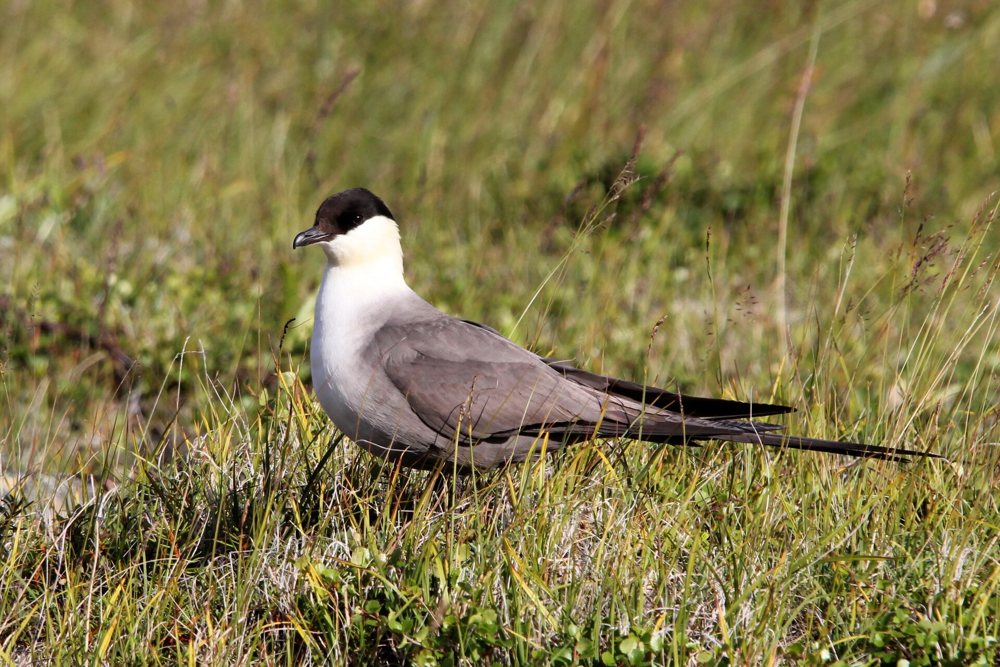
Photo: Svyatoslav Knyazev · CC BY 4.0 (May be cropped or resized)
Stercorarius longicaudus
U.S. national list: unknown
Basic stats
Diet
Small mammals, birds, insects and other animal prey
Habitat
Arctic tundra when breeding; open ocean outside the breeding season
Range
Breeds across the high Arctic of Eurasia and North America; disperses widely through the Atlantic and Pacific
Clutch size
Usually 2 eggs
Incubation period
About 23 days
Size
38–58cm
Wingspan
102–117cm
Weight
Averages about 288g
The Long-tailed Jaeger is the smallest and most lightly built jaeger, with narrow wings and exceptionally long central tail feathers in breeding adults. Adults have a dark cap, pale neck and underparts, grey upperparts and a dark breast band, while juveniles are browner and more heavily barred. Its buoyant flight can appear tern-like. Including the variable tail, it measures 38–58 cm, spans 102–117 cm and averages about 288 g (Wikipedia, general species account; AVONET, Tobias et al. 2022).
Across the high Arctic of Eurasia and North America, the species nests on open tundra, then spends the non-breeding season far out at sea in the Atlantic and Pacific. On breeding grounds it takes small mammals, birds and insects, with animal prey dominating its diet; at sea it also obtains food from the water and may harry other seabirds. Two eggs are usual, and incubation averages about 23 days (Wikipedia, general species account; EltonTraits, Wilman et al. 2014; AnAge).
Where to see Long-tailed Jaeger in the USA
GBIF records grouped by protected area. They show where the species has been reported, not that it is there now, and they are not population counts.
Recorded in 183 protected areas (1910–2026). The 8 with the most records:
- Monterey Bay National Marine Sanctuary: 8,422 records (1910–2026)
- National Petroleum Reserve–Alaska: 2,997 records (1932–2026)
- Yukon Delta National Wildlife Refuge: 1,591 records (1950–2024)
- Cordell Bank National Marine Sanctuary: 1,553 records (1986–2024)
- Arctic National Wildlife Refuge: 944 records (1912–2024)
- Denali National Park: 816 records (1969–2025)
- Denali Wilderness: 746 records (1969–2025)
- Greater Farallones National Marine Sanctuary: 637 records (1987–2024)
Quick answers
- What does the Long-tailed Jaeger eat?
- Small mammals, birds, insects and other animal prey
- What habitat does the Long-tailed Jaeger live in?
- Arctic tundra when breeding; open ocean outside the breeding season
- Where is the Long-tailed Jaeger found?
- Breeds across the high Arctic of Eurasia and North America; disperses widely through the Atlantic and Pacific
- How many eggs does the Long-tailed Jaeger lay?
- Usually 2 eggs
- How long are the eggs of the Long-tailed Jaeger incubated?
- About 23 days
- How big is the Long-tailed Jaeger?
- 38–58cm
- What is the wingspan of the Long-tailed Jaeger?
- 102–117cm
- How much does the Long-tailed Jaeger weigh?
- Averages about 288g