
 Wildlife
of USA
Roseate Tern
Gulls, Terns & Jaegers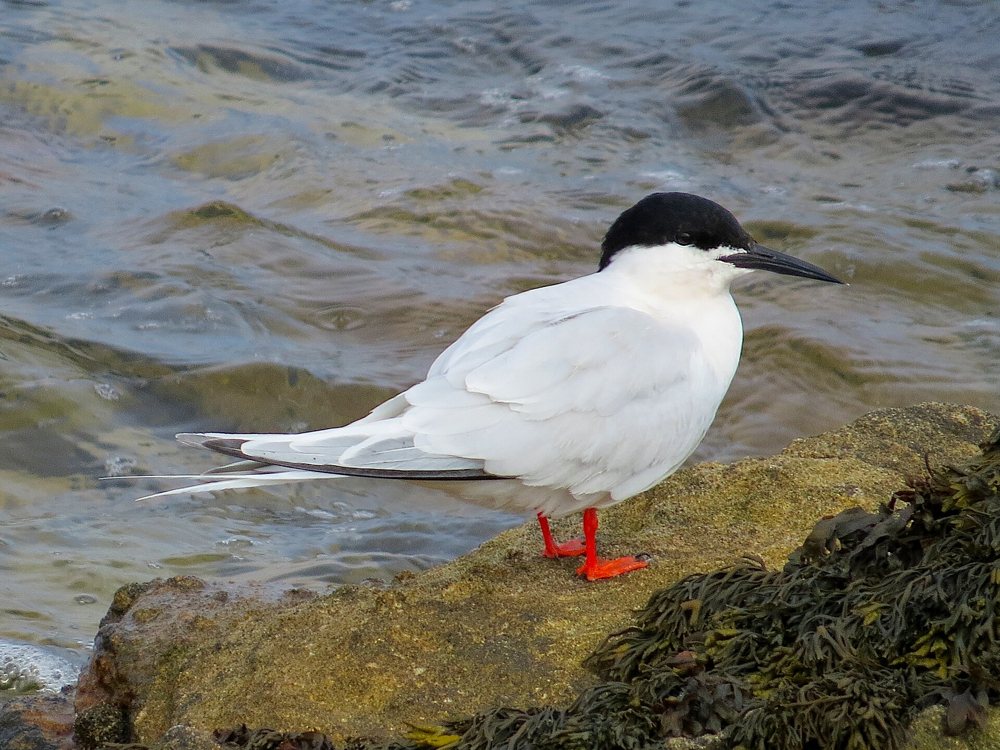
Photo: MPF · CC BY-SA 4.0 (May be cropped or resized)
Sterna dougallii
U.S. national list: unknown
Basic stats
Diet
Mostly marine fish
Habitat
Coasts and islands, nesting in colonies on open or vegetated ground
Range
Scattered tropical and temperate populations around the Atlantic, Indian and Pacific oceans
Clutch size
Usually 1–2 eggs
Incubation period
About 23 days
Size
33–36cm
Wingspan
67–76cm
Weight
Averages about 112g
The Roseate Tern is a slender, pale tern with a fine pointed bill and exceptionally long, flexible tail streamers. Breeding adults have a black cap, pale grey upperwings, orange-red legs and a subtle pink wash below; the bill develops red at its base as the season advances. In winter the forehead turns white and the bill darkens. It measures 33–36 cm, spans 67–76 cm and averages about 112 g (Wikipedia, general species account; AVONET, Tobias et al. 2022).
Across its scattered tropical and temperate range, the species is strongly marine and feeds mainly by plunge-diving for fish. It breeds colonially on coasts and islands, sometimes among other seabirds. The nest is a scrape placed on open ground, in a hollow or beneath dense vegetation. Most clutches contain one or two eggs, and incubation averages about 23 days. Adults are less aggressive in nest defence than several related terns (Wikipedia, general species account; EltonTraits, Wilman et al. 2014; AnAge).
Where to see Roseate Tern in the USA
GBIF records grouped by protected area. They show where the species has been reported, not that it is there now, and they are not population counts.
Recorded in 121 protected areas (1923–2026). The 8 with the most records:
- Monomoy National Wildlife Refuge: 2,676 records (1967–2024)
- Maine Coastal Islands National Wildlife Refuge: 1,911 records (1977–2025)
- Florida Keys National Marine Sanctuary: 1,872 records (1961–2026)
- Dry Tortugas National Park: 1,382 records (1971–2026)
- Rachel Carson National Wildlife Refuge: 1,229 records (1968–2024)
- Parker River National Wildlife Refuge: 1,055 records (1966–2026)
- Seal Island National Wildlife Refuge: 891 records (2000–2025)
- Monomoy Wilderness: 890 records (1967–2024)
Quick answers
- What does the Roseate Tern eat?
- Mostly marine fish
- What habitat does the Roseate Tern live in?
- Coasts and islands, nesting in colonies on open or vegetated ground
- Where is the Roseate Tern found?
- Scattered tropical and temperate populations around the Atlantic, Indian and Pacific oceans
- How many eggs does the Roseate Tern lay?
- Usually 1–2 eggs
- How long are the eggs of the Roseate Tern incubated?
- About 23 days
- How big is the Roseate Tern?
- 33–36cm
- What is the wingspan of the Roseate Tern?
- 67–76cm
- How much does the Roseate Tern weigh?
- Averages about 112g