
 Wildlife
of USA
Gray Catbird
Other Songbirds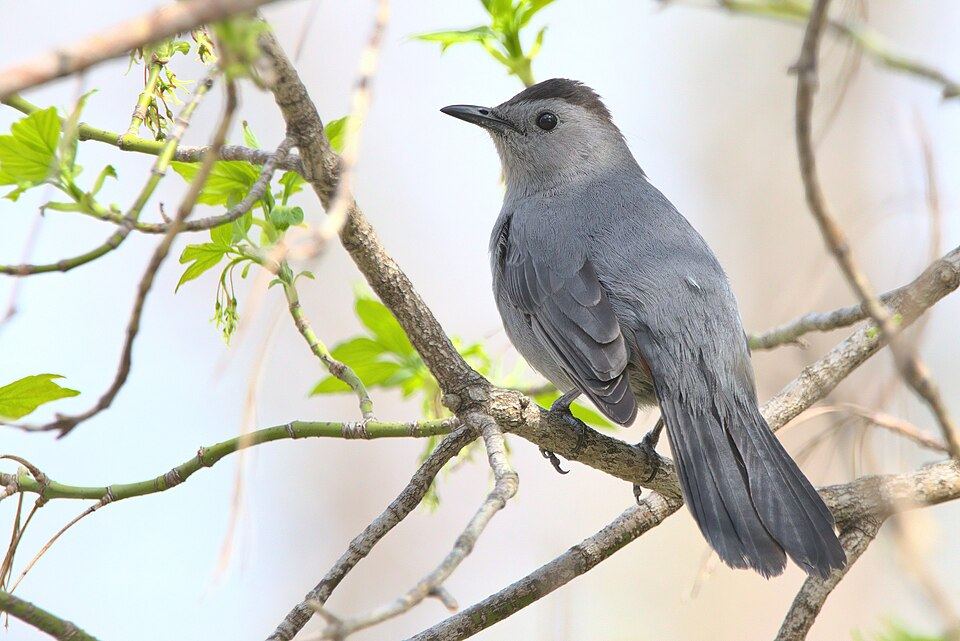
Photo: AMMuench · CC BY 4.0 (May be cropped or resized)
Dumetella carolinensis
U.S. national list: unknown
Basic stats
Diet
Arthropods and fruit (Wikipedia, general species account; EltonTraits, Wilman et al. 2014)
Habitat
Dense scrub, woodland edges, overgrown farmland, orchards, and berry-rich thickets (Wikipedia, general species account)
Range
Temperate North America east of the Rocky Mountains, with winter range in Mexico, Central America, and the Caribbean (Wikipedia, general species account)
Clutch size
4
Incubation period
13
Weight
35
Gray Catbirds breed across temperate North America east of the Rocky Mountains and migrate in winter to the southeastern United States and tropical wintering grounds. They favor dense vegetation, especially thorny scrub, woodland edges, overgrown farmland, abandoned orchards, and berry-rich thickets near water. AVONET gives an average mass of 35 g after rounding; AnAge lists 34.5 g (Wikipedia, general species account; AVONET, Tobias et al. 2022; AnAge).
Arthropods and fruit are the principal recorded foods. Birds forage on the ground, in shrubs, and in trees, and may feed heavily on berries during winter. A bulky cup nest is placed close to the ground in a shrub or tree. Clutches contain one to five eggs, most often two or three; AnAge gives four and an incubation value of 13 days (Wikipedia, general species account; EltonTraits, Wilman et al. 2014; AnAge).
Where to see Gray Catbird in the USA
GBIF records grouped by protected area. They show where the species has been reported, not that it is there now, and they are not population counts.
Recorded in 8,885 protected areas (1816–2026). The 8 with the most records:
- Pinelands National Reserve: 64,486 records (1862–2026)
- Parker River National Wildlife Refuge: 34,686 records (1963–2026)
- National Capital Parks-East: 28,120 records (1889–2026)
- Jacques Cousteau National Estuarine Research Reserve: 28,090 records (1951–2026)
- Edwin B. Forsythe National Wildlife Refuge: 27,834 records (1957–2026)
- Brigantine National Wildlife Refuge: 27,518 records (1951–2026)
- Everglades & Dry Tortugas: 26,909 records (1930–2026)
- Gateway National Recreation Area: 26,279 records (1961–2026)
Quick answers
- What does the Gray Catbird eat?
- Arthropods and fruit (Wikipedia, general species account; EltonTraits, Wilman et al. 2014)
- What habitat does the Gray Catbird live in?
- Dense scrub, woodland edges, overgrown farmland, orchards, and berry-rich thickets (Wikipedia, general species account)
- Where is the Gray Catbird found?
- Temperate North America east of the Rocky Mountains, with winter range in Mexico, Central America, and the Caribbean (Wikipedia, general species account)
- How many eggs does the Gray Catbird lay?
- 4
- How long are the eggs of the Gray Catbird incubated?
- 13
- How much does the Gray Catbird weigh?
- 35