
 Wildlife
of USA
Cedar Waxwing
Other Songbirds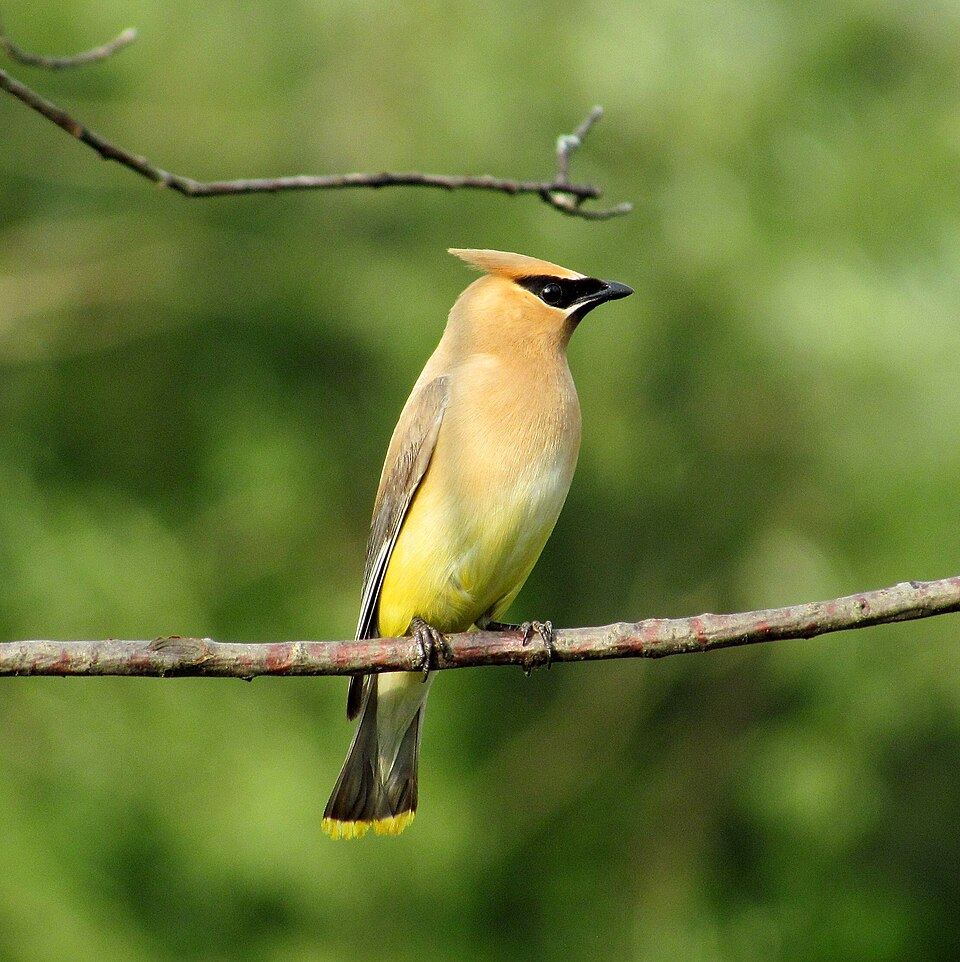
Photo: Jason Quinn · CC BY-SA 3.0 (May be cropped or resized)
Bombycilla cedrorum
U.S. national list: unknown
Basic stats
Diet
Fruit and insects
Habitat
Open woodland
Range
North and Central America
Clutch size
5–6 eggs
Incubation period
11–13 days
Size
About 15–18cm
Weight
Averages about 32g
The Cedar Waxwing is a medium-sized passerine with smooth brown, gray and yellow plumage. Some wing feathers carry red, wax-like tips, while the tail ends in a yellow band. It breeds in open wooded areas of southern Canada and the United States, then winters through the southern Central America, the northwestern edge of South America and the United States. Its average mass is about 32 g (Wikipedia, general species account; AVONET, Tobias et al. 2022).
Fruit is the dominant recorded food, including cedar cones and holly berries, with insects also taken. Open woodland supplies the setting for feeding and nesting, and birds may travel in groups between fruiting trees. The nest is a loose cup of grass and twigs supported on a branch, often 2–6 m above ground but sometimes higher. Clutches usually contain five or six eggs, incubated by the female for 11–13 days (EltonTraits, Wilman et al. 2014; Wikipedia, general species account).
Where to see Cedar Waxwing in the USA
GBIF records grouped by protected area. They show where the species has been reported, not that it is there now, and they are not population counts.
Recorded in 10,088 protected areas (1874–2026). The 8 with the most records:
- Adirondack Park: 24,929 records (1906–2026)
- Pinelands National Reserve: 20,214 records (1953–2026)
- Parker River National Wildlife Refuge: 19,599 records (1965–2026)
- Montgomery County Agricultural Reserve: 14,178 records (1963–2025)
- American River Parkway: 12,663 records (1970–2026)
- Gateway National Recreation Area: 12,378 records (1967–2026)
- Jamaica Bay Unit: 12,257 records (1967–2026)
- Montezuma National Wildlife Refuge: 11,583 records (1965–2026)
Quick answers
- What does the Cedar Waxwing eat?
- Fruit and insects
- What habitat does the Cedar Waxwing live in?
- Open woodland
- Where is the Cedar Waxwing found?
- North and Central America
- How many eggs does the Cedar Waxwing lay?
- 5–6 eggs
- How long are the eggs of the Cedar Waxwing incubated?
- 11–13 days
- How big is the Cedar Waxwing?
- About 15–18cm
- How much does the Cedar Waxwing weigh?
- Averages about 32g