
 Wildlife
of USA
American Dipper
Other Songbirds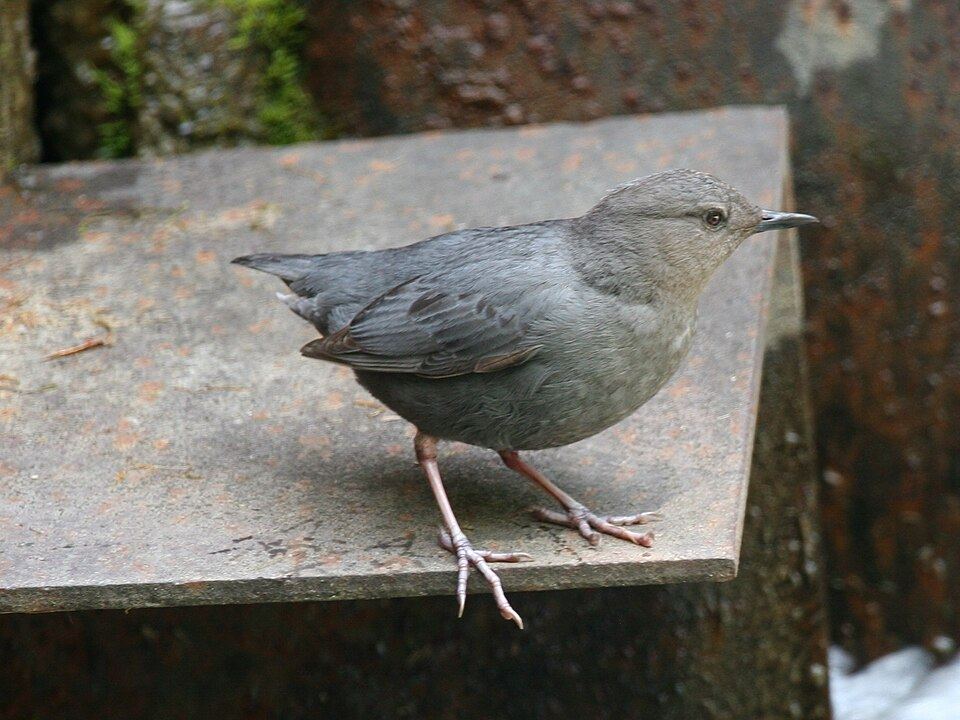
Photo: dominic sherony · CC BY-SA 2.0 (May be cropped or resized)
Cinclus mexicanus
U.S. national list: unknown
Basic stats
Diet
Invertebrates, fish and other aquatic prey
Habitat
Rivers, streams and rocky watercourses
Range
Western North and Central America
Clutch size
3–5 eggs
Incubation period
About 16 days
Size
About 18cm
Weight
Averages about 57g
The American Dipper is a compact, slate-gray songbird with a short tail and a characteristic habit of standing beside fast water. It occurs in western North and Central America, where rocky streams and rivers provide its setting. Its body is adapted to movement along wet margins, and the average mass is about 57 g. The species is often encountered singly along suitable watercourses (Wikipedia, general species account; AVONET, Tobias et al. 2022).
Aquatic invertebrates form the main food, with fish and other small aquatic prey also supported. The bird walks on stream margins and can forage below the surface, using rocks and shallow water rather than open ground. A nest is placed near running water; three to five eggs are laid and incubation lasts about 16 days. Its water-associated diet and habitat are central to the account (EltonTraits, Wilman et al. 2014; AnAge; Wikipedia, general species account).
Where to see American Dipper in the USA
GBIF records grouped by protected area. They show where the species has been reported, not that it is there now, and they are not population counts.
Recorded in 973 protected areas (1873–2026). The 8 with the most records:
- Wasatch–Cache National Forest: 5,811 records (1930–2026)
- Yellowstone National Park: 3,858 records (1875–2026)
- Glacier National Park: 3,321 records (1915–2026)
- Zion National Park: 3,217 records (1939–2026)
- Okanogan–Wenatchee National Forest: 3,204 records (1948–2025)
- Rocky Mountain National Park: 2,980 records (1947–2026)
- White River National Forest: 2,971 records (1948–2026)
- Roosevelt National Forest: 2,902 records (1882–2026)
Quick answers
- What does the American Dipper eat?
- Invertebrates, fish and other aquatic prey
- What habitat does the American Dipper live in?
- Rivers, streams and rocky watercourses
- Where is the American Dipper found?
- Western North and Central America
- How many eggs does the American Dipper lay?
- 3–5 eggs
- How long are the eggs of the American Dipper incubated?
- About 16 days
- How big is the American Dipper?
- About 18cm
- How much does the American Dipper weigh?
- Averages about 57g