
 Wildlife
of USA
Boreal Owl
Owls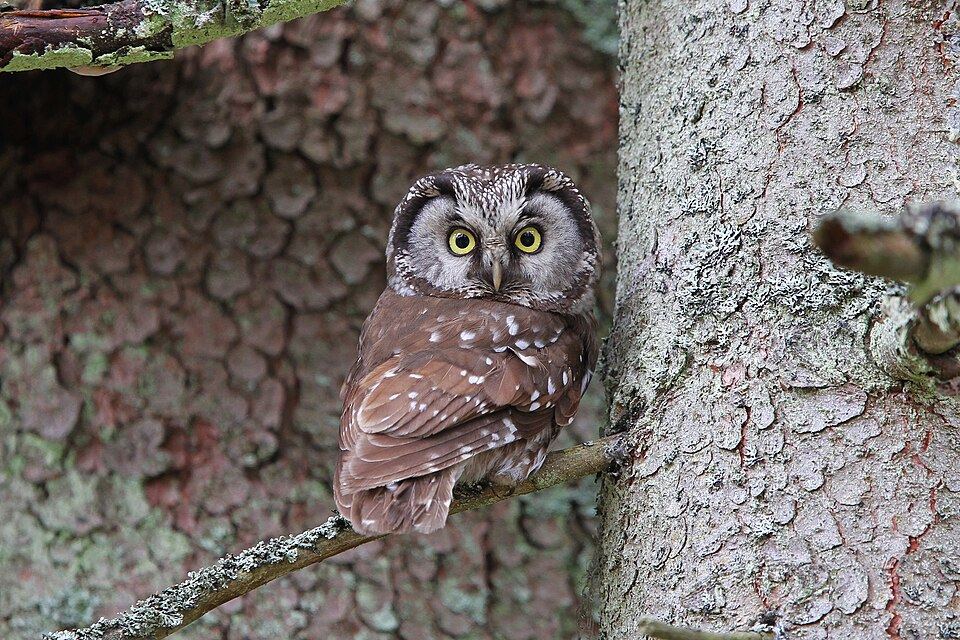
Photo: Christoph Moning · CC BY 4.0 (May be cropped or resized)
Aegolius funereus
U.S. national list: unknown
Basic stats
Diet
Small vertebrates and invertebrates
Habitat
Old boreal, subalpine and mixed forest
Range
Northern North America and Eurasia, with mountain populations farther south
Clutch size
Usually 3–7 eggs
Incubation period
About 27–29 days
Size
21–28cm
Wingspan
55–62cm
Weight
Averages about 137g
The Boreal Owl is a small, large-headed owl measuring 21–28 cm with a 55–62 cm wingspan. Brown upperparts carry conspicuous white spots, while pale underparts are streaked rusty brown. Yellow eyes sit within a whitish facial disc bordered dark. Females are larger than males. AVONET records an average mass of about 137 g, above the AnAge adult value (Wikipedia, general species account; AVONET, Tobias et al. 2022; AnAge).
It inhabits old boreal, subalpine and mixed forests across northern North America and Eurasia, with southern populations in mountain ranges. Small vertebrates contribute 70% and invertebrates 30% to the EltonTraits diet profile. This nocturnal owl hunts mainly near the ground, aided by asymmetrical ears. It nests in old woodpecker holes or boxes; three to seven eggs are usual and the female incubates for roughly 27–29 days (Wikipedia, general species account; EltonTraits, Wilman et al. 2014).
Where to see Boreal Owl in the USA
GBIF records grouped by protected area. They show where the species has been reported, not that it is there now, and they are not population counts.
Recorded in 112 protected areas (1945–2026). The 8 with the most records:
- State Forest State Park: 523 records (1981–2024)
- Chugach National Forest: 228 records (1969–2023)
- Roosevelt National Forest: 228 records (1981–2024)
- Wasatch–Cache National Forest: 185 records (1999–2024)
- Lake Superior State Forest - Newberry Unit: 174 records (1966–2024)
- Routt National Forest: 145 records (1981–2024)
- Grand Mesa National Forest: 136 records (1985–2024)
- Colville National Forest: 135 records (1986–2024)
Quick answers
- What does the Boreal Owl eat?
- Small vertebrates and invertebrates
- What habitat does the Boreal Owl live in?
- Old boreal, subalpine and mixed forest
- Where is the Boreal Owl found?
- Northern North America and Eurasia, with mountain populations farther south
- How many eggs does the Boreal Owl lay?
- Usually 3–7 eggs
- How long are the eggs of the Boreal Owl incubated?
- About 27–29 days
- How big is the Boreal Owl?
- 21–28cm
- What is the wingspan of the Boreal Owl?
- 55–62cm
- How much does the Boreal Owl weigh?
- Averages about 137g