
 Wildlife
of USA
Western Barn Owl
Owls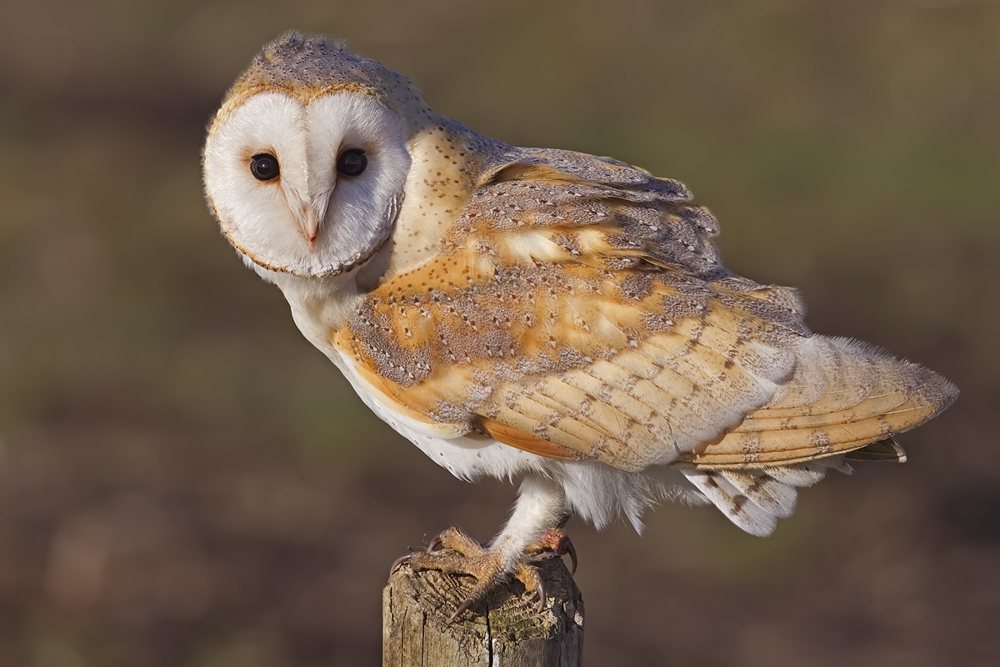
Photo: Steven Ward · CC BY 2.0 (May be cropped or resized)
Tyto alba
U.S. national list: unknown
Basic stats
Diet
Mostly small mammals, with some birds and invertebrates
Habitat
Farmland, grassland and other open human-modified landscapes
Range
Europe, southwestern Asia and Africa
Clutch size
6 eggs
Incubation period
33 days
Size
About 33–35cm
Wingspan
80–95cm
Weight
Averages about 403g
The Western Barn Owl is a pale, medium-sized owl with long wings, a short square tail and a large heart-shaped facial disc. Its upperparts vary from grey to brown, while the underparts range from white to brown and may carry dark speckles. Fine structures along the flight feathers reduce turbulence and make its wingbeats quiet. Instead of hooting, the species gives a drawn-out, piercing screech (Wikipedia, general species account).
Across Europe, southwestern Asia and Africa, it hunts mainly over open ground in farmland and other modified landscapes. Most activity is nocturnal, although daytime hunting occurs in some parts of the range. Acute hearing, aided by asymmetrically placed ears and the facial disc, lets it locate ground prey by sound. Small mammals dominate the diet, with birds and invertebrates taken less often (EltonTraits, Wilman et al. 2014; Wikipedia, general species account).
Records of Western Barn Owl in the USA
This bird's natural range lies outside the USA (AviList v2026), so these are records of wandering, escaped or introduced birds, not places to expect it.
GBIF records grouped by protected area. They show where the species has been reported, not that it is there now, and they are not population counts.
Recorded in 24 protected areas (1953–2018). The 8 with the most records:
- Morley Nelson Snake River Birds of Prey National Conservation Area: 45 records (2004–2016)
- San Joaquin River National Wildlife Refuge: 11 records (2001–2004)
- Channel Islands National Park: 8 records (1976–2012)
- Minidoka National Wildlife Refuge: 8 records (2013–2016)
- Channel Islands National Marine Sanctuary: 7 records (1976–2012)
- Cloverdale Coastal Ranches: 6 records (1999–2007)
- Mohonk Preserve: 6 records (1953–2003)
- Santa Monica Mountains National Recreation Area: 6 records (1978–2003)
Quick answers
- What does the Western Barn Owl eat?
- Mostly small mammals, with some birds and invertebrates
- What habitat does the Western Barn Owl live in?
- Farmland, grassland and other open human-modified landscapes
- Where is the Western Barn Owl found?
- Europe, southwestern Asia and Africa
- How many eggs does the Western Barn Owl lay?
- 6 eggs
- How long are the eggs of the Western Barn Owl incubated?
- 33 days
- How big is the Western Barn Owl?
- About 33–35cm
- What is the wingspan of the Western Barn Owl?
- 80–95cm
- How much does the Western Barn Owl weigh?
- Averages about 403g