
 Wildlife
of USA
Long-eared Owl
Owls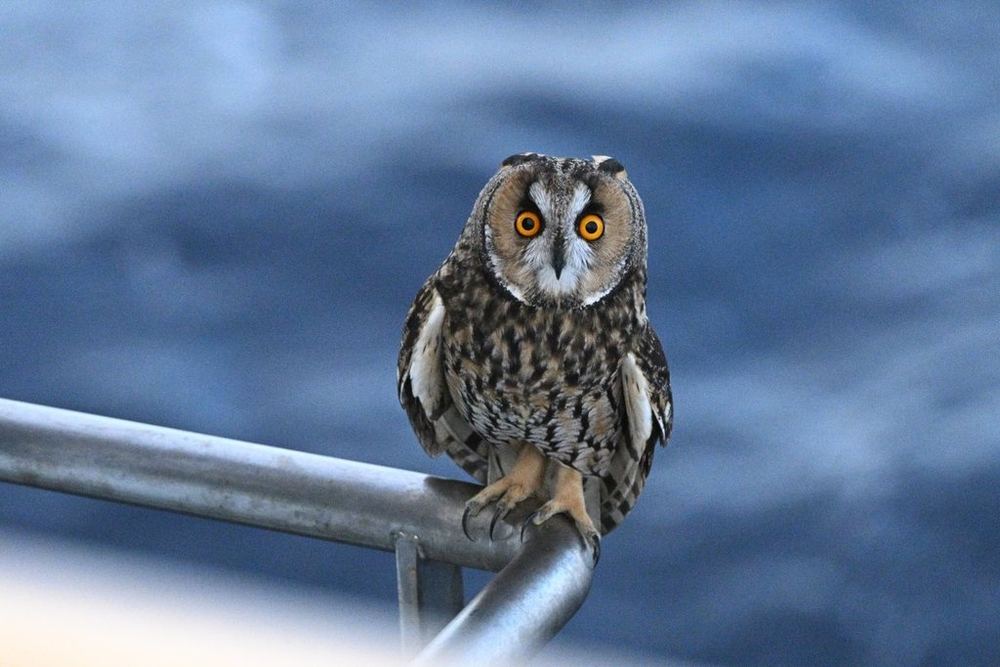
Photo: (c) Charlotte Kirchner, some rights reserved (CC BY) · CC BY 4.0 (May be cropped or resized)
Asio otus
U.S. national list: unknown
Basic stats
Diet
Small mammals, especially rodents
Habitat
Woodland edge and dense groves beside open hunting ground
Range
Europe, Asia and North America
Clutch size
Averages about 4–5 eggs
Incubation period
About 27 days
Size
31–40cm
Wingspan
86–102cm
Weight
Averages about 297g
The Long-eared Owl is a slim, long-winged owl with tall central ear tufts, orange eyes and finely patterned tawny-brown plumage. The facial disc is strongly developed, and females are generally larger than males. Adults measure 31–40 cm, span 86–102 cm and average roughly 297 g. Its soft flight and mottled colours suit a nocturnal hunter that roosts by day in dense cover (Wikipedia, general species account; AVONET, Tobias et al. 2022).
Across Europe, Asia and North America, the species favours woodland edges or dense groves beside open hunting ground. Small mammals, especially voles and other rodents, dominate its diet. It commonly adopts an old nest built by a crow or another bird rather than making its own. AnAge reports an average clutch of about four to five eggs and incubation near 27 days. Outside breeding, several owls may share a traditional roost (Wikipedia, general species account; EltonTraits, Wilman et al. 2014; AnAge).
Where to see Long-eared Owl in the USA
GBIF records grouped by protected area. They show where the species has been reported, not that it is there now, and they are not population counts.
Recorded in 16 protected areas (1904–2026). The 8 with the most records:
- Humboldt–Toiyabe National Forest: 15 records (1923–2006)
- Inyo National Forest: 13 records (1915–2025)
- Salisbury Salt Marsh Wildlife Management Area: 10 records (2023–2026)
- Anza-Borrego Desert State Park: 6 records (1974–1994)
- Great Swamp National Wildlife Refuge: 6 records (2009)
- Anza-Borrego Desert State Wilderness: 5 records (1974–1994)
- Pinelands National Reserve: 5 records (1961–1963)
- Santa Rosa and San Jacinto Mountains National Monument: 5 records (1908–2012)
Quick answers
- What does the Long-eared Owl eat?
- Small mammals, especially rodents
- What habitat does the Long-eared Owl live in?
- Woodland edge and dense groves beside open hunting ground
- Where is the Long-eared Owl found?
- Europe, Asia and North America
- How many eggs does the Long-eared Owl lay?
- Averages about 4–5 eggs
- How long are the eggs of the Long-eared Owl incubated?
- About 27 days
- How big is the Long-eared Owl?
- 31–40cm
- What is the wingspan of the Long-eared Owl?
- 86–102cm
- How much does the Long-eared Owl weigh?
- Averages about 297g