
 Wildlife
of USA
Big Brown Bat
Bats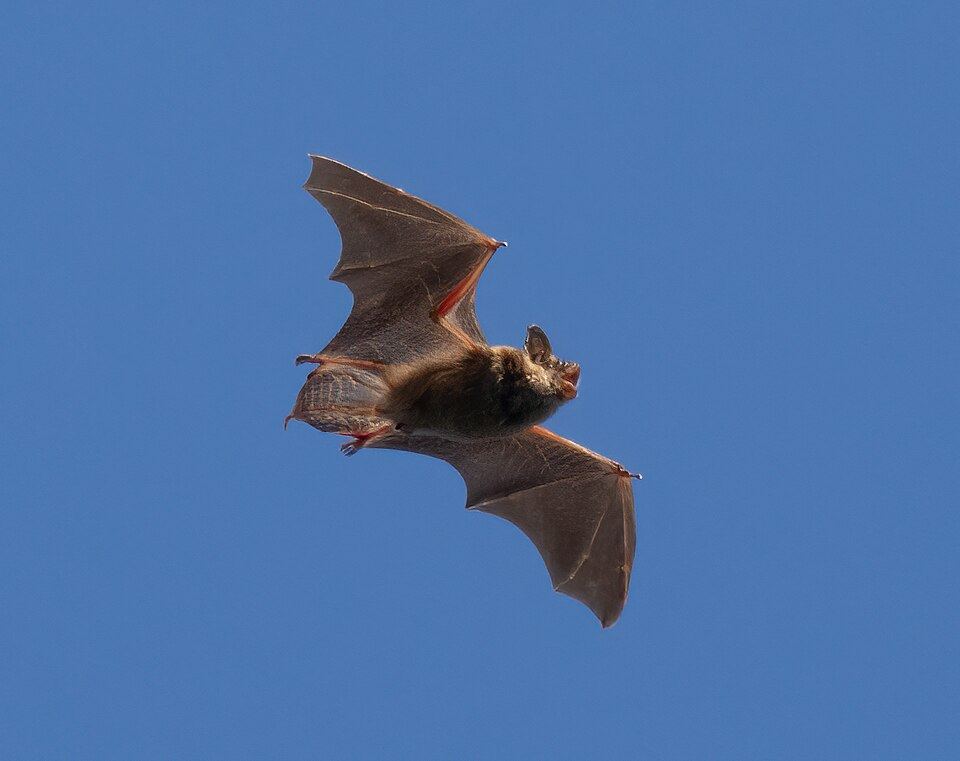
Photo: Rhododendrites · CC BY-SA 4.0 (May be cropped or resized)
Eptesicus fuscus
U.S. national list: unknown
Basic stats
Diet
Mainly beetles and other night-flying insects
Habitat
Adaptable generalist; roosts in caves, tunnels, tree cavities and buildings
Range
North America, the Caribbean and northern South America
Litter size
Usually one, twins common in the eastern US
Size
Adult body length 110–130mm
Weight
15–26g
The big brown bat is a relatively large microbat, first described in 1796, with a wingspan of 32.5–35cm and a weight of 15–26g. Adult body length is 110–130mm, and the tail measures 47–52mm. Its dorsal fur is reddish brown and glossy, and its underside is lighter brown. The snout, wing membranes and uropatagium are black and hairless, and the short, rounded ears are black and 12–13mm long. It has a robust skull, about 19.25mm long, with large upper incisors (Wikipedia, general species account).
It is widely distributed across North America, the Caribbean and northern South America, reaching as far south as Colombia and Venezuela. It is adaptable and considered a generalist. It mainly eats beetles and other night-flying insects, including agricultural pests such as cucumber beetles. It roosts by day in caves, tunnels, tree cavities and human structures. Breeding takes place in the autumn before hibernation, and in spring females form maternity colonies, usually producing one young per litter, though twins are common in the eastern US (Wikipedia, general species account).
Where to see Big Brown Bat in the USA
GBIF records grouped by protected area. They show where the species has been reported, not that it is there now, and they are not population counts.
Recorded in 166 protected areas (1870–2026). The 8 with the most records:
- Rocky Mountain Arsenal National Wildlife Refuge: 151 records (1997–1998)
- Coronado National Forest: 139 records (1893–2023)
- Gila National Forest: 133 records (1908–2024)
- Cibola National Forest: 118 records (1951–2020)
- Dinosaur National Monument: 73 records (1948–1990)
- Custer–Gallatin National Forest: 54 records (1949–1970)
- Carson National Forest: 48 records (1928–2024)
- San Bernardino National Forest: 48 records (1885–2012)
Quick answers
- What does the Big Brown Bat eat?
- Mainly beetles and other night-flying insects
- What habitat does the Big Brown Bat live in?
- Adaptable generalist; roosts in caves, tunnels, tree cavities and buildings
- Where is the Big Brown Bat found?
- North America, the Caribbean and northern South America
- What is the litter size of the Big Brown Bat?
- Usually one, twins common in the eastern US
- How big is the Big Brown Bat?
- Adult body length 110–130mm
- How much does the Big Brown Bat weigh?
- 15–26g