
 Wildlife
of USA
Desert Red Bat
Bats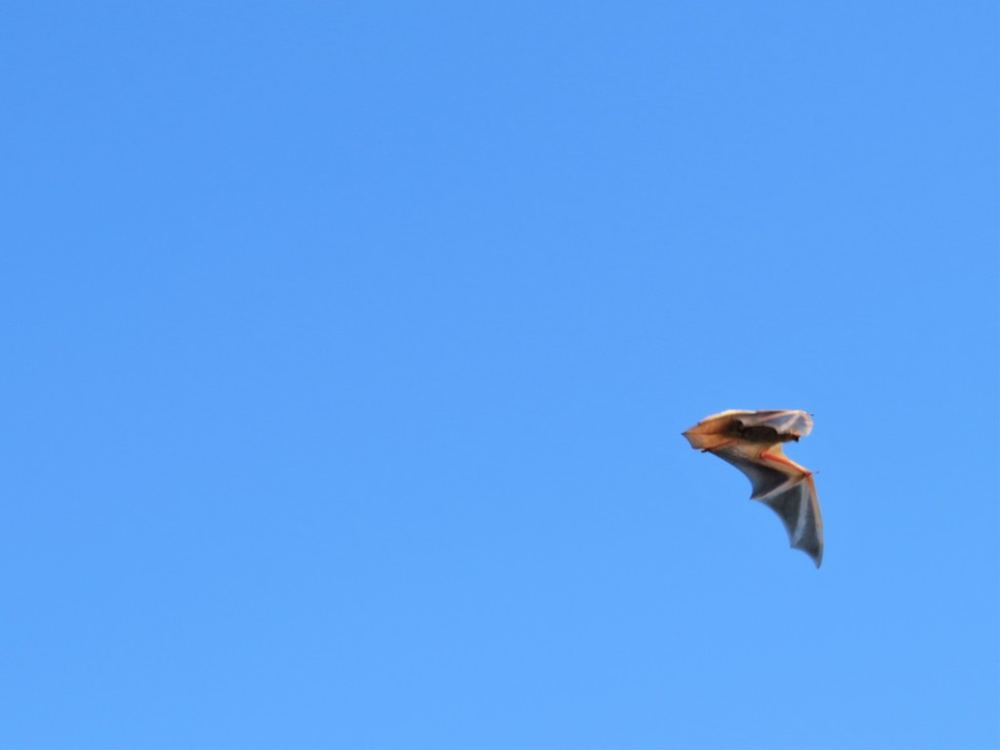
Photo: Linzy L. · CC BY-SA (May be cropped or resized)
Lasiurus frantzii
U.S. national list: unknown
Basic stats
Diet
Moths, flies, true bugs, beetles and cicadas
Habitat
Rainforest, dry tropical and deciduous forest, and xeric shrubland, 30–3,200m
Range
Western North America to Central America
Litter size
Up to four pups
Size
Head and body 49–65mm, tail 45–57mm
The desert red bat is a microbat in the family Vespertilionidae. Its fur is dense and long, dark reddish to brown, with some white wash, and the dorsal hairs have blackish bases and rufous red tips. The underparts are paler, with yellowish white patches on each shoulder that are often linked by a white collar. Its ears are short and rounded, and dense fur covers roughly two-thirds of the tail membrane. Head and body measure 49–65mm and tail 45–57mm (Wikipedia, general species account; GBIF description, Vespertilionidae).
It is found from southern Canada through the western United States to Central America, and it is a migratory solitary species that roosts in tree foliage. In winter it moves south and in summer north, and it hibernates under leaves in forests. Its food is moths, flies, true bugs, beetles and cicadas, and predators include owls, blue jays, raccoons and opossums. Mating happens in August and September, and pups are born about 90 days later. Litters of up to four pups are carried by the mother until they can fly, which takes up to six weeks, and maturity takes one to three years (Wikipedia, general species account).
Where to see Desert Red Bat in the USA
GBIF records grouped by protected area. They show where the species has been reported, not that it is there now, and they are not population counts.
Recorded in 6 protected areas (1894–2024).
- Coronado National Forest: 12 records (1894–2024)
- San Joaquin River National Wildlife Refuge: 6 records (1931–1933)
- Chiricahua Wilderness: 4 records (1894–1958)
- Point Reyes National Seashore: 4 records (1949–1970)
- Greater Farallones National Marine Sanctuary: 3 records (1949–1970)
- Los Padres National Forest: 3 records (1912–2021)
Quick answers
- What does the Desert Red Bat eat?
- Moths, flies, true bugs, beetles and cicadas
- What habitat does the Desert Red Bat live in?
- Rainforest, dry tropical and deciduous forest, and xeric shrubland, 30–3,200m
- Where is the Desert Red Bat found?
- Western North America to Central America
- What is the litter size of the Desert Red Bat?
- Up to four pups
- How big is the Desert Red Bat?
- Head and body 49–65mm, tail 45–57mm