
 Wildlife
of USA
Yellow-billed Loon
Seabirds & Cormorants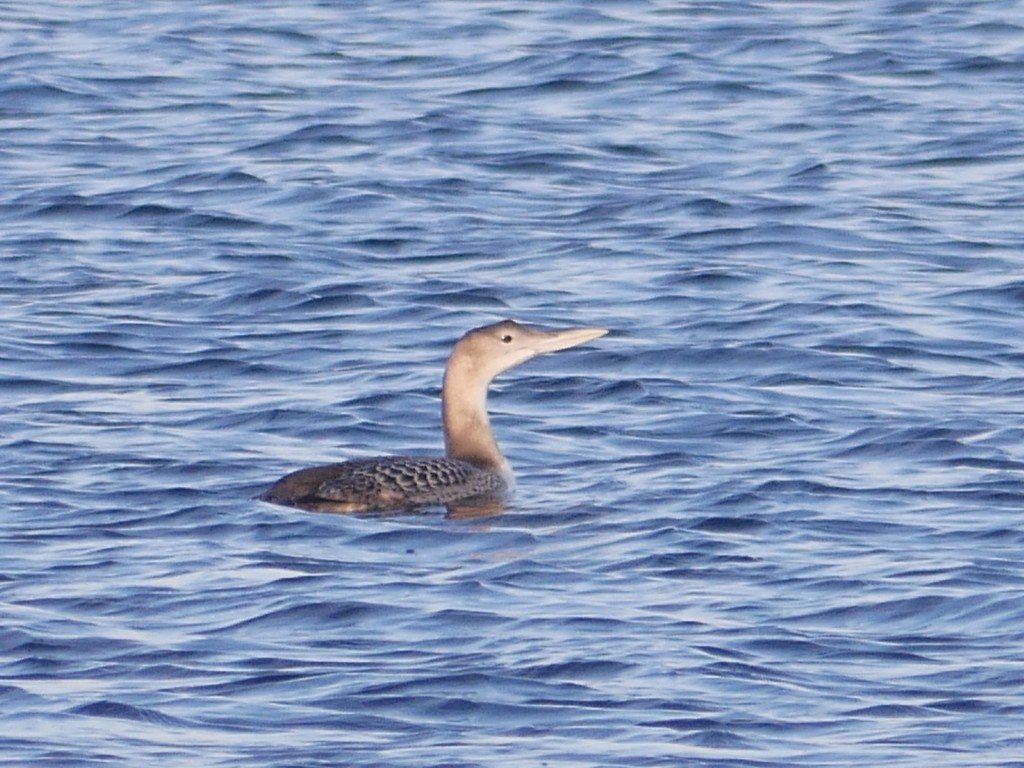
Photo: (c) Alexis Tinker-Tsavalas, some rights reserved (CC BY) · CC BY 4.0 (May be cropped or resized)
Gavia adamsii
U.S. national list: unknown
Basic stats
Diet
Mostly fish, with aquatic invertebrates
Habitat
Arctic tundra lakes and rivers; sheltered northern coastal waters in winter
Range
Breeds across Arctic North America and Eurasia; winters chiefly in the northern Pacific and northwestern Europe
Clutch size
Usually 2 eggs
Incubation period
About 27–29 days
Size
76–97cm
Wingspan
135–160cm
Weight
Averages about 4944g
The Yellow-billed Loon is the largest loon, measuring 76–97 cm with a wingspan of 135–160 cm. In breeding plumage, its dark head and patterned black-and-white back contrast strongly with the white underside; winter birds are duller and show white on the chin and front of the neck. Its long straw-yellow bill appears slightly upturned. AVONET records an average mass of about 4,944 g (Wikipedia, general species account; AVONET, Tobias et al. 2022).
It breeds beside tundra lakes and rivers across Arctic North America and Eurasia, then winters mainly on sheltered northern Pacific coasts and in northwestern Europe. Fish contribute 80% and invertebrates 20% to the EltonTraits diet profile. Birds pursue prey underwater, also taking crustaceans, molluscs and worms. A plant nest is built immediately beside water. Two eggs are usual and both are incubated for about 27–29 days (Wikipedia, general species account; EltonTraits, Wilman et al. 2014; AnAge).
Where to see Yellow-billed Loon in the USA
GBIF records grouped by protected area. They show where the species has been reported, not that it is there now, and they are not population counts.
Recorded in 143 protected areas (1882–2026). The 8 with the most records:
- National Petroleum Reserve–Alaska: 6,077 records (1882–2024)
- Chatfield State Park: 895 records (1981–2024)
- Lake Pueblo State Park: 473 records (1987–2024)
- Tongass National Forest: 409 records (1911–2024)
- Bering Land Bridge National Preserve: 296 records (1987–2022)
- Alaska Maritime National Wildlife Refuge: 230 records (1981–2024)
- Arctic National Wildlife Refuge: 216 records (1914–2024)
- Cherry Creek State Park: 212 records (2019–2024)
Quick answers
- What does the Yellow-billed Loon eat?
- Mostly fish, with aquatic invertebrates
- What habitat does the Yellow-billed Loon live in?
- Arctic tundra lakes and rivers; sheltered northern coastal waters in winter
- Where is the Yellow-billed Loon found?
- Breeds across Arctic North America and Eurasia; winters chiefly in the northern Pacific and northwestern Europe
- How many eggs does the Yellow-billed Loon lay?
- Usually 2 eggs
- How long are the eggs of the Yellow-billed Loon incubated?
- About 27–29 days
- How big is the Yellow-billed Loon?
- 76–97cm
- What is the wingspan of the Yellow-billed Loon?
- 135–160cm
- How much does the Yellow-billed Loon weigh?
- Averages about 4944g