
 Wildlife
of USA
White-winged Crossbill
Sparrows, Buntings & Finches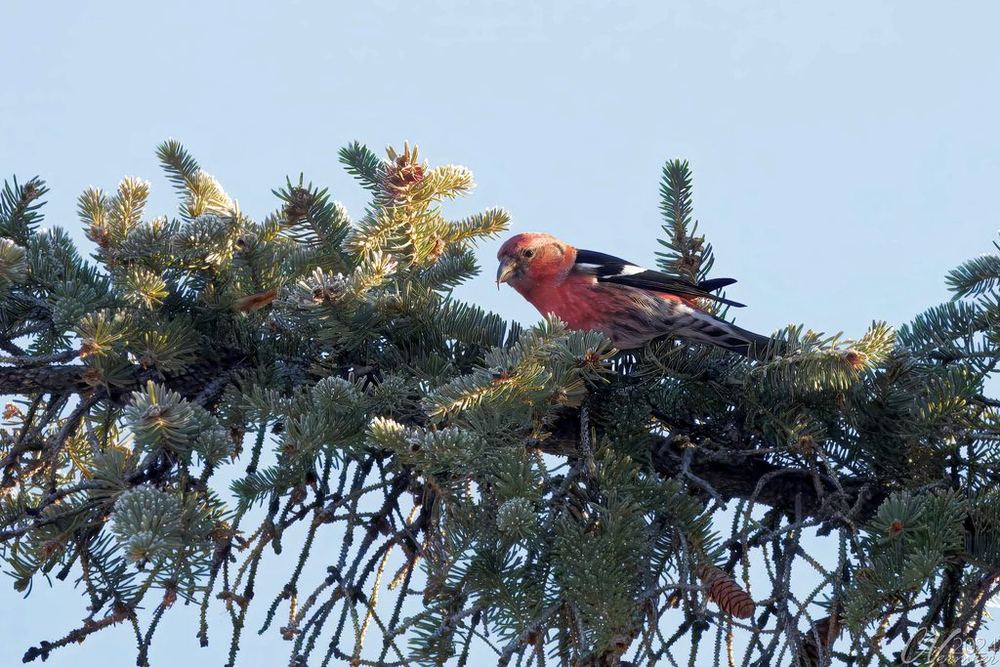
Photo: Carol Ann Vermeer · CC BY 4.0 (May be cropped or resized)
Loxia leucoptera
U.S. national list: unknown
Basic stats
Diet
Seeds, other plant material, fruit and invertebrates
Habitat
Northern conifer forest, especially larch, spruce and hemlock
Range
Northern North America and northern Eurasia
Clutch size
Usually 3–4 eggs
Incubation period
About 14–15 days
Size
14.5–17cm
Weight
Averages about 29g
The White-winged Crossbill is a 14.5–17 cm finch with short legs, a forked tail and crossed bill tips adapted for opening cones. Two bold white wing bars distinguish it from most other crossbills. Adult males are bright raspberry red, whereas females are greenish yellow above. AVONET records an average mass of about 29 g, closely matching the AnAge value (Wikipedia, general species account; AVONET, Tobias et al. 2022; AnAge).
Across northern North America and Eurasia it inhabits conifer forest, especially stands of larch, spruce and hemlock. Seeds and other plant material each contribute 30%, with fruit and invertebrates each at 20% in EltonTraits. Flocks wander irregularly when cone crops fail and may mix with other crossbills. A twig nest placed against a conifer trunk holds three or four eggs, incubated by the female for about 14–15 days (Wikipedia, general species account; EltonTraits, Wilman et al. 2014).
Where to see White-winged Crossbill in the USA
GBIF records grouped by protected area. They show where the species has been reported, not that it is there now, and they are not population counts.
Recorded in 993 protected areas (1882–2026). The 8 with the most records:
- Adirondack Park: 1,936 records (1909–2025)
- Tongass National Forest: 1,585 records (1920–2024)
- Chugach National Forest: 1,477 records (1908–2025)
- Lake Superior State Forest - Newberry Unit: 1,373 records (1924–2024)
- Denali National Park: 1,252 records (1919–2026)
- Wenlock Wildlife Management Area: 1,082 records (1980–2024)
- Acadia National Park: 1,050 records (1963–2024)
- White Mountain National Forest: 1,033 records (1894–2024)
Quick answers
- What does the White-winged Crossbill eat?
- Seeds, other plant material, fruit and invertebrates
- What habitat does the White-winged Crossbill live in?
- Northern conifer forest, especially larch, spruce and hemlock
- Where is the White-winged Crossbill found?
- Northern North America and northern Eurasia
- How many eggs does the White-winged Crossbill lay?
- Usually 3–4 eggs
- How long are the eggs of the White-winged Crossbill incubated?
- About 14–15 days
- How big is the White-winged Crossbill?
- 14.5–17cm
- How much does the White-winged Crossbill weigh?
- Averages about 29g