
 Wildlife
of USA
Virginia Opossum
Other Mammals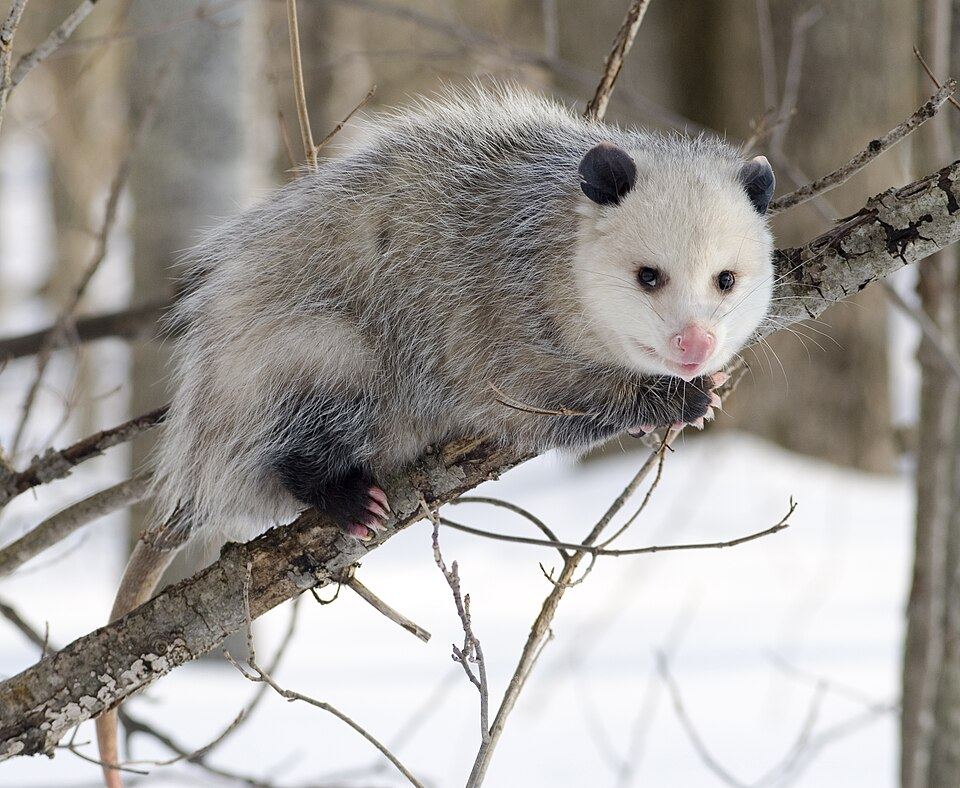
Photo: Cody Pope · CC BY-SA 2.5 (May be cropped or resized)
Didelphis virginiana
U.S. national list: unknown
Basic stats
Diet
Opportunistic; scavenges garbage, pet food and garden produce
Habitat
Settled areas near food, including cities and gardens
Range
Southern Canada to northern Costa Rica
Litter size
15 (AnAge)
Gestation period
12 days (AnAge)
Size
Roughly as large as a domestic cat
Weight
3000g (AnAge)
The Virginia opossum, also known as the North American opossum, is a member of the opossum family and the northernmost marsupial in the world. It is solitary and nocturnal, roughly as large as a domestic cat, and a successful opportunist. The word opossum traces through a Powhatan form back to a Proto-Algonquian term meaning white animal, and the genus name Didelphis comes from Greek words for two and womb. AnAge gives an adult weight of 3000g, a maximum longevity of 6.6 years and a gestation of 12 days (Wikipedia, general species account; AnAge).
It occurs from southern Canada to northern Costa Rica, and its range keeps spreading northward. Its ancestors evolved in South America and reached North America during the Great American Interchange, with Didelphis arriving about 0.8 million years ago. Before European settlement it reached as far north as Maryland. Since 1900 it has expanded across most of New England, into New York, and through much of Michigan, Wisconsin and Minnesota. It is drawn to settled areas by trash cans, pet food, compost and gardens, which also makes it prone to roadkill. GBIF lists records across Louisiana and Oklahoma (Wikipedia, general species account; GBIF description, Didelphidae).
Where to see Virginia Opossum in the USA
GBIF records grouped by protected area. They show where the species has been reported, not that it is there now, and they are not population counts.
Recorded in 78 protected areas (1842–2026). The 8 with the most records:
- Mohonk Preserve: 375 records (1842–2014)
- Crocodile Lake National Wildlife Refuge: 80 records (1949–2026)
- Florida Keys National Marine Sanctuary: 66 records (1949–2026)
- Terry Hershey Park: 19 records (2023–2026)
- Cuyahoga Valley National Park: 17 records (2004–2026)
- Minnesota Valley National Wildlife Refuge: 17 records (1956–2026)
- National Capital Parks-East: 14 records (2015–2023)
- Floracliff Nature Sanctuary: 13 records (2023–2025)
Quick answers
- What does the Virginia Opossum eat?
- Opportunistic; scavenges garbage, pet food and garden produce
- What habitat does the Virginia Opossum live in?
- Settled areas near food, including cities and gardens
- Where is the Virginia Opossum found?
- Southern Canada to northern Costa Rica
- What is the litter size of the Virginia Opossum?
- 15 (AnAge)
- How long is the gestation period of the Virginia Opossum?
- 12 days (AnAge)
- How big is the Virginia Opossum?
- Roughly as large as a domestic cat
- How much does the Virginia Opossum weigh?
- 3000g (AnAge)