
 Wildlife
of USA
White-nosed Coati
Other Mammals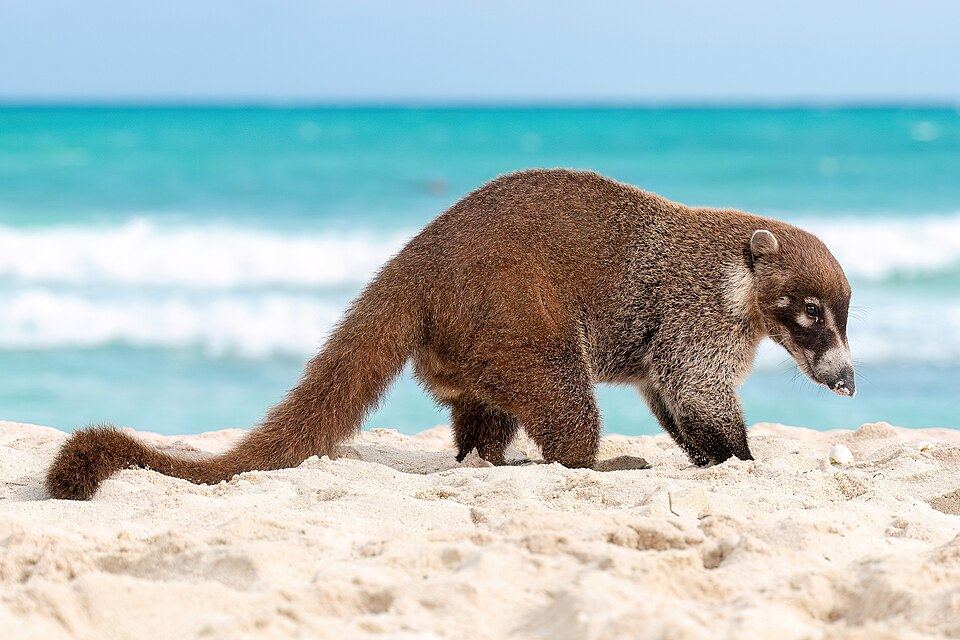
Photo: Giles Laurent · CC BY-SA 4.0 (May be cropped or resized)
Nasua narica
U.S. national list: unknown
Basic stats
Diet
Mostly fruit; also invertebrates and small vertebrates
Habitat
Wooded habitats from sea level to 3,000m, mainly rainforest
Range
Arizona and New Mexico through Mexico and Central America to northwestern Colombia
Litter size
About 4
Gestation period
70–78 days
Size
Nose to tail about 110cm, half of it tail
Weight
4–6kg (3.1–9kg)
The white-nosed coati, or coatimundi, is a member of the raccoon family. It weighs about 4–6kg, though small females can weigh as little as 3.1kg and large males as much as 9kg, and the nose-to-tail length is about 110cm, with about half of it tail. It is distributed from Arizona and New Mexico through Mexico and Central America to the far northwest of Colombia, in wooded areas from sea level to 3,000m. The Cozumel Island coati is treated as a subspecies. It has also been introduced in Florida (Wikipedia, general species account).
Unlike other raccoon relatives, coatis are mainly diurnal, spending about 90% of waking hours foraging and the nights in trees or on rocky ledges. They are among the most gregarious carnivorans, living in bands of related females and young, typically 5–18 and up to 30. Breeding is highly seasonal, within two to four weeks. Females leave their band to give birth in a tree after a gestation of 70–77 days. Coatis are known pollinators of the balsa tree (GBIF description, Procyonidae; Wikipedia, general species account).
Where to see White-nosed Coati in the USA
GBIF records grouped by protected area. They show where the species has been reported, not that it is there now, and they are not population counts.
Recorded in 12 protected areas (1947–2026). The 8 with the most records:
- Coronado National Forest: 132 records (1947–2026)
- Mount Wrightson Wilderness: 20 records (1964–2025)
- Chiricahua National Park: 11 records (2020–2025)
- Pusch Ridge Wilderness Area: 11 records (2019–2025)
- Sabino Canyon: 9 records (2021–2025)
- Tonto National Forest: 6 records (2023–2025)
- Aravaipa Canyon Wilderness: 4 records (2019–2025)
- Miller Peak Wilderness: 4 records (1951–2025)
Quick answers
- What does the White-nosed Coati eat?
- Mostly fruit; also invertebrates and small vertebrates
- What habitat does the White-nosed Coati live in?
- Wooded habitats from sea level to 3,000m, mainly rainforest
- Where is the White-nosed Coati found?
- Arizona and New Mexico through Mexico and Central America to northwestern Colombia
- What is the litter size of the White-nosed Coati?
- About 4
- How long is the gestation period of the White-nosed Coati?
- 70–78 days
- How big is the White-nosed Coati?
- Nose to tail about 110cm, half of it tail
- How much does the White-nosed Coati weigh?
- 4–6kg (3.1–9kg)